
Easy Ways to Save Energy at Home
Small steps can add up to big reductions in your electricity use—and your utility bill.
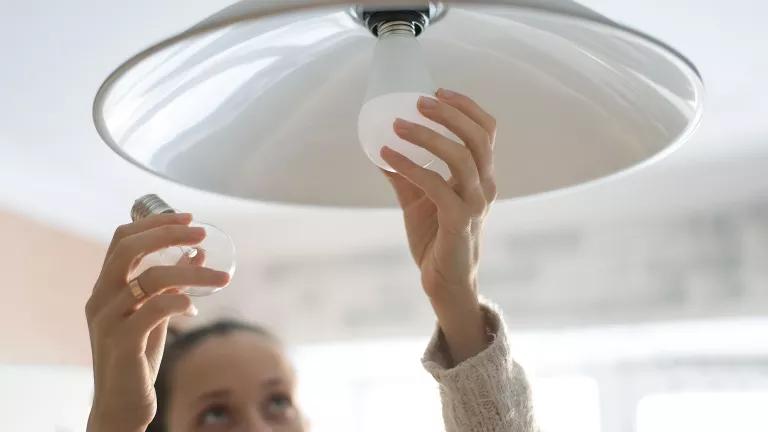
LEDs use up to 85 percent less energy to deliver the same amount of light as incandescents.
Artem Rastorguev/Alamy
When it comes to fighting air pollution and global warming, action at the federal and state levels are certainly important for effecting real change. But so are the smaller actions that you, personally, can take every day in your own home. These simple habits, easy home improvements, and smart buying tips can add up to considerable energy savings over time. Skeptical? Give them a try. Let your energy bill speak for itself.
1. Turn things off.
That doesn't just mean hitting the light switch when you leave a room (although that's important, too). You should also make sure your television, computer, video game consoles, cable boxes, and digital video recorders are switched off when you're not actively using them—or unplugged completely, if they light up or otherwise use energy even when powered down. Chargers for cell phones, tablets, and other cordless devices also use small amounts of energy even when they're not charging. Plug items you use regularly into a power strip, so you can easily switch them all off at once.
Computers can also be set to sleep or hibernate mode, which use much less power than when they're on and active; program yours to do this automatically after 10 to 15 minutes of inactivity. And skip the screen savers; they're not necessary to protect modern monitors, and it's much more efficient to simply set your monitor to switch off when it's not in use.
2. Buy smarter bulbs.
An LED light bulb costs as little as $5 at home improvement stores, and it can save more than $100 over its lifetime. LEDs use up to 85 percent less energy to deliver the same amount of light as incandescents, and they come in many different shapes, colors, and intensities. They also reach full brightness instantly and can work with dimmer switches. Check to see whether your local utility offers a rebate for energy-efficient bulbs, which would bring their cost down even further.)
3. Don't use more energy than you need.
Don't run the dishwasher when it's not full, set your washing machine to the appropriate water level, and wash clothes—except for the dirtiest of loads—in cold water. Set your refrigerator temperature between 28 and 42 degrees Fahrenheit and your freezer between 0 and 5, and make sure both are sealed tightly. (If a dollar bill shut in the door is easy to pull out, replace the gaskets.)
The clothes dryer is one of the largest energy users in the home, often consuming as much as a new refrigerator, dishwasher, and clothes washer combined. Air-dry clothing when possible, and when you have to use your machine, be sure to clean the lint filter after each use, use the auto-dry or moisture-sensor setting, and don't add wet items to a load that's already partially dry.
4. Tweak your TV settings.
Although today's high-definition televisions use around 60 percent less energy than earlier ones, some Internet-ready models consume excess power after they're turned off, thanks to a "quick start" feature that allows them to boot up a few seconds faster. Disable that option in your television's settings—and while you're there, see if your model has an automatic brightness control, or ABC, sensor, which will adjust the picture brightness to the level of light in the room. Since most TV viewing occurs at night, this can make a big difference in energy consumption.
If you want to stream movies and use services like Netflix or YouTube, consider buying an Internet-ready television or a small add-on device—like Apple TV, Google Chromecast, or a Roku box—which uses very little power. Avoid streaming video through game consoles like PlayStation or Xbox, which can use up to 30 times more energy. (If you do use a game console regularly, at least set it to "auto power down" mode.)
5. Measure your electricity.
An electricity monitor meter, such as a Kill A Watt Meter, measures how much energy each gadget in your home uses, when on and when ostensibly turned off. These typically cost less than $30 at home improvement stores, but can provide many aha moments. For example, one could show that your "turned off" DVR set-top box from the cable or satellite company is drawing around 20 watts even though you're not watching or recording a show.
6. Close up the cracks.
If you add up all the gaps around the windows and doors in an average American house, you have the equivalent of a 3-foot by 3-foot hole in the wall. Caulk and weather-strip to seal off these air leaks, and use window putty to seal gaps around loose window panes. And stop heated or cooled air from escaping under doors by attaching "sweeps" or "shoes" to their bottoms.
You may also benefit from better insulation in your attic, under your floors, around your hot water heater and pipes, and in crawl spaces. Even something as simple as replacing old windows or covering bare floors with rugs can make a big difference. Ask your utility company if it provides free energy audits, during which a professional will assess your home and make suggestions for improvements, or visit EnergyStar.gov's Home Improvement section. Many energy-saving insulation upgrades are now more affordable thanks to the Energy Efficient Home Improvement [Tax] Credit.
7. Shop smarter.
Many of today's new appliances use half the energy of those from 20 years ago. If you're in the market, look for products with the Energy Star label. They typically use about 10 to 40 percent less energy than other new models. Some electric companies and even state governments offer consumer rebates on Energy Star–rated models.
Shopping for a new computer? Keep in mind that laptops use significantly less energy than desktop versions and can be hooked up to external monitors and keyboards when you want the big-screen experience. Remodeling your bathroom? Replace old showerheads with new low-flow designs to prevent excess hot water (and the energy used to heat it) from going down the drain.
8. Choose renewable energy.
If you are able to choose your own energy supplier, pick one that uses renewable power resources, like solar, wind, low-impact hydroelectric, or geothermal. In some states, instead of choosing a specific electricity supplier, you can support renewable energy by paying a small premium on your electric bill. Ask your electricity supplier what options are available for you.
9. Recycle old electronics.
When you buy new energy-efficient appliances and electronics, it's important to dispose of the old ones in a planet-friendly way. Hand down devices that still work—like telephones, laptops, or tablets—to younger family members, or go online and search for buy-back programs. Retailers such as Best Buy and Staples have extensive in-store recycling programs for working and nonworking devices; they'll accept most electronics and will recycle them properly for free, regardless of where you bought them.
10. Adjust the temperature.
Even if you buy the most efficient air conditioner, heater, or water heater on the market, your energy savings are highly dependent on the settings you select. (Do you really need your AC cranked up to sweater-wearing temps?) If you own your home, invest in a programmable thermostat; it costs $100 or less and can cut energy consumption by 20 to 30 percent—saving $180 a year—by adjusting the temperature throughout the day.
Check the temperature settings on your gas or electric water heater, too. If it's set higher than you really need, it's working harder than necessary—and costing you more money—to make sure hot water is always ready for you. If the hot water from your tap almost burns your hand, your setting is too high.
This story was originally published on March 15, 2016 and has been updated with new information and links.
This NRDC.org story is available for online republication by news media outlets or nonprofits under these conditions: The writer(s) must be credited with a byline; you must note prominently that the story was originally published by NRDC.org and link to the original; the story cannot be edited (beyond simple things such as grammar); you can’t resell the story in any form or grant republishing rights to other outlets; you can’t republish our material wholesale or automatically—you need to select stories individually; you can’t republish the photos or graphics on our site without specific permission; you should drop us a note to let us know when you’ve used one of our stories.
What Are the Solutions to Climate Change?
A Consumer Guide to the Inflation Reduction Act
How You Can Stop Global Warming