
NRDC et al. v. City of Los Angeles et al. (China Shipping)
Case Status
Last Update

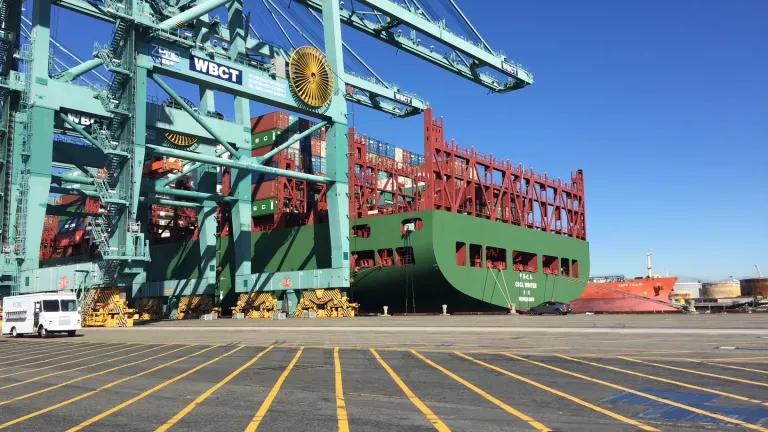
The China Shipping North America Container Terminal at the Port of Los Angeles
Hal Bergman/Getty Images
Although the Port of Los Angeles joined ambitious updates to the San Pedro Bay Ports Clean Air Action Plan in 2017 to reduce air pollution from its operations, this seaport has not always recognized the growing public health crisis caused by freight pollution. For decades, the Port of L.A. dodged pollution-cutting measures that were required by law. As a result, the toxic fumes emitted by diesel-fueled trucks, ships, trains, and equipment operating at the port gave the Los Angeles Harbor area its reputation as a “diesel death zone.” People who live, work, and attend school near the Port of L.A.—largely low-income communities and communities of color—suffer higher rates of asthma, cardiovascular disease, and cancer, and have a shortened life expectancy. Meanwhile, Port of L.A. cargo volumes continue to rise, increasing port traffic and deadly air pollution.
Since 2001, NRDC has partnered with community groups to fight pollution from a terminal leased by China Shipping, one of the port’s largest tenants. (The list of local allies has grown to include Coalition for Clean Air, East Yard Communities for Environmental Justice, San Pedro & Peninsula Homeowners Coalition, and San Pedro Peninsula Homeowners United, and many more.) That year, the port violated California’s keystone environmental law, the California Environmental Quality Act (CEQA), when it approved construction of a new terminal for China Shipping without preparing an environmental impact report (EIR). NRDC and its partners sued and won a resounding victory in the Court of Appeal. Licking its wounds, the port agreed to a landmark settlement, whereby it would prepare an EIR and pay $50 million to address pollution from the terminal. When the port finally issued a court-ordered EIR, it included additional promises to mitigate the significant pollution created by the diesel-powered ships, trucks, and other cargo-handling equipment.
But the port never lived up to those promises, instead issuing China Shipping backdoor waivers from even the simplest mitigation efforts. When these failures were exposed, the port issued a supplemental EIR, in which it managed to weaken and even renege on its earlier commitments. Not only are these actions shameful, they’re illegal: CEQA requires projects to use alternatives or mitigation measures to prevent significant, avoidable damage to the environment.
So NRDC and its allies sued again and, in 2022, the trial court found that the port’s failure to adopt proper mitigation measures for the terminal was a “profound violation of CEQA.” Unfortunately, the court allowed the terminal to continue business as usual while the port works on an updated environmental review.
Thankfully, in December 2023, the California Court of Appeal found that the port must take immediate measures to address the unlawful pollution. The three-judge panel wrote, “Certainly, a ‘remedy’ that permits terminal operations to continue in the absence of the implementation and enforcement of any of the feasible mitigation measures identified by the port…is no real remedy at all, and seems to be at odds with one of the primary purposes of CEQA.”
The case was sent back to the trial court to ensure the port complied with the law. And in May 2024, after a decades-long battle led by communities fighting for clean air, the San Diego County Superior Court ruled in favor of area residents with a decision that requires the lease between the port and China Shipping to include enforceable measures to improve air quality and safeguard public health. The court held that, under CEQA, the port is required to implement lifesaving measures, such as phasing in cleaner cargo handling equipment and the use of Alternative Maritime Power (AMP), allowing cargo ships to plug in at berth.
This decision represented an important victory for local communities. Since then, NRDC and our partners have been keeping a watchful eye on the port’s compliance with the court's ruling. The public has been able to access the port's mitigation compliance reports here (under "Berths 97–109 [China Shipping] Container Terminal Project–Certified 10/08/2019" and "Compliance Reports on Status of Mitigation Measures and Lease Measures").
In September 2024, after reviewing the port’s first mitigation compliance report, NRDC found that the port had failed to fully comply with the mitigation measures that the court ordered in the final judgment. In particular, the port failed to have all docked ships covered by the court’s judgment use AMP to reduce diesel emissions, instead excluding some ships from its compliance determination without proper justification. Diesel engines emit diesel particulate matter, a toxic air contaminant known to increase cancer risk.
After the port continued to disobey the court’s judgment, NRDC filed a motion to enforce in April 2025 to request that the court compel the port to comply with the measure requiring that these ships use AMP, or else report that it is in violation of the measure. On May 2, 2025, the court ruled in our favor, granting our motion and ruling that the port had been in violation of the court’s judgment. In doing so, the court chastised the port for “watering down” the measure with exceptions that did not previously exist.
Going forward, the port must continue providing status reports on its compliance every six months, and NRDC will continue monitoring those reports to ensure that the port abides by its legal obligation to mitigate the significant air pollution that degrades the quality of life in the surrounding community.
Case Documents
Order Enforcing Writ, May 2025 (NRDC et al. v. City of Los Angeles et al.) (PDF) Ruling on Motion to Enforce, May 2025 (NRDC et al. v. City of Los Angeles et al.) (PDF) Motion to Enforce, April 2025 (NRDC et al. v. City of Los Angeles et al.) (PDF) Community petitioner's opening brief, December 6, 2022 (NRDC et al. v. City of Los Angeles et al.) (PDF) Court decision enforcing air regulations at Port of Los Angeles, December 29, 2023 (NRDC et al. v. City of Los Angeles et al.) (PDF) San Diego County Superior Court minute order, May 24, 2024 (NRDC et al. v. City of Los Angeles et al.) (PDF) Petition for Writ of Mandate, September 16, 2020 (NRDC et al. v. City of Los Angeles et al.) (PDF)Related Content

NRDC and Partners Sue L.A. to Protect Communities from Port Pollution
Court Finds Port of L.A. in Violation of California Environmental Law

Fastlane Transportation, Inc. et al. v. City of Los Angeles and BNSF Railway Co.
Appellate Court Rules Port of LA Must Obey Environmental Law or Risk Closure of Largest Terminal

Docking Diesel Pollution
Air Pollution: Everything You Need to Know
