
How to Protect Yourself From Outdoor Air Pollutants
Every time you go outside, you may be inhaling harmful chemicals. But don't hold your breath. Just use your head.
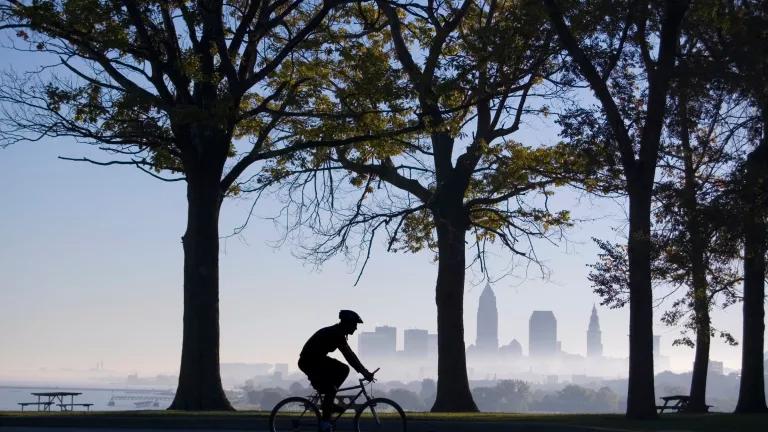
yogibehr/Getty Images
Much of the haze that once blanketed our cities has cleared since the 1970s, thanks to tough environmental laws. But air pollution, including the kind you can't see, still poses health risks to millions of Americans both urban and rural.
On any given day, the following contaminants may be found at dangerous levels in the air you breathe. "They represent some of the top nationwide health risks from air pollution, and they're also connected to sources of emissions that we are working hard to clean up," says NRDC senior scientist Miriam Rotkin-Ellman. Until that goal is achieved, here's what you can do to protect yourself.
Diesel exhaust
That black, smelly exhaust that pours from diesel vehicles is a mix of more than 40 toxic contaminants and has been linked to cancer, asthma, premature death, and health risks for unborn babies. Many Americans live or work near diesel hot spots such as truck depots, bus terminals, ports, construction sites, and busy roads and highways. Kids who ride in older school buses that run on diesel fuel (which most do) can also be exposed to unhealthy levels of pollution.
It's true that natural gas and hybrid-electric buses and trucks have replaced many of the diesel vehicles that ruled the roadways for decades. And thanks to federal fuel and pollution standards, new vehicles for both road and nonroad uses (like tractors and bulldozers) pollute much less than older ones. But because diesel engines can last for decades, we'll continue to see these dinosaurs in action for years to come.
What you can do
Keep your distance from anything spewing smoke from its tailpipe. If you're a parent, talk with school officials about how buses can reduce idling while loading and unloading. And urge your local transit authority, school district, and municipal government to retire old vehicle fleets or retrofit them with pollution controls, as well as to clean up ports and other transit hubs.
Benzene
Benzene is a known human carcinogen that can cause childhood leukemia, blood disorders, and a number of other illnesses. Even short-term exposure can lead to drowsiness, dizziness, headache, and eye, skin, and respiratory tract irritation. Virtually everyone is exposed to benzene in at least small amounts, at gas stations (it's in the gasoline), in diesel exhaust, or from cigarette smoke. High levels have also been found in the air near oil and gas facilities—including refineries and fracking sites—as well as in the neighboring communities.
What you can do
Avoid one significant source of benzene by stepping away from the gas pump when refueling your car—especially if you're pregnant, Rotkin-Ellman says. You can also fight for more stringent pollution control at local and state levels, especially if you live near active industrial areas.
Particulate matter
Also known as particle pollution, particulate matter is a mix of microscopic solids and liquids floating in the air. These particles are present in soot, smoke, and haze but are too small to be seen by the naked eye. That microscopic size is part of what makes them so dangerous. When inhaled, they're small enough to make their way into the lungs or even the bloodstream and have been linked to respiratory and cardiovascular problems, emergency room visits, and premature death. Most particulate pollution results from the burning of coal, oil, diesel, gasoline, or wood.
What you can do
Follow the air quality reports in your area (sign up at AirNow.gov); if particulate matter is a concern on any given day, follow recommendations for avoiding physical activity or prolonged exertion outdoors. When levels are high, also avoid activities that add to the problem, such as driving or using your fireplace.
Ground-level ozone
High in the stratosphere, ozone forms a protective layer that blocks harmful ultraviolet rays from the sun. When pollution causes excess ozone to form at the ground level, however, it can irritate or permanently damage lungs. Ground-level ozone, which you likely know as smog, forms when nitrogen oxides and other pollutants emitted by vehicles and power plants react with sunlight.
Smog was once primarily an urban problem, but thanks to expansion of the oil and gas industries and historically lax regulations, rural areas have begun to battle it as well. "Both particulate matter and ozone standards have been tightened in recent years, but neither is as low as the science suggests they should be," Rotkin-Ellman says.
What you can do
Your local air quality index will also indicate when ground-level ozone is at unhealthy levels. Avoiding prolonged physical activity during these times is your best defense against this dangerous pollutant. If you do exercise outdoors on high-ozone days, do it in the early morning or late evening, when ozone levels are usually lower. And to help reduce the amount of ozone in the air, take public transportation or, even better, bike or walk.
This NRDC.org story is available for online republication by news media outlets or nonprofits under these conditions: The writer(s) must be credited with a byline; you must note prominently that the story was originally published by NRDC.org and link to the original; the story cannot be edited (beyond simple things such as grammar); you can’t resell the story in any form or grant republishing rights to other outlets; you can’t republish our material wholesale or automatically—you need to select stories individually; you can’t republish the photos or graphics on our site without specific permission; you should drop us a note to let us know when you’ve used one of our stories.
How EPA Rollbacks Will Cost Us—in Dollars and Lives
What Is the Air Quality Index?
The Particulars of PM 2.5