
The Dirty Fight Over Canadian Tar Sands Oil
Dredging up oil from under Canada’s boreal forest and piping it through the United States is a lose-lose proposition.
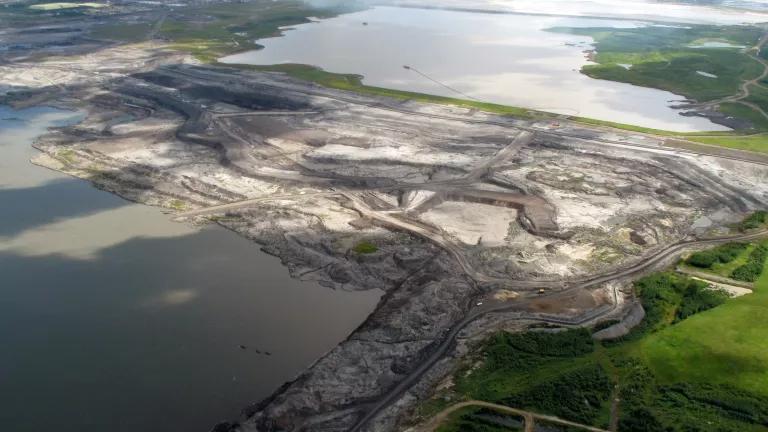
A tar sands tailings lake
Jennifer Grant/Pembina Institute/Flickr
Just south of the polar region’s barren tundra, Canada’s boreal forest provides 1.3 billion acres of wild habitat for a mind-boggling array of species—from large carnivores like grizzly bears, wolves, and lynx to nesting migratory birds to thousands of plant varieties. Its trees and bogs capture vast amounts of climate-changing carbon pollution, and its wetlands filter millions of gallons of water. The boreal is also home to hundreds of First Nations communities, many of whom rely on hunting, fishing, and trapping for their livelihoods.
Yet this pristine paradise is central to one of today’s most contentious debates about dirty energy. It’s a conversation with origins dating back 300 years, when British explorer James Knight noted the “gum or pitch that flows out of the banks” of what is now Canada’s Athabasca River.
Knight was describing tar sands, a sludgy deposit of sand, clay, water, and sticky, black bitumen (used to make synthetic oil) that lies beneath northern Alberta’s boreal forest in a region the size of Florida. Extracting and converting tar sands into usable fuel is a hugely expensive energy- and water-intensive endeavor that involves strip mining giant swaths of land and creating loads of toxic waste and air and water pollution.
Despite these economic and environmental costs, a race to make money from this dirty fuel was kicked off in the mid-1990s by rising oil prices. By 2004, Canadian production of tar sands oil had reached one million barrels per day—with much of the output bound for the United States—and Big Oil had ambitious plans to expand.
“It was a blight on the boreal,” says Susan Casey-Lefkowitz, NRDC’s chief program officer and a policy advocate for the organization’s Canada work at the time. “But no one was doing anything about it. People thought it was too big. It had the backing of the Canadian government and U.S. support.”
Not everyone could turn a blind eye to the havoc wrought by tar sands, though. First Nations communities who had inhabited the new ground zero for tar sands oil development for thousands of years began voicing concerns. Their water, fishing, and hunting traditions were at risk—as was their health, with more rare and unusual cancers being diagnosed.
In 2005, these communities invited Canadian activist groups and NRDC to Alberta to talk about tar sands. They shared disturbing images of a lunar-like landscape of open-pit mines and vast wastewater containment ponds where boreal forest had once stood, and they asked for help in stopping the devastation.
Shortly thereafter, NRDC launched the first campaign by a U.S. organization against the expanding industry. It forged partnerships with Canadian counterparts like the Pembina Institute, Environmental Defence Canada, Greenpeace Canada, and First Nations communities and set its focus on challenge number one: making the tar sands issue a compelling one to people outside of Alberta. “We had to show people that the United States was a driver for what was happening up there,” says Danielle Droitsch, senior policy analyst for NRDC’s Canada project. “It was the United States that had the solution and ability to effect change.”
Energy giant TransCanada helped bring that fact to light. In December 2006, it proposed a plan for Keystone XL, a 2,000-mile-long pipeline that would deliver tar sands crude to refineries on the Gulf Coast. The project promised to strengthen the tar sands industry, put America’s public safety at risk, and lock the United States into a dirty energy future. Once Canada’s Big Oil industry threatened to trash Americans’ backyards, the tar sands debate gained traction.
One of NRDC’s main goals has been to disseminate the facts. “We put the best research front and center,” Casey-Lefkowitz says. By conducting environmental, health, and economic analyses and partnering with allies like Corporate Ethics International, the Sierra Club, Friends of the Earth, and Oil Change International as well as scientists, economists, doctors, and others on the front lines of the tar sands battle, NRDC has been a driving force in putting technical data and peer-reviewed science in the hands of policymakers and the public.
The key has been demonstrating the differences between conventional crude and tar sands oil. “We were one of the leading groups to look at the unique risks tar sands oil poses during extraction, refinement, and transportation via rail and pipeline,” Droitsch says. Tar sands extraction emits up to three times more global warming pollution than does producing the same quantity of conventional crude. It also depletes and pollutes freshwater resources and creates giant ponds of toxic waste. Refining the sticky black substance produces piles of petroleum coke, a hazardous by-product. “This isn’t your grandfather’s typical oil,” she says. “It’s nasty stuff.”
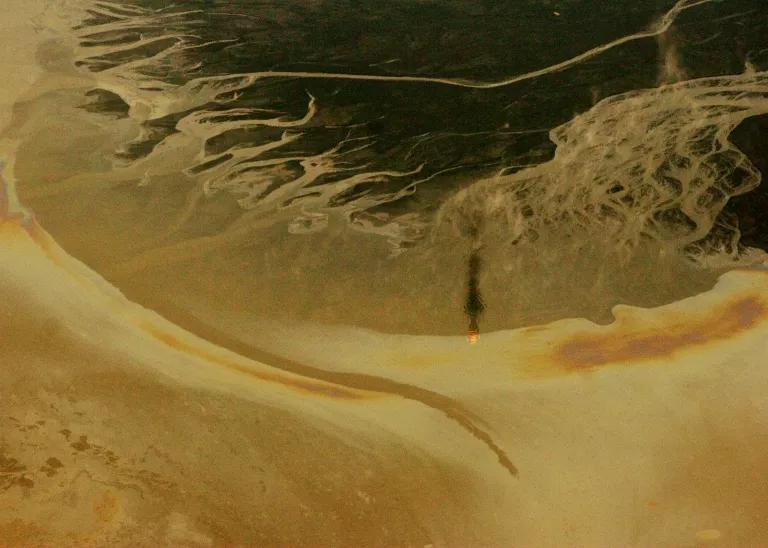
Oil sheen on a tailings pond
Julia Kilpatrick/Pembina Institute/Flickr
And shipping more of that “nasty stuff”—according to a 2011 joint report put out by NRDC, the National Wildlife Federation, the Pipeline Safety Trust, and the Sierra Club—increases spill risk in communities that sit along tar sands pipeline routes, many of which run through America’s agricultural heartland. As the report explains, tar sands oil is thicker and more acidic than lighter conventional crude, and this ups the likelihood that a pipeline carrying it will leak. Complicating matters, leaks can be difficult to detect. And when the oil does spill, it is far more detrimental to sensitive water resources. Evidence of the latter was the billion-dollar-plus Kalamazoo, Michigan, disaster of 2010, which energy company Enbridge admitted was a tar sands spill only after NRDC questioning.
NRDC’s widely accepted economic analysis of the expanding industry discredits Big Oil claims. “When the industry said tar sands would protect national energy security, we were out there showing the oil would actually be exported,” Casey-Lefkowitz says. “When it was said tar sands would lower the price of oil, we showed that in some cases, it could make it more expensive.” Similarly, when TransCanada claimed thousands of U.S. jobs would be permanently created by the construction of Keystone XL, NRDC exposed the real number to be just 35.
In addition to shedding light on the facts, NRDC has helped give voice to those who live in tar sands regions and along pipeline paths. “People don’t connect if they haven’t been there,” Droitsch says. “We knew it was our job to bring home the impact of tar sands on local communities and the environment.” To that end, NRDC has brought farmers, ranchers, and tribespeople threatened by the dirty fuel to Washington to tell their stories before key decision makers. It has also produced video interviews with those impacted, including First Nations members who live in communities where cancer-causing chemicals linked to tar sands are increasingly found in the air, water, and local wildlife. “It’s a sad situation all around,” said one interviewee, Alice Rigney, a resident of Fort Chipewyan in northern Alberta. “And we’re the ones that are paying the ultimate price with our lives.”
NRDC testifies before legislators and, with the help of its allies, gets heavy hitters to coalesce in the fight, too. In 2014, NRDC partnered directly with the Nobel Women’s Initiative to write a letter against the Keystone XL pipeline to President Obama and Secretary of State Kerry that was signed by 10 Nobel Peace Prize winners including the Dalai Lama and Archbishop Desmond Tutu. “As leaders who have spoken out strongly on these issues,” the laureates wrote, “we urge you, once again, to be on the right side of history and send a clear message that you are serious about moving beyond dirty oil.” President Obama went on to reject Keystone XL in 2015.
Perhaps most significantly, NRDC has helped prove that the expansion of the tar sands industry isn’t inevitable. By halting any pipeline project, more fuel is kept beneath the boreal forest, where it belongs. The tar sands industry once had plans to triple production by 2030, but it’s now canceling mining contracts by the dozen. There are other market forces at play, like falling fuel prices, but one can’t deny the impact of halting a major pipeline project. The more dirty oil left underground in the north, the more space left for clean energy to grow.
This NRDC.org story is available for online republication by news media outlets or nonprofits under these conditions: The writer(s) must be credited with a byline; you must note prominently that the story was originally published by NRDC.org and link to the original; the story cannot be edited (beyond simple things such as grammar); you can’t resell the story in any form or grant republishing rights to other outlets; you can’t republish our material wholesale or automatically—you need to select stories individually; you can’t republish the photos or graphics on our site without specific permission; you should drop us a note to let us know when you’ve used one of our stories.
Single-Use Plastics 101
Why We Need the EPA
We Are Here to Make a Difference: Our Litigators Are at the Ready