
Are the Effects of Global Warming Really that Bad?
Short answer: Yes. Even a seemingly slight average temperature rise is enough to cause a dramatic transformation of our planet.
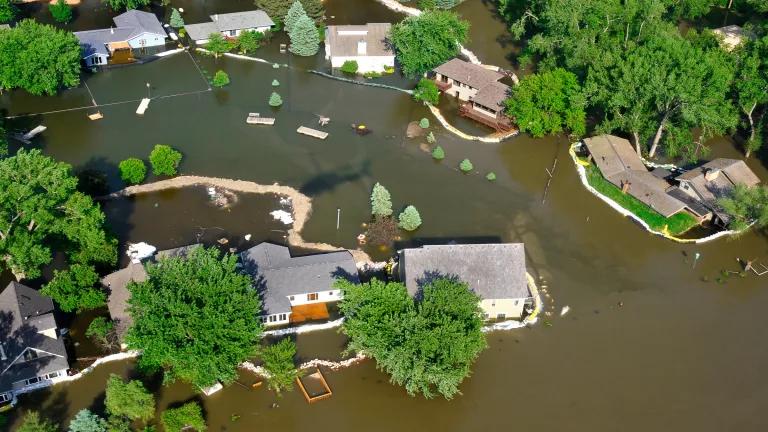
The Missouri River encroaches on homes in Sioux City, Iowa, during a 2011 flood
Stocktrek Images/Media Bakery
Five and a half degrees Fahrenheit. It may not sound like much—perhaps the difference between wearing a sweater and not wearing one on an early-spring day. But for the world in which we live—which climate experts project will be at least 5.7 degrees Fahrenheit warmer by 2100, relative to pre-industrial levels (1850–1900), should global emissions continue on their current path—this small rise will have grave consequences. These impacts are already becoming apparent for every ecosystem and living thing, including us.
Human influences are the number one cause of global warming, especially the carbon pollution we cause by burning fossil fuels and the pollution capture we prevent by destroying forests. The carbon dioxide, methane, soot, and other pollutants we release into the atmosphere act like a blanket, trapping the sun's heat and causing the planet to warm. Evidence shows that the 2010s were hotter than any other decade on record—and every decade since the 1960s has averaged hotter than the previous one. This warming is altering the earth's climate system, including its land, atmosphere, oceans, and ice, in far-reaching ways.
More frequent and severe weather
Higher temperatures are worsening many types of disasters, including storms, heat waves, floods, and droughts. A warmer climate creates an atmosphere that can collect, retain, and unleash more water, changing weather patterns in such a way that wet areas become wetter and dry areas drier.
According to the National Oceanic and Atmospheric Administration, in 2021, there were 20 weather and climate disaster events in the United States—including severe storms, floods, drought, and wildfires—that individually caused at least $1 billion in losses. “Disasters in 2021 had a staggering total price tag of $145 billion—and that’s an underestimate because it excludes health damages,” says Vijay Limaye, senior scientist at NRDC. “These climate and weather disasters endanger people across the country throughout the entire year. In fact, more than 4 in 10 Americans live in a county that was struck by climate-related disasters in 2021.”
The increasing number of droughts, intense storms, and floods we're seeing as our warming atmosphere holds—and then dumps—more moisture poses risks to public health and safety too. Prolonged dry spells mean more than just scorched lawns. Drought conditions jeopardize access to clean drinking water, fuel out-of-control wildfires, and result in dust storms, extreme heat events, and flash flooding in the States. Elsewhere around the world, lack of water is a leading cause of death and serious disease and is contributing to crop failure. At the opposite end of the spectrum, heavier rains cause streams, rivers, and lakes to overflow, which damages life and property, contaminates drinking water, creates hazardous-material spills, and promotes mold infestation and unhealthy air. A warmer, wetter world is also a boon for foodborne and waterborne illnesses and disease-carrying insects, such as mosquitoes, fleas, and ticks.
Higher death rates
Today's scientists point to climate change as the biggest global health threat of the 21st century. It's a threat that impacts all of us—especially children, the elderly, low-income communities, and minorities—and in a variety of direct and indirect ways. As temperatures spike, so does the incidence of illness, emergency room visits, and death.
"There are more hot days in places where people aren't used to it," Limaye says. "They don't have air-conditioning or can't afford it. One or two days isn't a big deal. But four days straight where temperatures don't go down, even at night, leads to severe health consequences." In the United States, hundreds of heat-related deaths occur each year due to direct impacts and the indirect effects of heat-exacerbated, life-threatening illnesses, such as heat exhaustion, heatstroke, and cardiovascular and kidney diseases. Indeed, extreme heat kills more Americans each year, on average, than hurricanes, tornadoes, floods, and lightning combined.
Dirtier air
Rising temperatures also worsen air pollution by increasing ground-level ozone smog, which is created when pollution from cars, factories, and other sources react to sunlight and heat. Ground-level ozone is the main component of smog, and the hotter things get, the more of it we have. Dirtier air is linked to higher hospital admission rates and higher death rates for asthmatics. It worsens the health of people suffering from cardiac or pulmonary disease. And warmer temperatures also significantly increase airborne pollen, which is bad news for those who suffer from hay fever and other allergies.
Higher wildlife extinction rates
As humans, we face a host of challenges, but we're certainly not the only ones catching heat. As land and sea undergo rapid changes, the animals that inhabit them are doomed to disappear if they don't adapt quickly enough. Some will make it, and some won't. According to the Intergovernmental Panel on Climate Change's Sixth Assessment Report, the risk of species extinction increases steeply with rises in global temperature—with invertebrates (specifically pollinators) and flowering plants being some of the most vulnerable. Moreover, a 2015 study showed that vertebrate species (animals with backbones, like fish, birds, mammals, amphibians, and reptiles) are also disappearing more than 100 times faster than the natural rate of extinction, due to human-driven climate change, pollution, and deforestation.
More acidic oceans
The earth's marine ecosystems are under pressure as a result of climate change. Oceans are becoming more acidic, due in large part to their absorption of some of our excess emissions. As this acidification accelerates, it poses a serious threat to underwater life, particularly creatures with calcium carbonate shells or skeletons, including mollusks, crabs, and corals. This can have a huge impact on shellfisheries. In total, the U.S. shellfish industry could lose more than $400 million annually by 2100 due to impacts of ocean acidification.
Higher sea levels
The polar regions are particularly vulnerable to a warming atmosphere. Average temperatures in the Arctic are rising twice as fast as they are elsewhere on earth, and the world's ice sheets are melting fast. This not only has grave consequences for the region's people, wildlife, and plants; its most serious impact may be on rising sea levels. By 2100, it's estimated our oceans will be 1.6 to 6.6 feet higher, threatening coastal systems and low-lying areas, encompassing entire island nations and the world’s largest cities, including Los Angeles, Miami, and New York City, as well as Mumbai, India; Rio de Janeiro; and Sydney, Australia.
But this isn’t the end of the story
There’s no question: Unchecked climate change promises a frightening future, and it's too late to fully turn back the clock. We've already taken care of that by pumping a century's worth of pollution into the atmosphere. “Even if we stopped all carbon dioxide emissions tomorrow, we'd still see some dangerous effects,” Limaye says. That, of course, is the bad news.
But there's also good news. By aggressively reducing our global emissions now, “we can avoid a lot of the severe consequences that climate change would otherwise bring,” says Limaye. While change must happen at the highest levels of government and business, your voice matters too: to your friends, to your families, and to your community leaders. Together, we can envision a safer, healthier, more equitable future—and build toward it. You can join with millions of people around the world fighting climate change and even work to reduce fossil fuels in your own life.
This story was originally published on March 15, 2016, and has been updated with new information and links.
This NRDC.org story is available for online republication by news media outlets or nonprofits under these conditions: The writer(s) must be credited with a byline; you must note prominently that the story was originally published by NRDC.org and link to the original; the story cannot be edited (beyond simple things such as grammar); you can’t resell the story in any form or grant republishing rights to other outlets; you can’t republish our material wholesale or automatically—you need to select stories individually; you can’t republish the photos or graphics on our site without specific permission; you should drop us a note to let us know when you’ve used one of our stories.
What Are the Solutions to Climate Change?
1.5 Degrees of Global Warming—Are We There Yet?
What Are the Effects of Climate Change?