
Control Household Pests Without Scary Poisons
How to get rid of bugs and vermin without putting your own family’s health at risk.
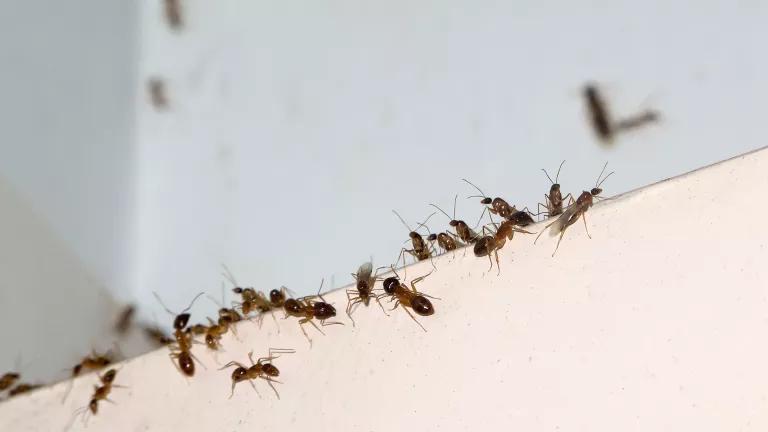
When the creepies come crawling, it's tempting to reach for a can of Insect Eliminator and spray them away. But not so fast. "People have a knee-jerk reaction and think, 'I need poison now!'" says Miriam Rotkin-Ellman, a senior scientist in NRDC's Health program. Even if all you want to see is those pests' feet in the air, she says, remember that there are often safer, nonchemical control methods that will solve your problem.
Integrated pest management, or IPM, focuses on preventing infestations before they start and using pesticides as a last resort. It's a low-cost, environmentally friendly solution that has been proven in studies to slash pest-removal costs by one-third—and pest complaints by 90 percent. A win-win, in other words.
The problem with pesticides
For the good of our health—and that of our planet—scientists say we need to reconsider our dependence on synthetic pesticides. Since they came into widespread use after World War II, these toxic chemicals have seeped into 90 percent of our streams and rivers. The U.S. Centers for Disease Control and Prevention says Americans now have an average of 43 different pesticides in their bloodstreams. These are chemicals that can trigger everything from nausea, vomiting, and headaches to more serious health concerns, such as lung damage, reproductive problems, and cancer.
Pesticides are especially hazardous to children, who spend more time closer to the ground where these chemicals are often applied. Kids are also less resilient to these toxic chemicals than adults, and their developing brains are more susceptible to neurological problems and learning disabilities caused by exposure. Of all the cases of pesticide poisoning in the United States, half of them are in kids under six.
Less means more
The worst part of insecticide overuse and poisoning is that these chemicals aren't always that effective. "Pesticides can't always eradicate pest infestations because they can't kill them off at every stage of their life cycles," Rotkin-Ellman explains. Consider fleas, which take about a month to hatch from eggs and develop into larvae, then pupae, and then adults. Many of the chemicals used in conventional flea treatments target only fully grown fleas. Meanwhile, human exposure to these chemicals can trigger dizziness, vomiting, and convulsions and have long-term effects on learning and behavior.
Just as they're sometimes ineffective, pesticides can also backfire and made bug infestations even worse. Spray them on an ant colony, for instance, and it can spur the ants to divide into multiple colonies and ramp up reproduction. "Bugs often grow resistant to pesticides," Rotkin-Ellman explains. "Spray them and they'll just bounce back stronger."
Seal it up
Enter IPM. A single treatment of that type "was more effective than the regular application of pesticides alone," according to a 2009 Environmental Health Perspectives study. The first line of defense with IPM is preventing vermin from entering your home at all. Repair ripped window and door screens. Seal bathroom and kitchen cracks with silicone caulk. In the rest of the house, plug openings that are larger than ¼ inch wide. Mice can readily wriggle through such small holes—but not if you seal them with cement, steel wool, or other metals. Remember: Vermin can chew through plastic, rubber, vinyl, and wood.
Keep it clean
Once you're fortified your home, the next step is to deny pests the shelter, food, and water they need to thrive. Do you have holes in your floorboards? Replace the flooring before ants or termites can infest the rotting wood. Stacks of old newspapers piled up in your garage? Recycle them before rats shred them and use the scraps to build their nests.
If you're cutting corners with your housecleaning, you have more to fear than gossipy neighbors. Pests will notice—and move in. So mop up spills, and sweep and vacuum regularly. Wash dishes and take out the garbage daily, and keep trash cans free of food residue. Store ripe fruit in the refrigerator, and never leave leftovers uncovered overnight. Wash your pet's bedding once a week to ward off flea infestations. "Also fix leaking pipes and faucets," Rotkin-Ellman says. "Spots that are regularly damp can provide places for pests to breed."
Pick your battles
Nobody wants to share their turf with bugs and vermin. But IPM asks us to think twice before killing 'em dead. Because bees pollinate plants that account for 30 percent of the crops we consume—and because their population has plummeted 50 percent over the past 40 years, likely due in part to pesticide overuse—many IPM advocates recommend leaving bees alone if you discover them nesting near your home. Many are not aggressive and only sting when handled or stepped on.
As for other pests, IPM maintains that whether you call the exterminator should hinge on the nature of the beast. Silverfish, for example, may be annoying, but they don't present real health risks. "Insects that do—and that you want to deal with—include disease-carrying mice, cockroaches, fleas, and ticks," says Rotkin-Ellman.
Go green
When you do roll up your sleeves to kill persistent pests, IPM recommends the old-school methods as your first weapons of choice. Reach for the flyswatter. Sweep up individual bugs and nests and cut off their air supply by placing them in sealed vacuum bags. Use mousetraps, jar traps, pheromone traps, and other nontoxic bait.
Dust cracks and crevices with boric acid powder, which will slowly poison crawling insects but is less toxic to humans than pesticides are. Also consider scrubbing affected areas with insecticidal or fatty-acid soaps, which are safe for people unless accidentally ingested. (Though less toxic, these options should still be handled carefully and kept away from kids and pets.)
IPM approaches can be tailored to particular pests. Ants nesting in your potted plants, for example? Douse the plants with water for 20 minutes on the porch, and the ants should crawl right out. Pest-specific instructions are available from the Northwest Center for Alternatives to Pesticides.
Go for the big guns
If rodents or insects still persist, pesticides should be your last resort. IPM advocates using these chemicals sparingly, with spot treatments limited to affected areas rather than sprayed around the whole house. Use pesticides with the lowest toxicity—those labeled IV on a scale of I to IV). Avoid chemicals that are known to be carcinogens, neurotoxins, and endocrine disrupters, which can potentially wreak havoc on human hormones. Never exceed the application quantity indicated on the label, and take all recommended precautions, such as wearing gloves and masks. And rest assured: Once you've sealed and cleaned your home thoroughly, responsible and restrained pesticide use should finally end the unwelcome infestation.
And if all else fails, hire a pro
Just make sure any extermination service you hire:
- is licensed in your state
- is certified by reputable programs such as EcoWise, GreenPro, and Green Shield
- supplies a list of references
- provides a written report of findings, recommended treatments, and costs
- offers a written guarantee of service
- explains the causes and remedies of your pest problems
- offers a sustainable, long-term strategy for preventing further outbreaks
- schedules a follow-up visit to evaluate the success of IPM
This NRDC.org story is available for online republication by news media outlets or nonprofits under these conditions: The writer(s) must be credited with a byline; you must note prominently that the story was originally published by NRDC.org and link to the original; the story cannot be edited (beyond simple things such as grammar); you can’t resell the story in any form or grant republishing rights to other outlets; you can’t republish our material wholesale or automatically—you need to select stories individually; you can’t republish the photos or graphics on our site without specific permission; you should drop us a note to let us know when you’ve used one of our stories.
How to Limit Your PFAS Exposure in the Great Outdoors
NRDC to EPA: Get the Rocket Fuel Out of Our Water Already!
Should Harmful Pesticides Come with Warning Labels?