
What We Learned from the BP Oil Disaster
The resulting loss to life, livelihoods, and the environment hasn't slowed offshore drilling in the Gulf of Mexico. But it should.
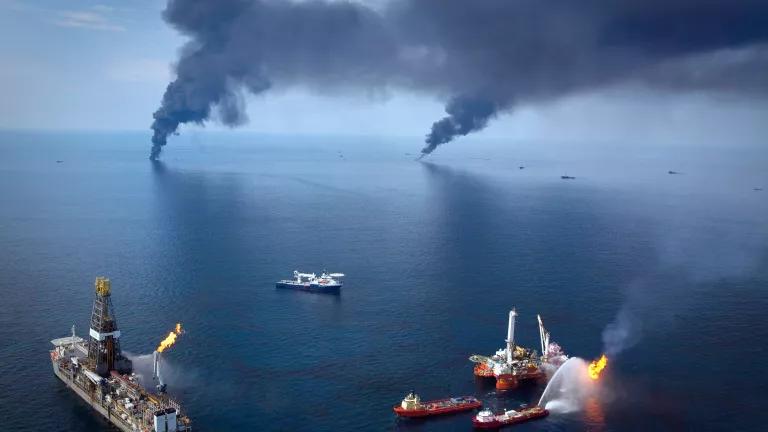
Oil burning off the water's surface near the source of the Deepwater Horizon disaster in the Gulf of Mexico
REUTERS/Lee Celano
The biggest offshore oil spill in American history began on April 20, 2010, about 50 miles off the coast of Louisiana. In mile-deep water, a BP-operated well blew out, causing the Deepwater Horizon drill rig to explode and uncork a geyser of raw crude oil and gas that gushed into the surrounding waters for 87 days. Hundreds of millions of gallons of oil were released into the Gulf of Mexico, creating one of the worst manmade environmental calamities on record.
Years have passed since the deadly accident aboard the offshore drilling platform tarred hundreds of miles of beaches and inflicted billions of dollars in economic damages on businesses and residents in the Gulf, but only recently has the federal government released its assessment of the disaster's environmental impacts. It concluded that the damage from the spill—as well as the cleanup techniques—changed the ecosystem of the entire northern Gulf of Mexico.
Here are the facts: Eleven workers on the Deepwater Horizon died, and another 17 were seriously injured. Tens of thousands of dolphins and whales were exposed to the oil, with a record high number of dolphin deaths. Nearly 100,000 birds from 93 species died. Centuries-old deep-sea corals were smothered by oil.

A brown pelican coated in heavy oil tries to take flight on Louisiana's East Grand Terre Island.
Win McNamee/Getty Images
Among the most enduring images of the disaster, TV viewers will remember the heartbreaking photos of brown pelicans, Louisiana's state bird and a species made famous by the watercolors of John James Audubon, hopelessly weighed down with sludge the color of raw sewage. Some of our nation’s most imperiled species were especially hard hit. All five species of the Gulf's sea turtles, for instance, are endangered—the spill killed as many as 7,600 large sea turtles and as many as 160,000 baby ones. Endangered sperm whales suffered an estimated 7 percent decline in their population, which will take 21 years to recover. Half of all Bryde’s whales were impacted by the spill, resulting in a 22 percent population loss; that means it'll take 69 years to get them back to where they were.
Where did all the oil, only a small amount of which (perhaps 8 percent) was skimmed and collected from the surface of the ocean, eventually go? That was one of the questions NRDC asked in an investigation commissioned on the fifth anniversary of the disaster. The answer? Potentially as much as half of the crude spewed by the runaway gusher before it was eventually capped is likely to still be in the deep ocean. Which means the BP Deepwater Horizon disaster is not over—far from it.
While the immediate cleanup was still underway, NRDC worked on several fronts to prevent the repeat of a disaster that could have been prevented with stricter laws and industrial oversight. We documented the ecological and economic impact on the region's population, animal life, and ecosystems. We partnered with StoryCorps to tell the stories of residents struggling to live through the resulting economic downturn, including Gulf fishermen, shrimpers, tour operators, and Native Americans whose ancestors have lived in the Mississippi River Delta for centuries. Frances Beinecke, then NRDC's president, served on President Obama's committee convened to investigate the disaster, which issued recommendations to make offshore drililng safer and more ecologically sound (Congress has yet to act on most of these).

Sara Stone wipes away tears as she listens to her husband, Deepwater Horizon survivor Stephen Stone, testify before the House Judiciary Committee on May 27, 2010, as BP America Executive Vice President David Nagel (right) listens.
Chip Somodevilla/Getty Images
The only sure way to prevent offshore oil spills, of course, is to abandon drilling for oil offshore. Even removing human error from the equation—an outcome that is arguably impossible—would not eliminate the dangers risked by oil drilling on the outer continental shelf, since natural disasters are also inevitable. During hurricanes Katrina and Rita, for example, high winds and waves caused 514 individual spills and the release of 11 million gallons of oil—the same amount dumped by the Exxon Valdez in Alaska’s Prince William Sound in 1989. NRDC applauds President Obama’s March 2016 actions to close the waters off the Atlantic states to oil and gas production but is concerned by the administration's announcement of plans to lease in 13 new areas off of Alaska (including in the fragile Arctic) and in the Gulf to energy companies for oil and gas exploration.
“Obviously, this is an important win for the Atlantic,” says Michael Jasny, director of NRDC's Marine Mammal Protection Project. “But the Gulf of Mexico and the Arctic remain at risk in this plan. It’s destructive of ocean life, destructive to communities, and inconsistent with the president’s vision and commitment to a clean energy future.”
At a time when the paramount ecological challenge faced by humankind is climate change, does it make sense to spend billions of dollars every year to seek out and exploit sources of fuels that release carbon into the atmosphere rather than to invest in clean and renewable energy? The answer—for the sake of our health, our livelihoods, and the environment—is no.
This NRDC.org story is available for online republication by news media outlets or nonprofits under these conditions: The writer(s) must be credited with a byline; you must note prominently that the story was originally published by NRDC.org and link to the original; the story cannot be edited (beyond simple things such as grammar); you can’t resell the story in any form or grant republishing rights to other outlets; you can’t republish our material wholesale or automatically—you need to select stories individually; you can’t republish the photos or graphics on our site without specific permission; you should drop us a note to let us know when you’ve used one of our stories.
Deb Haaland Is the Interior Secretary Our Country Needs
Empty Nests
A Recurring Nightmare