
Ocean Acidification: What You Need to Know
Carbon pollution isn't just warming the climate—it's also making our oceans more acidic.
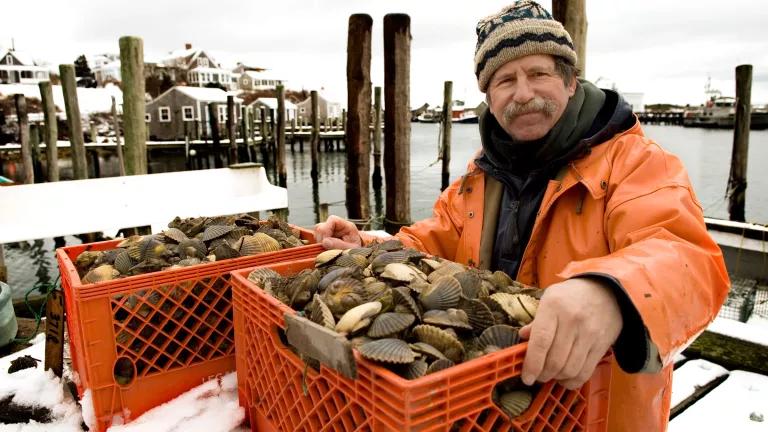
A scalloper on Martha's Vineyard, Massachusetts
David Welch/Massachusetts Office of Travel and Tourism via Flickr, CC BY-ND 4.0

When we release carbon dioxide (CO2) into the air, you might wonder where it goes. Does it just stick around in the atmosphere? Indeed, about half of it does, but the rest gets absorbed—by plants and our oceans, in about an even split. In fact, since the industrial revolution began over 200 years ago, our oceans have absorbed around one-third of all CO2 released from fossil fuel. Put another way, humans have transformed the chemistry of the ocean: The average acidity of seawater has increased by 30 percent due to our activities.
Here’s everything you need to know about the process and impacts of ocean acidification.
What is ocean acidification?
Ocean acidification is the process in which seawater becomes more acidic because of the excess carbon dioxide (CO2) it is absorbing from the atmosphere. This phenomenon, which is impacting every ocean on Earth (as well as coastal estuaries and other waterways), is a direct consequence of the burning of fossil fuels and the resulting carbon pollution.
“There is no meaningful scientific debate over whether acidification is occurring or what causes it,” explains NRDC oceans expert Lisa Suatoni. “This is simple textbook chemistry, coupled with thousands of reliable measurements.”
How is acidification measured?
In chemistry 101, we learn that pH is a measure for how acidic or basic (alkaline) a water-based liquid is. A pH of 7, as in pure water, is neutral. Tart lemon juice has a pH of 2; a cup of coffee, a pH of 5. Ammonia and bleach, on the other hand, are basic, with a pH of 11 and 13.5, respectively.
Our oceans support an abundance of life with an average pH level of 8.1, making seawater slightly basic. But experts estimate that over the course of the 21st century, the pH of ocean water could dip down to 7.8. That may sound like a small change, but the last time the ocean pH was this low was some 14 to 17 million years ago, when the Earth was a very different place. Scientists predict the change will have serious ramifications for ocean ecologies, food security, and economies, big and small, that depend on marine industries.
What causes ocean acidification?
Let’s go over some basics (no pun intended). When carbon dioxide dissolves into the ocean, it triggers a chemical reaction that increases acidity over time. More technically: CO2 and water produce carbonic acid, which releases hydrogen and bicarbonate ions. The more hydrogen ions there are, the more acidic the water becomes. This is what drives ocean acidification.
In addition to the burning of fossil fuels, another main culprit behind the sharp rise in ocean acidification is deforestation (both are major contributors to climate change). That’s because when a forest is cut or burnt down, it releases all of the carbon that was stored into the air.
How do we know that the decrease in ocean pH isn’t part of a natural cycle? Because research has shown that the rise in fossil fuels and atmospheric CO2 correlates with the decline of ocean pH. And while correlation doesn't always equal causation, Suatoni explains, “the consistency between what scientists theorize and what we’ve observed—as well as the lack of good alternative explanations—gives us high confidence that carbon dioxide pollution is causing ocean acidification.”
Why is ocean acidification a problem?
What is especially alarming about ocean acidification today is the speed of change and its direct impacts on ocean ecosystems.
When CO2 dissolves into the ocean, it reduces the availability of carbonate: an essential building block for shellfish like mussels, clams, and oysters to create their protective shells and skeletons. Lower concentrations of carbonate in marine habitats therefore directly impact these animals’ chances of survival, as researchers studying declining shellfish options in the Gulf of Maine have shown. If acidity were to rise high enough, seawater could literally dissolve shells.
Coral reefs also suffer the consequences. For example, Australia’s Great Barrier Reef has shown a 14 percent decline in calcification since 1990. Coral reefs are an essential part of marine ecosystems, providing shelter for 25 percent of marine species. These structures also protect coastal communities from erosion and storm sturges. Acidification is especially hard on reefs that already face natural bioerosion from the species of fish and worms that eat away at them. The reefs, which are famously slow-growing, can’t outpace this dissolution.
Is ocean acidification bad for people?
Absolutely. Even if you don't have a shell, the impacts of ocean acidification can ripple through the entire food chain, in water and on land.
Significant portions of our economy rely on the ocean's bounty in one way or another. The U.S. shellfish industry, for instance, plays a huge role in coastal economies, providing employment to thousands of people and generating millions of dollars in revenue each year. If ocean acidification is left unchecked, it is estimated that the industry can lose more than $400 million annually by the year 2100. “As we transform the sea with our actions—by the burning of fossil fuels—we’re interfering with the crucial role it plays for humanity, from stabilizing our climate and protecting coastal communities to providing food for billions of people around the world,” says Suatoni.
Which communities are most at risk of ocean acidification in the United States?
A 2015 study co-authored by NRDC looked at which coastal communities around the nation are most vulnerable to ocean acidification. It found 15 states at risk of long-term economic harm as a direct result: Alaska, California, Connecticut, Florida, Hawaii, Louisiana, Maine, Maryland, Massachusetts, New Jersey, New York, Oregon, Rhode Island, Virginia, and Washington.
Researchers took into consideration communities’ dependence on the shellfish industry, ocean areas that are experiencing the most rapid chemical changes, and areas where shellfish are most vulnerable. You can see whether your community is being impacted through NRDC’s interactive map.
Because CO2 dissolves faster in cold water, areas like the Pacific Northwest will see more serious impacts from acidification. Many communities there rely heavily on the shellfish industry, which supports some 3,200 jobs and has an estimated economic impact of $270 million annually.
What are the solutions to ocean acidification?
We can tackle ocean acidification on multiple fronts.
First and foremost, since we know ocean acidification is caused primarily by carbon pollution from fossil fuels, we know we have to advance the global transition to clean energy. Pollution regulations for power plants and stronger fuel-economy standards for our cars can help with that. Government leaders can also step up conservation efforts to protect and enhance the resilience of our forests, wetlands, and other critical carbon sinks, through initiatives like the 30x30 pledge, which sets aside 30 percent of our lands and waters to let ecosystems recover and withstand these growing challenges. Policymakers—recognizing the job sectors and other economic engines at risk from ocean acidification—are introducing climate action plans that promote increased investments in monitoring, forecasting, and mitigation.
Considering the scale and rate of change, we need to prepare ourselves and safeguard vulnerable industries. “While ocean acidification’s effects have a global reach, local factors also influence how at risk regions are,” says Suatoni. Some managers of West Coast oyster hatcheries, for example, have invested in monitoring systems. When harmful acidic water upwells on the coast, they shut off their intake valves to prevent baby oysters from being exposed. Other solutions include cultivating ocean acidification–resistant strains of shellfish and diversifying aquaculture systems. For example, scientists are teaming up with fishermen to see how cultivating seaweeds like sugar kelp can potentially buffer farmed oysters, clams, and mussels from acidification as they absorb carbon dioxide from the salty water.
The changes in our oceans are startling, and we don’t yet fully understand what’s to come as oceans acidify. But we know we must act. “We both love and need our oceans,” says Suatoni. “If they fail, we all do.”
This story was originally published on August 15, 2013, and has been updated with new information and links.
This NRDC.org story is available for online republication by news media outlets or nonprofits under these conditions: The writer(s) must be credited with a byline; you must note prominently that the story was originally published by NRDC.org and link to the original; the story cannot be edited (beyond simple things such as grammar); you can’t resell the story in any form or grant republishing rights to other outlets; you can’t republish our material wholesale or automatically—you need to select stories individually; you can’t republish the photos or graphics on our site without specific permission; you should drop us a note to let us know when you’ve used one of our stories.
Biodiversity 101
Will Shifting to Reusable Straws Really Make a Difference?
Go Green in Margaritaville: Eco-Friendly Beach Vacation Tips