hen I was eight years old, I bit into a red apple and my throat closed. It was an autumn morning, and I was sitting in the back seat of the car. My mouth began to itch and I felt like I had to burp, but I couldn't. I could barely speak. Outside, dry leaves were scuttling across the sidewalk. I couldn't get enough air. My parents, twisting around in alarm to look at me from the front seat, started inhaling and exhaling deeply and slowly, as if modeling breathing would remind me how to do it. But I hadn't forgotten how to breathe. I simply couldn't.
Soon afterward, I was diagnosed with atopic asthma -- asthma caused by allergies, which is a chronic condition with no known cure. The word asthma comes from the Greek word for "panting," which is what we asthmatics do when we're trying to get air. My own panting is induced by any number of factors: dust mite dung, dry wind, cat dander, cold air, rabbits, wood smoke, pollen, guinea pigs, cigarettes, grass, horses, and some species of trees, among other things. Any of these will make my eyes itch, my nose run, and my skin break out in a rash. Or they will shut my airways.
Because I have asthma, for most of my life I've had to pay attention to my surroundings. I've had to be aware of hovering dust, the direction of a spring breeze, the presence of a cat. Luckily, my asthma is mild. My attacks aren't life-threatening, and as long as I have my inhaler along, they're easily relieved. And I can usually get myself out of the path of the allergens, away from the cats and rabbits, in from the pollens, and into a "clean" air space.

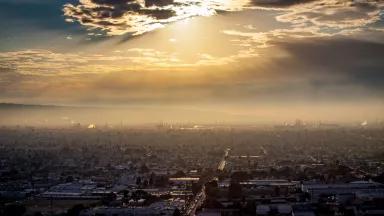
But for the 17 million other people with asthma in the United States, controlling the air space is not always so simple, especially because some of the most common triggers of asthma -- smog and soot from tailpipe exhaust and power plants -- are in the air we breathe every day.
It's possible that air pollution is doing more than just triggering asthma attacks. It may also be an element in the development of the disease -- a criminal accomplice, not just an accessory after the fact. In industrialized countries, asthma is becoming more common and more severe. Five thousand people die of it every year in the United States. Currently it's the sixth most common chronic condition in the nation. Three times as many people have it now as in 1980. Some 6 million of them are children. For children, asthma is the most common chronic disorder, the leading cause of missed school, and the leading cause of hospitalization.
Is polluted air helping to drive this epidemic? As yet, there's no scientific consensus. But the evidence pointing to air pollution as one major culprit is getting harder and harder to ignore.