
2,4-D: The Most Dangerous Pesticide You've Never Heard Of
This toxic herbicide comes with known health risks, but it's still being used on crops, in parks, and maybe even in your own backyard.
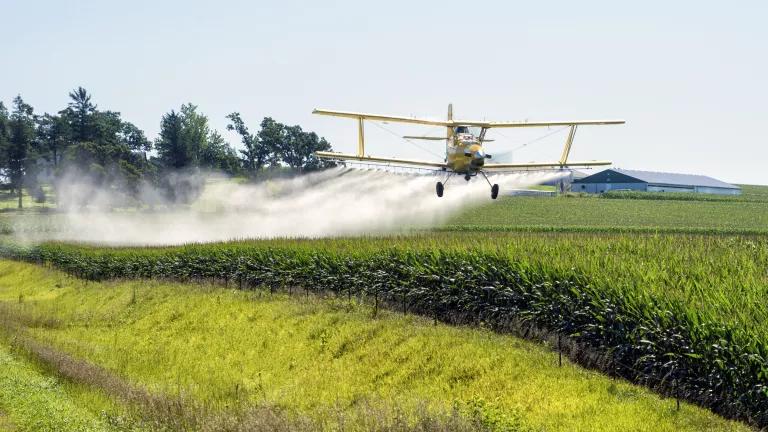
Gavin Baker Photography/Shutterstock
One of the cheapest and most common weed killers in the country has a name you've probably never heard: 2,4-D. Developed by Dow Chemical in the 1940s, this herbicide helped usher in the clean, green, pristine lawns of postwar America, ridding backyards everywhere of aesthetic undesirables like dandelion and white clover. But 2,4-dichlorophenoxyacetic acid, as it's known to chemists, has a less wholesome side. There's a growing body of scientific evidence that the chemical poses a danger to both human health and the environment.
The pesticide, which allows not just grasses but also fruits and vegetables to flourish, can attack both the roots and leaves of weeds by making the unwanted plant's cells grow out of control—sort of like inducing cancer in the plant to kill it or drastically slow its spread. It's used widely in agriculture in soybean, corn, sugarcane, and wheat fields, and it turns up in most "weed and feed" products as well as in many lawn treatments. The problem is, the herbicide that was once considered clean and green may no longer be safe by today's standards.
The evidence is slowly mounting—but not yet conclusive. It's not always easy to determine whether a particular substance is causing harm or just happens to be present when some other agent is to blame. Public health experts can't always draw a firm conclusion from studies whose methodologies are lacking in scientific rigor. Take the link between chronic exposure to 2,4-D and cancer: "The evidence isn't clear enough to draw conclusions with confidence, but it is better to take precautions to prevent possible cancers than to wait for more evidence," says Jennifer Sass, an NRDC senior scientist.
Researchers have observed apparent links between exposure to 2,4-D and non-Hodgkin's lymphoma (a blood cancer) and sarcoma (a soft-tissue cancer). But both of these can be caused by a number of chemicals, including dioxin, which was frequently mixed into formulations of 2,4-D until the mid-1990s. Nevertheless, in 2015, the International Agency for Research on Cancer declared 2,4-D a possible human carcinogen, based on evidence that it damages human cells and, in a number of studies, caused cancer in laboratory animals.
More conclusive is the proof that 2,4-D falls into a class of compounds called endocrine-disrupting chemicals, compounds that mimic or inhibit the body's hormones. Laboratory studies suggest that 2,4-D can impede the normal action of estrogen, androgen, and most conclusively, thyroid hormones. Dozens of epidemiological, animal, and laboratory studies have shown a link between 2,4-D and thyroid disorders. "That's really important when we're thinking about development," says Kristi Pullen, a staff scientist in NRDC's Health program. "Our thyroid works to ensure the proper timing and development of the brain."
There are reports that 2,4-D can decrease fertility and raise the risk of birth defects. But even though fetuses, infants, and children are at highest risk of these, no studies have looked directly at the effects of 2,4-D on those groups.
Despite concerns about potential health risks, in 2014 the U.S. Environmental Protection Agency approved the combined use of 2,4-D and the popular weed killer Roundup (also known as glyphosate, a whole other—and in many ways more worrying—story when it comes to health and the environment). Enlist Duo, as the combo is called, was already legal in several states. It is used mainly on big farms, where it is sprayed on genetically modified crops called Enlist soy and Enlist corn that have been engineered to be resistant to the poisons.
In other words, farmers can now douse their fields with high concentrations of the weed killer without worrying that it will also destroy their crops. Originally, plants genetically engineered to resist Roundup were sprayed with that herbicide alone. But when the weeds it was intended to kill also developed resistance, 2,4-D was added to make the mix more effective. As Pullen puts it, "These chemicals by themselves can be problematic, but when we start combining them with other toxic chemicals, we're just creating a new problem in order to solve another problem."
The U.S. Department of Agriculture estimates that by 2020, the use of 2,4-D on America's farms could rise between 100 percent and 600 percent now that it has been approved as part of Enlist Duo. According to Pullen, "When you combine increased use with the potential for increased developmental, cancer, and other health impacts, you could create a perfect storm of hazard and exposure coming together."
Also problematic: 2,4-D sticks around in the environment. Depending on the formulation, it can drift through the air from the fields where it is sprayed or be tracked inside homes by pets or children. By the EPA's own measure, 2,4-D has already been detected in groundwater and surface water, as well as in drinking water. Australian scientists reported in 2012 that it was found in more than 90 percent of samples taken from agricultural catchments bordering the Great Barrier Reef—bad news for many fish, for whom the herbicide can be toxic. It can also poison small mammals, including dogs who can ingest it after eating grass treated with 2,4-D.
The easiest way to avoid 2,4-D is to avoid the products that contain it. You can ask your town whether 2,4-D is used in specific parks. You can also visit the website of the National Pesticide Information Center, which has easy-to-read fact sheets on 2,4-D and most other pesticides. If you think you, your child, or your pet have been in contact with plants recently treated with 2,4-D or any other pesticide, contact a poison-control center.
This NRDC.org story is available for online republication by news media outlets or nonprofits under these conditions: The writer(s) must be credited with a byline; you must note prominently that the story was originally published by NRDC.org and link to the original; the story cannot be edited (beyond simple things such as grammar); you can’t resell the story in any form or grant republishing rights to other outlets; you can’t republish our material wholesale or automatically—you need to select stories individually; you can’t republish the photos or graphics on our site without specific permission; you should drop us a note to let us know when you’ve used one of our stories.
Neonicotinoids 101: The Effects on Humans and Bees
A Growing Concern: Microplastic Pollution on Farm Fields
Murder Hornets Are Scary. But Pesticides Are Scarier.