
Beach Pollution 101
Litter, sewage, plastic, and other pollutants do more than just ruin the beauty of the beach. They are closing down coastal areas, destroying marine life, and making people seriously sick.
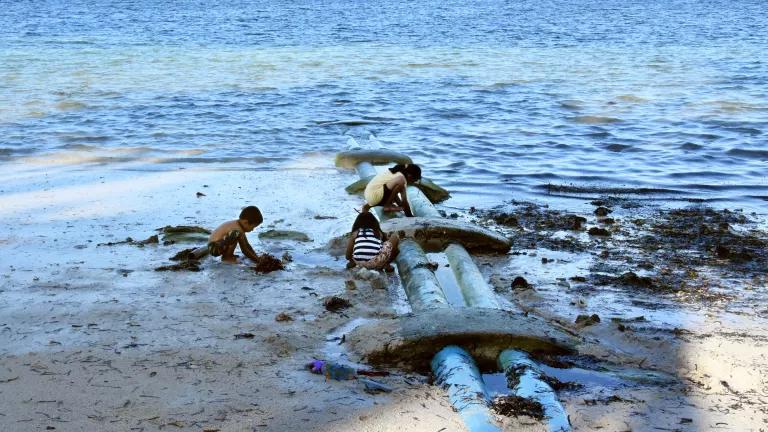
Photo taken at a beach on Boracay Island in the Philippines on April 2, 2018, shows pipes through which sewage is presumed to flow into the ocean.
Kyodo via AP Images

One of our greatest natural resources has become a garbage dump—and the results are taking a toll on human and marine health. According to the National Oceanic and Atmospheric Administration (NOAA), billions of pounds of pollution end up in our oceans each year, and the majority of it comes from human activities along the coastlines and inland. Understanding the devastating effects of pollution on our beaches is the first step to fixing the problem.
What is beach pollution?
Beach pollution is any harmful substance that contaminates our coasts, ranging from plastic, trash, and litter to sewage, pesticides, and oil. Excess amounts of natural substances, such as nitrogen and phosphorus from fertilizers and animal waste, are also pollutants.
Litter and garbage
These are the most visible types of beach pollution. Litter such as cigarette butts, food wrappers, and plastic bottles can simply be left behind by beachgoers. More indirectly, residential or commercial trash that is not properly disposed of will also eventually reach our beaches—rain reliably washes trash through storm drains, and rivers and streams carry it to the ocean. Litter is also bad in the Great Lakes, the world’s largest freshwater ecosystem. The accumulation became so extreme that Lake Erie was once labeled “the poster child of pollution” (although it is slowly making a comeback thanks to a multistate and international partnership and funding provided by Congress).
Nutrient pollution
While nitrogen and phosphorus are naturally occurring parts of the ecosystem, an overabundance of them in our waterways can have a devastating impact on the environment and human health. Large-scale industrial agriculture practices have dramatically increased the amount of both elements in our soil, air, and water, thanks to commercial fertilizers and animal manure, which contain large amounts of these nutrients. Fertilizer and manure are both applied to crops to help them grow, but often they’re applied in excess. Anything that isn’t absorbed can be washed into waterways by rain or leach through the soil to a nearby groundwater source.
Additionally, animal waste generated by concentrated animal feeding operations (CAFOs) can spill from storage structures into waterways during storms. Common household items such as dish soaps, dishwasher detergents, and fertilizers can also contribute to nutrient pollution. Many of these cleaning products contain a form of phosphorus called phosphate, which can travel down our drains and eventually wind up on our beaches.
Too much nitrogen and phosphorus in water can cause algae to grow much faster than usual. These colonies of algae, referred to as harmful algal blooms (HABs), can take over large swaths of water and are detrimental to aquatic ecosystems, blocking light and depleting oxygen. They can also release toxins that sicken humans and wildlife.
Wet weather discharges
Wet weather discharges include any end-of-pipe contaminants that are brought to the ocean through precipitation, such as rainfall and snowmelt. There are three types:
Stormwater runoff
Stormwater runoff happens when rain or melted snow flows over paved land and does not soak into the ground. As the water travels over sidewalks, parking lots, and roads, it picks up and accumulates pollutants including trash, chemicals, oil, and dirt. Water can also pick up harmful pollutants (heavy metals or organic chemicals) near industrial and construction sites. Newer underground drainage systems—those built since the 1950s—tend to separate this surface runoff from sewage by maintaining two different networks. In these two-pipe systems, stormwater is collected at inlets and discharged directly into a nearby body of water.
Although this system was designed to reduce the risk of sewage overflows, it may actually increase the amount of pollutants in our coastal waters because it directly dumps untreated runoff into our waterways. The EPA estimates that more than 10 trillion gallons of untreated stormwater enter our coastal waters every year, and NRDC’s research found that stormwater runoff is the biggest cause of beach closings and advisories.
Combined sewer overflows (CSOs)
According to the EPA, there are still more than 860 municipalities in the United States with older systems known as combined sewer systems (CSSs). CSSs funnel domestic sewage, industrial wastewater, and stormwater through a single set of pipes to a waste treatment facility to be processed and then dumped in a nearby body of water. During periods of heavy rainfall, however, the wastewater volume in a CSS can exceed the capacity of the sewer system or treatment facility. For this reason, the sewers have been specifically designed with overflow pipes so that the mixture of sewage and stormwater doesn’t back up into buildings, including homes. The resulting combined sewer overflow (CSO) dumps raw, untreated sewage into lakes, rivers, and coastal waters. CSOs are a common source of raw sewage appearing on beaches, particularly in the Great Lakes basin.
Sanitary sewage overflows (SSOs)
A sanitary sewage system (SSS) is another type of waste system that collects and transports industrial and domestic wastewater to a treatment facility. Unlike CSSs, SSS pipes are not designed to carry much rainwater and therefore have a smaller capacity. These systems, especially if old or undersized, often let raw sewage leak out into nearby bodies of water if there is any type of heavy precipitation. The EPA estimates that there are at least 23,000 to 75,000 SSOs per year in the United States, making them one of the biggest causes of wet weather discharge.
Overflows from combined and sanitary sewer systems are both categorized as point source pollution, or pollution that originates from a single, identifiable source such as a factory, sewage treatment facility, farm, or septic tank. Point source pollution is less common than nonpoint source pollution, which is caused by rainfall or snowmelt moving over and through the ground and comes from many diffuse sources but often has a larger and more destructive impact.
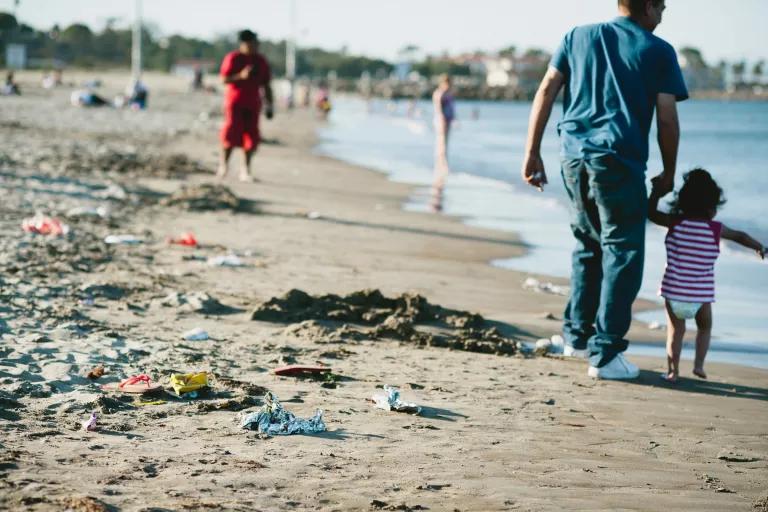
Families walk near plastic litter washed up on Cabrillo Beach in Los Angeles.
Arista/Docuvitae for NRDC
Why is beach pollution a problem?
The impact on public health
Polluted beaches pose a serious health risk for people who come in contact with dirty water or sand. Ten percent of all water samples collected in 2013 from 3,500 coastal and Great Lakes beaches failed to meet the EPA’s most restrictive benchmark for swimmer safety. The EPA estimates that up to 3.5 million people get sick from being in contact with sewage while swimming; children are the most vulnerable because they tend to swallow more water. Bacteria, fertilizers, animal and human waste, and trash can cause a range of illnesses for beachgoers. The most common is an upset stomach, but swimmers can also suffer neurological disorders, respiratory ailments, pinkeye, earaches, meningitis, and hepatitis. People with compromised immune systems, small children, and seniors may even be at risk of death.
Because there is a lag between contact with contaminated waters and onset of symptoms, most people don’t even realize it was the beach that caused their illness. One study found that people can get sick without even going into the water—contact with polluted beach sand was enough exposure to sicken them.
A notable example of the effect that polluted water can have on public health is the Santa Cruz River at the Arizona–Mexico border. Replenished by discharge from a nearby wastewater treatment plant, the river has been slowly polluted by sewage as the decades-old waste pipeline deteriorated. The governor of Arizona had to declare a state of emergency in 2017 as heavy rainfall ruptured the pipeline. After the breach, health officials found that E.coli bacteria levels were so high during an initial test, they exceeded capabilities of field equipment and surpassed recommended levels. Border patrol agents have suffered chemical burns from wading through the water due to the presence of industrial waste, including heavy metals, chemical solvents, and even DDT. The cost to replace the wastewater line is about $80 million, but finding the funding is proving difficult. The Arizona state government allocated $2.6 million in 2019 to help repair the sewer line, and a funding bill was introduced in Congress the same year with the goal of directing $4 million to cover future maintenance costs.
There is another health concern in addition to sewage contamination: Harmful algal blooms (HABs) can also cause serious illness in humans. Several species of phytoplankton produce toxins that can cause serious and potentially life-threatening symptoms in people who come in contact with or ingest them. Effects can include paralysis, seizures, vomiting, and cardiovascular problems, among others.
The impact on animals
It is estimated that beach pollution affects more than 800 species of wildlife around the world. More than 100,000 seabirds, sea turtles, seals, and other marine mammals die each year after ingesting plastic or getting entangled in it. Animals can easily mistake floating plastic for food, causing them to choke, sustain an internal injury, or starve. The ingested plastic can then move through the food chain, eventually reaching the stomachs of seafood-eating humans. Plastic pollution has become so overwhelming that it is even affecting sea turtles’ reproduction rates because it alters the temperature of the sand where incubation typically occurs.
HABs are also detrimental to marine wildlife. HABs consume oxygen when they die and decompose, creating dead zones—areas with little or no oxygen. This not only kills off feeding sources for larger aquatic animals but also destroys habitats. Some types of HABs also damage or clog fish gills or block sunlight for beneficial algae and seagrasses.
In 2015, parts of the U.S. West Coast experienced significant impacts of a large-scale HAB. The toxic bloom affected wildlife, including anchovies, seabirds, whales, and sea lions, and resulted in closures of recreational and commercial fisheries in California, Oregon, and Washington. The bloom involved the proliferation of Pseudo-nitzschia diatoms, a type of microscopic alga that produces a neurotoxin called domoic acid.
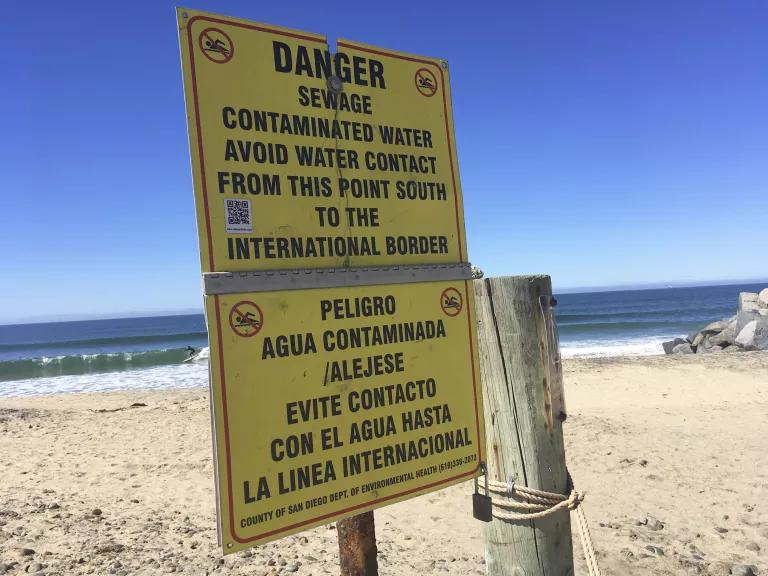
Local governments in the San Diego area have sued the federal government to stop sewage from spilling into the country from Mexico.
AP Photo/Elliot Spagat
The economic toll
In 2013 an NRDC report found that beaches in the United States had experienced more than 20,000 closings and advisory days in the previous year due to pollution and contamination. It found that more than 80 percent of the closings were related to near-shore bacteria levels that violated public health standards. Closed beaches directly impact the economies of coastal destinations: Americans take more than 900 million trips to coastal areas and spend around $44 billion on those trips every year. Beachside cities and economic activities associated with the ocean play a sizable role in the U.S. economy. Having these beaches closed due to pollution not only ruins the experience of beachgoers but adversely impacts local businesses and the tourism industry in the region.
Beach pollution solutions
Policy enforcement and change are two essential ways to address pollution on a national level. The Environmental Protection Agency (EPA) has the biggest responsibility to enact preventive and reparative programs and laws to protect our beaches.
One of the solutions for beach pollution is enforcing all aspects of the Clean Water Act (CWA), including regulations pertaining to wastewater management, stormwater pollution, CAFO manure management, and oil and hazardous substance spill prevention and response. The amount of regulatory enforcement undertaken by the EPA varies according to the presidential administration. The Obama administration adopted rules that generally implemented the protections of the CWA appropriately, but the Trump administration has taken several actions to undermine the law’s enforcement.
The National Oceanic and Atmospheric Administration (NOAA) is also working in collaboration with the EPA and other federal agencies to control nonpoint source pollution through monitoring and assessing the exact causes.
You can speak up for policies that you support by contacting your federal, state, and city representatives. To make a real impact on beach pollution, encourage lawmakers to pass legislation that limits agricultural pesticides and promotes organic farming and eco-friendly pesticide use, cuts down on industry and manufacturing waste, and increases funding for state water-quality monitoring and notification programs to inform the public about possible health risks.
You can also support state and local legislation that encourages green infrastructure as a control on stormwater runoff. Porous pavements, green roofs and parks, roadside plantings, and rain barrels are all able to stop rain where it falls—letting it evaporate or filter into the ground—instead of carrying runoff into our coastal waters. They can also help cleanse the air, reduce asthma, save on heating and cooling costs, and boost economies.
Personal action, too, can go a long way in reducing beach pollution. Beaches are for the public to enjoy, and it is also our responsibility to help keep them clean. There are easy everyday steps one can take to help reduce ground leaching of chemicals and toxic materials, reduce carbon emissions, and protect marine wildlife, such as eating organic foods to limit the demand for pesticides, cleaning your home with natural ingredients, and avoiding chemical pesticides in your yard. We can also work together to minimize plastic use to help save marine wildlife—and our oceans.
This NRDC.org story is available for online republication by news media outlets or nonprofits under these conditions: The writer(s) must be credited with a byline; you must note prominently that the story was originally published by NRDC.org and link to the original; the story cannot be edited (beyond simple things such as grammar); you can’t resell the story in any form or grant republishing rights to other outlets; you can’t republish our material wholesale or automatically—you need to select stories individually; you can’t republish the photos or graphics on our site without specific permission; you should drop us a note to let us know when you’ve used one of our stories.
The Global Plastics Treaty: It’s Time to Clean Up Our Mess
Her Stand-Up Paddleboard Is a Platform for Campaigning Against Plastic Pollution
Single-Use Plastics 101