
The Smart Seafood and Sustainable Fish Buying Guide
Five ways to keep the environment in mind when you shop for fish and shellfish.

Getty Images

The seafood industry is in trouble. While fish is a key part of the diet for billions of people—and while the industry itself remains integral to the economies of coastal nations across the globe—the stats are bleak. Inadequate fisheries laws, poor enforcement on the high seas, and complex, obscure supply chains for many seafood products have led an estimated one-third of the world’s annual catch to be illegally fished. These factors all contribute to overfishing and mean that today, only 66 percent of wild marine fish stock are considered to exist at biologically sustainable levels. Over the last 50 years, fishing has been the major cause of marine biodiversity loss in the ocean, contributing to the global biodiversity crisis.
Climate change is also affecting fisheries: As our ocean warms rapidly, fish populations off our coasts are moving into cooler waters, dwindling in productivity, and facing more frequent marine heat waves and other environmental challenges. Ocean acidification, which is intensifying as the oceans absorb more carbon dioxide, is a direct threat to the survival of shellfish and degrades the coral reefs that provide essential habitat. Separately, the impacts of the plastic waste crisis are also taking a toll on marine life.
Thankfully, shoppers are increasingly factoring in sustainability when purchasing seafood. And the United States remains a global leader in sustainable fishing. But when browsing the fish counter or dinner menu, the options can sometimes feel overwhelming. So to help you make the best choices, keep these five tips in mind.
Buy American-caught seafood to support strong fishery management.
Given the numerous threats to our oceans, consumers should make their best efforts to buy fish caught sustainably in U.S. waters. Referring to the Monterey Bay Aquarium's Seafood Watch is a good place to start.
Why choose domestically caught seafood over imports? As much as 32 percent of imports sold in the United States—nearly $2.4 billion worth, in 2019 alone—is harvested through illegal, unreported, and unregulated (IUU) fishing. This complex global problem thwarts legitimate fisheries management and drives overfishing, jeopardizing the health of many fish stocks. Other problems include bycatch (the unintentional capture of other marine species, such as dolphins and sea turtles, in fishing nets), as well as destructive harvesting methods like bottom trawling, which can devastate deep-sea corals, sponge fields, and other unique habitats and denizens of the ocean floor. Global bycatch of whales, dolphins, and other marine mammals is the leading driver of marine mammal decline, killing or seriously injuring more than 650,000 animals every year. Under the Marine Mammal Protection Act, foreign fisheries are supposed to meet stringent U.S. bycatch standards—a fact that wildlife advocates say our government must take more seriously and one that concerned consumers can address by refusing imported seafood.
Watch this video from our sister organization, NRDC Action Fund, to learn more about illegal fishing.
These issues not only threaten ocean health but can destabilize economies and increase international conflict, precisely because the lucrative industry often and so easily evades authorities. IUU fishing is also directly tied to forced labor and human rights abuses at sea and in the seafood supply chain. As a top market for seafood, the United States has the ability to influence change. But much work remains to build an effective American seafood traceability program, including expanding the Seafood Import Monitoring Program, which is overseen by NOAA’s National Marine Fisheries Service and is a crucial tool to helping combat IUU fishing and labor abuses at sea.
A whole other issue with imported fish is the lack of regulations on some overseas fish farms, where fish can be exposed to dangerous antibiotics and chemicals (many of which are banned in the United States). The clincher? The U.S. Food and Drug Administration (FDA) only inspects about 2 percent of all seafood that comes from abroad.
Of course, not all U.S. fisheries are sustainably managed or adequately ensuring the overall health of ocean ecosystems. As one piece of evidence, take the continued decline of endangered North Atlantic right whales, for which entanglement in lobster lines is a top threat. However, the nation’s primary fisheries law, the Magnuson-Stevens Act, has played a critical role in curbing overfishing and rebuilding dozens of once-depleted fish stocks in U.S. waters.
Diversify to prevent overfishing.
Year after year, Americans opt predominantly for the same five types of seafood: shrimp, salmon, canned tuna, tilapia, and pollock. Each comes with its own set of concerns, but such high demand on only a handful of aquatic species can lead to overfishing, harmful catch methods, habitat destruction, and overuse of antibiotics in the case of farmed fish. (This risk does not apply to all farmed fish; open-ocean farms tend to be the worst offenders when it comes to antibiotics use and pollutants.)
Meanwhile, the protected ocean waters along the U.S. coasts are teeming with hundreds of delicious and currently abundant species, like mussels, oysters, rockfish, and scup (aka porgy). By choosing to eat these underappreciated species, we can minimize damage and help U.S. fisheries continue to rebound. Even different edible seaweed varieties, which have the potential to absorb carbon dioxide from the ocean and are available dried in many markets, can provide that salty, savory flavor that seafood lovers crave.
Learn More: Ocean Pollution

Think small to keep it clean.
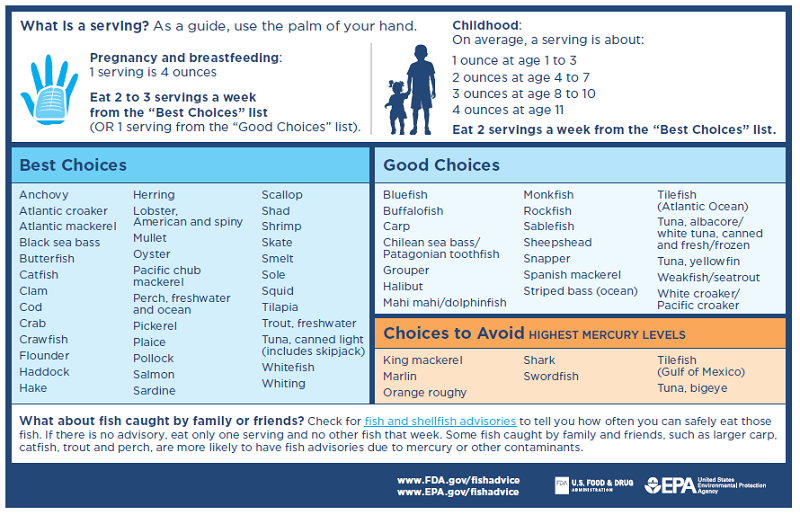
Mercury is a dangerous neurotoxin that can disrupt brain function and harm the nervous system. High concentrations of this pollutant (which can be traced back to emissions from coal-burning power plants) in both ocean predators, like tuna and swordfish, as well as freshwater fish, such as bass and trout, put consumers at risk of adverse health effects. It’s especially threatening to pregnant women and young children. As a general rule, smaller seafood—like sardines, scallops, squid—contain less mercury than larger varieties like tuna and swordfish.
Why is that? Mercury pollution (much like other dangerous particles, including microplastics) settles to the seafloor and is then taken in by organisms that live or feed on bottom sediments. These compounds aren't digested; instead, they accumulate within the animals that ingest them. As they pass through the food chain, they become more and more concentrated—a process known as biomagnification. So when a tuna eats a bunch of anchovies, the tuna is accumulating the mercury of all those anchovies into its own body.
This handy chart produced by the FDA, which tests fish for mercury, and the U.S. Environmental Protection Agency, which determines mercury levels that it considers safe for women of childbearing age, helps you figure out which fish are safer to eat than others when it comes to avoiding mercury.
Eat local fish and shellfish.
You’ve heard of farm to table, but what about boat to table? Community-supported fisheries—modeled on community-supported agricultural programs, where customers pay to receive a regular share of a farmer’s harvest—are growing in popularity. Joining a community-supported fishery is an excellent way to know exactly where your fish comes from, who caught it, and how. (Small-scale, sustainable fishermen often employ lower-impact catch methods like hook and line or pots and traps.) These programs help bolster regional fishing economies while increasing demand for local, sustainable seafood. Some, like oyster and kelp farmers, even help to boost climate resiliency in local waters. Visit localcatch.org to find a CSF in your area.
Be vigilant about wild capture and fish farms.
If you can't join a CSF, buy your seafood from trusted retailers and restaurants. Certain businesses have set higher standards for the seafood they sell in their stores, and many have pledged to create long-term sustainable seafood plans.
By simply asking if a store or restaurant offers sustainable seafood, you can help shape demand for fish that has been caught or farmed in environmentally responsible ways. This video from Monterey Bay Aquarium’s Seafood Watch program highlights why such questions are important.
Some shops make use of labels that help take the guesswork out of making ethical choices when you shop. In addition to Seafood Watch’s “best choice” recommendations, certification programs worth paying attention to include that of the Aquaculture Stewardship Council, which evaluates aquaculture practices involved in responsible fish farming, and Fair Trade USA, which focuses on the labor conditions and other social impacts for workers in the seafood industry.
However, be wary of greenwashing—where industries create the appearance of eco-friendly practices for consumers without actually doing the work. To learn how to spot the differences between legitimate certifications and meaningless labels at the grocery store and beyond, check out our greenwashing guide.
This story was originally published on August 26, 2015, and has been updated with new information and links.
This NRDC.org story is available for online republication by news media outlets or nonprofits under these conditions: The writer(s) must be credited with a byline; you must note prominently that the story was originally published by NRDC.org and link to the original; the story cannot be edited (beyond simple things such as grammar); you can’t resell the story in any form or grant republishing rights to other outlets; you can’t republish our material wholesale or automatically—you need to select stories individually; you can’t republish the photos or graphics on our site without specific permission; you should drop us a note to let us know when you’ve used one of our stories.
We Are Here to Make a Difference: Our Litigators Are at the Ready
Is the Future of Grocery Shopping B.Y.O. Container?
Neonicotinoids 101: The Effects on Humans and Bees