
How You Can Stop Global Warming
Healing the planet starts in your garage, in your kitchen, and at your dining room table.
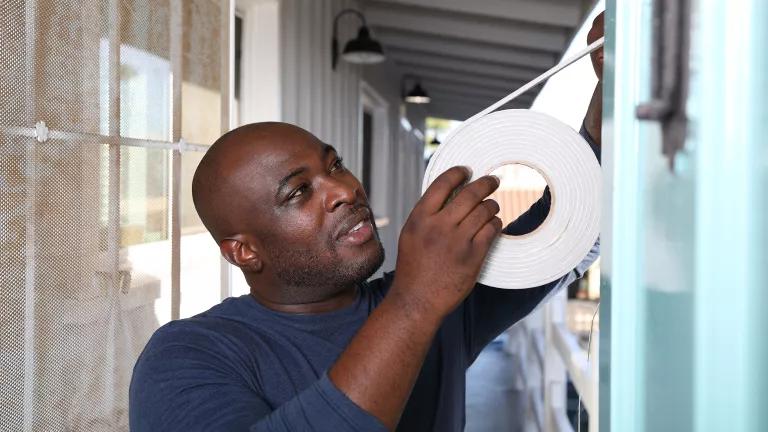
Weatherizing doors and windows by sealing drafts can make your home more energy efficient.
Getty Images
Rising sea levels. Raging storms. Searing heat. Ferocious fires. Severe drought. Punishing floods. The effects of climate change are already threatening our health, our communities, our economy, our security, and our children’s future.
What can you do? A whole lot, as it turns out. Americans, on average, produce 21 tons of carbon a year, about four times the global average. Personal action is, of course, no substitute for meaningful government policies. We still must limit carbon pollution and aggressively move away from dirty fossil fuels toward cleaner power.
But it’s important to remember the equally vital contributions that can be made by private citizens—which is to say, by you. “Change only happens when individuals take action,” says clean energy advocate Aliya Haq. “There’s no other way, if it doesn’t start with people.”
Here are a dozen easy, effective ways each one of us can make a difference.
1. Speak up!
What’s the single biggest way you can make an impact on global climate change? “Talk to your friends and family, and make sure your representatives are making good decisions,” Haq says. By voicing your concerns—via social media or, better yet, directly to your elected officials—you send a message that you care about the warming world. Encourage Congress to enact new laws that limit carbon emissions and require polluters to pay for the emissions they produce. “The main reason elected officials do anything difficult is because their constituents make them,” Haq says. You can help protect public lands, stop offshore drilling, and more here.
2. Power your home with renewable energy.
Choose a utility company that generates at least half its power from wind or solar and has been certified by Green-e Energy, an organization that vets renewable energy options. If that isn’t possible for you, take a look at your electric bill; many utilities now list other ways to support renewable sources on their monthly statements and websites.
3. Weatherize, weatherize, weatherize.
“Building heating and cooling are among the biggest uses of energy,” Haq says. Indeed, heating and air-conditioning account for almost half of home energy use. You can make your space more energy efficient by sealing drafts and ensuring it’s adequately insulated. You can also claim federal tax credits for many energy efficiency home improvements. To help you figure out where to start, you could also get a home energy audit, which some utilities offer free of charge. (Alternatively, you can hire a professional to come to your home and perform one; the Inflation Reduction Act offers a partial tax credit for this.) The EPA’s Home Energy Yardstick gives you a simple assessment of your home’s annual energy use compared with similar homes.
4. Invest in energy-efficient appliances.
Since they were first implemented nationally in 1987, efficiency standards for dozens of appliances and products have kept 2.3 billion tons of carbon dioxide out of the air. That’s about the same amount as the annual carbon pollution coughed up by nearly 440 million cars. “Energy efficiency is the lowest-cost way to reduce emissions,” Haq says. When shopping for refrigerators, washing machines, heat pump water heaters, and other appliances, look for the Energy Star label. It will tell you which are the most efficient. (There may also be rebates to earn from your purchase of Energy Star–certified products.)
And when you’re ready to swap out your old machines, don’t just put them on the curb: Recycling an old refrigerator through the EPA’s Responsible Appliance Disposal Program can prevent an additional 10,000 pounds of carbon pollution because the global-warming pollutants in the refrigerants and foam would be properly captured rather than vented to the air.
5. Reduce water waste.
Saving water reduces carbon pollution, too. That's because it takes a lot of energy to pump, heat, and treat your water. So take shorter showers, turn off the tap while brushing your teeth, and switch to WaterSense-labeled fixtures and appliances. The EPA estimates that if just one out of every 100 American homes were retrofitted with water-efficient fixtures, about 100 million kilowatt-hours of electricity per year would be saved—avoiding 80,000 tons of global warming pollution.
6. Actually eat the food you buy—and compost what you can’t.
Approximately 10 percent of U.S. energy use goes into growing, processing, packaging, and shipping food—about 40 percent of which winds up in the landfill. “If you’re wasting less food, you’re likely cutting down on energy consumption,” Haq says. As for the scraps you can’t eat or the leftovers you don’t get to, collect them in a compost bin instead of sending them to the landfill where they release methane. Recycling food and other organic waste into compost provides a range of environmental benefits, including improving soil health, reducing greenhouse gas emissions, recycling nutrients, and mitigating the impact of droughts.
7. Buy better bulbs.
LED light bulbs use one-sixth the amount of energy to deliver the same amount of light as conventional incandescents and last at least 10 times longer. They’re also cheaper in the long run: A 10-watt LED that replaces your traditional 60-watt bulb will save you $125 over the light bulb’s life. And because the average American home has around 40 to 50 light bulbs, this is a simple swap that will reap huge rewards. If every household in the United States replaced just one incandescent with an Energy Star–labeled LED, we would prevent seven billion pounds of carbon pollution per year. That’s equivalent to the emissions of about 648,000 cars.
8. Pull the plug(s).
Taken together, the outlets in your home are likely powering about 65 devices—an average load for a home in the United States. Audio and video devices, cordless vacuums and power tools, and other electronics use energy even when they're not charging. This "idle load" across all U.S. households adds up to the output of 50 large power plants in the country. So don't leave fully charged devices plugged into your home's outlets, unplug rarely used devices or plug them into power strips and timers, and adjust your computers and monitors to automatically power down to the lowest power mode when not in use.
9. Drive a fuel-efficient vehicle.
Gas-smart cars, such as hybrids and fully electric vehicles, save fuel and money. And once all cars and light trucks meet 2025’s clean car standards, which means averaging 54.5 miles per gallon, they’ll be a mainstay. For good reason: Relative to a national fleet of vehicles that averaged only 28.3 miles per gallon in 2011, Americans will spend $80 billion less at the pump each year and cut their automotive emissions by half. Before you buy a new set of wheels, compare fuel-economy performance here.
10. Maintain your ride.
If all Americans kept their tires properly inflated, we could save 1.2 billion gallons of gas each year. A simple tune-up can boost miles per gallon anywhere from 4 percent to 40 percent, and a new air filter can get you a 10 percent boost. Also, remove unnecessary accessories from your car roof. Roof racks and clamshell storage containers can reduce fuel efficiency by as much as 5 percent.
11. Rethink planes, trains, and automobiles.
Choosing to live in walkable smart-growth cities and towns with quality public transportation leads to less driving, less money spent on fuel, and less pollution in the air. Less frequent flying can make a big difference, too. “Air transport is a major source of climate pollution,” Haq says. “If you can take a train instead, do that.” If you must fly, consider purchasing carbon offsets to counterbalance the hefty carbon pollution associated with flying. But not all carbon offset companies are alike. Do your homework to find the best supplier.
12. Reduce, reuse, and recycle.
In the United States, the average person generates 4.5 pounds of trash every day. Fortunately, not all the items we discard end up in landfills; we recycle or compost more than one-third of our trash. In 2014 this saved carbon emissions equivalent to the yearly output of 38 million passenger cars. But we could be doing so much more. “Reduce should always be the number-one priority,” says NRDC senior resource specialist Darby Hoover. And to reap the environmental benefits of “recyclable” goods, you must recycle according to the rules of your municipality, since systems vary widely by location. Search your municipality’s sanitation department (or equivalent) webpage to learn exactly what you can place in the recycling bin, as counties and cities often differ in what they accept.
This story was originally published on April 20, 2022 and has been updated with new information and links.
This NRDC.org story is available for online republication by news media outlets or nonprofits under these conditions: The writer(s) must be credited with a byline; you must note prominently that the story was originally published by NRDC.org and link to the original; the story cannot be edited (beyond simple things such as grammar); you can’t resell the story in any form or grant republishing rights to other outlets; you can’t republish our material wholesale or automatically—you need to select stories individually; you can’t republish the photos or graphics on our site without specific permission; you should drop us a note to let us know when you’ve used one of our stories.
What Are the Solutions to Climate Change?
A Consumer Guide to the Inflation Reduction Act
How to Ditch the Biggest Fossil Fuel Offenders in Your Life