
Experts Predict EV Sales Will Keep Rising Despite Setbacks
At a time of skyrocketing gas prices, more affordable EV models (both new and used) and sustained customer satisfaction continue to appeal to drivers looking to go electric.

An electric pickup truck production line at the Ford River Rouge complex in Dearborn, Michigan
Ford Motor Company
Electric vehicle (EV) sales were growing steadily. A $7,500 tax credit encouraged consumers to buy electric, and car companies offered a solid range of options at different price points. Then Congress passed a ruinous tax law last summer. Within a few months, those federal incentives for EV buyers and manufacturers disappeared.
Experts predicted that fewer people would choose EVs as a result. And they were right: U.S. sales fell from about 12 percent of the market to 6 percent. New EV sales are 27 percent lower than they were during the first quarter of last year, according to a report published in April by Cox Automotive, the biggest automotive services and technology provider in the country.
But something hopeful is also happening: Compared to this time last year, there’s been a 12 percent increase in sales of used EVs. The uptick suggests consumers are still very much interested in the benefits of going combustion-free. And the EV’s sustained appeal continues to be critical, given the transportation sector’s responsibility for nearly a third of the country’s greenhouse gas emissions.
The recent sales data also shows the complexity of today’s EV market. Globally, one in four vehicles sold last year were electric, putting pressure on automakers to continue making EVs or fall behind the competition. Here in the United States, a number of factors influence increased adoption, including lowered costs, expanded infrastructure, and high customer satisfaction, all of which currently point to EVs taking over a larger part of the market over time.
And that’s why, despite policy setbacks, auto companies aren’t throwing in the towel on clean cars. They’re rolling out electric models of budget hatchbacks, compact SUVs, and even rugged utility vehicles, with some taking advantage of advances in battery recycling to help power their manufacturing. “The general expectation is that EVs will increase in market share again,” says Brent Gruber, executive director of EV practice for JD Power.
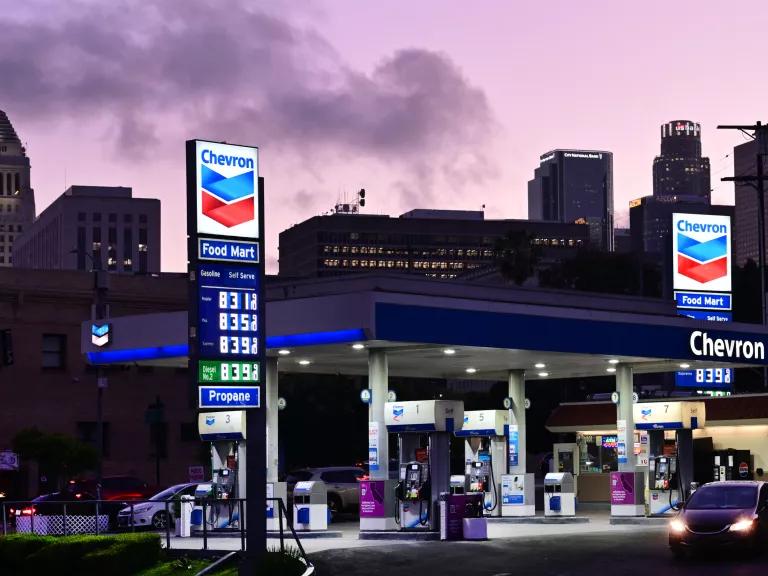
High gas prices seen at a Chevron gas station in Los Angeles, March 9, 2026, as pump costs surge amid the ongoing war with Iran
High gas prices and affordable EV models begin to change the landscape
Many recent EV models are considered luxury vehicles, with prices to match. The tax credit made those cars cost-competitive with some combustion engine cars, but there still isn’t parity in the domestic market, says Corey Cantor, research director for the Zero Emission Transportation Association. The result? New EVs became less accessible without the federal incentives. Most models are still $5,000 to $7,000 more expensive than an equivalent gas-powered car. (Up-front prices aside, a combination of factors—including the decreasing price of batteries and lower maintenance costs—often does give EVs the edge over gas car ownership.)
While some manufacturers, like Honda, announced they would not develop new EV models this year after all, others are charging forward with plans to make, sell, and support electric for the foreseeable future. Lucid and Rivian, for example, are pivoting to more affordable models. Chevy plans to reintroduce the Bolt, one of its most popular EVs. Nissan is doing the same with the Leaf.
“These lower-cost models are designed to resonate with the people who are looking for something more affordable,” says Gruber. But those price drops have been relatively modest; in February, according to Cox Automotive, the average price of a new electric vehicle was still more than $53,000. That represents a decrease of just 1.4 percent from last year.
Used EVs, on the other hand, are seeing a big dip in prices, with many models—purchased initially with the now expired tax credits—beginning to show up on sales lots. “You have these lower-cost vehicles hitting the market that were really satisfying, really good products when they were brand-new with still lots of life left in them, and they’re now more affordable,” says Gruber. More than half of these older models cost under $30,000, according to a recent report, and unsurprisingly, the market is booming: February sales were up by 28.8 percent, year-over-year.
The Iran war may also impact the market. The conflict is pushing gasoline prices higher—and fast. The average price of gasoline now tops $4 a gallon, but experts say it’s too early to see whether that’s affecting current buying habits. It usually takes several months before analysts see changes in a market due to higher costs from something like gasoline.
“We've seen historically that there is an increased inclination toward more fuel-efficient vehicles,” says Cantor. “EV interest goes up when gas prices are high enough,” he adds, especially over a sustained period of time.

A public EV charging station in Brooklyn, New York
Natiah Jones for NRDC
A growing charging network to alleviate range anxiety
EVs are indeed getting cheaper faster than anyone thought. Indeed, in China, the majority of new vehicles sold are electric in part because of their cost value compared to gas counterparts. But in the United States, price isn’t the only obstacle. An even more commonly cited barrier to adoption, as studies have found, stems from “range anxiety”—the idea that there aren’t enough places to recharge. And consumers will remain hesitant if access to charging is not improved.
“It's a very fast-moving market these days,” says Cantor. “What we like to do is really get back to the basics of what challenges we have to solve on EV adoption: the cost and convenience of charging.”
The nation’s charging network continues to grow despite the funding fits and starts at the federal level, bolstered by private investment from companies like Electrify America, EVgo, and Ionna, as well as Tesla and Rivian. A judge ruled in January that the federal government must unfreeze billions in National Electric Vehicle Infrastructure money that has already helped states develop charging stations all over the country. The case was brought by 17 states along with NRDC and other partners.
“I think that states are going to be really critical to help fill some of the gaps and rollbacks from the federal government,” says Kathy Harris, NRDC’s director of clean vehicles. “Once we can get states to continue building that momentum, it is going to help drive the market.”
New technology, perpetual appeal
The biggest positive indicator for the EV market may be that people just love driving them. For the last six years, JD Power has published an EV customer satisfaction survey. In its most recent survey, a whopping 96 percent of all EV owners said they plan to stick with electric cars into the future. That’s the highest the number has ever been.
“When people get into these vehicles, they’re just absolutely thrilled with them,” says Gruber. “They love the performance aspects, they love how quiet it is, they love not having to go to the gas station, being able to charge at home and have a full battery in the morning, and not having to go to the dealer for routine maintenance on a regular basis.”
EVs will only become more attractive as technology improves—which it’s doing all the time. For instance, EV batteries perform better than expected and are not as susceptible to cold weather as some people once feared. And as far as range anxiety goes, some models can now drive up to 500 miles on a single charge.
“I am optimistic that the industry and consumers will continue to see the importance of EVs, both for the environment and the ability of the country to compete on the global auto market,” says Harris. “We want to make sure that we’re transitioning as soon as possible toward cleaner, zero-emission vehicles, for all of the benefits they provide.”
This NRDC.org story is available for online republication by news media outlets or nonprofits under these conditions: The writer(s) must be credited with a byline; you must note prominently that the story was originally published by NRDC.org and link to the original; the story cannot be edited (beyond simple things such as grammar); you can’t resell the story in any form or grant republishing rights to other outlets; you can’t republish our material wholesale or automatically—you need to select stories individually; you can’t republish the photos or graphics on our site without specific permission; you should drop us a note to let us know when you’ve used one of our stories.
The High Price of Diesel Pollution
How EPA Rollbacks Will Cost Us—in Dollars and Lives
A Consumer Guide to the Inflation Reduction Act