
About NRDC
NRDC (the Natural Resources Defense Council) works to safeguard the earth, its people, its plants and animals, and the natural systems on which all life depends.
As an international environmental nonprofit organization, NRDC aims to address the world’s most urgent environmental challenges and advance innovative, science-based, and durable solutions. Supported by our more than three million members and activists, along with leading philanthropic foundations and individual donors, we focus our work around three ambitious and interconnected goals: confronting climate change, protecting public health, and defending nature while improving quality of life, especially in the most vulnerable communities.
Since our founding in 1970, NRDC has helped craft and deliver many of America’s bedrock environmental protections, including the Clean Air Act, Clean Water Act, and Safe Drinking Water Act. Today, we continue to play a central role in shaping and defending strong environmental protections at the local, state, federal, and international levels. Our team of more than 800 lawyers, policy experts, scientists, economists, and communications specialists work across the United States and around the world, from offices in Washington D.C., New York City, Chicago, San Francisco, and Santa Monica, as well as a representative office in Beijing and affiliate offices in New Delhi (through NRDC’s wholly owned for-profit subsidiary, NRDC India Private Limited) and London (through NRDC International).
History & Victories
On January 1, 1970, New York–based lawyer John H. Adams came together with other like-minded litigators to set up an organization they called the Natural Resources Defense Council. NRDC was the first national environmental advocacy group to focus on legal action, and we committed ourselves to protecting the environment for generations to come.
NRDC takes on the role of secretariat for a coalition seeking to create new, large-scale, fully protected high seas marine protected areas

NRDC President Manish Bapna speaking at a High Seas Treaty celebration event in New York City, September 23, 2025
After the ratification of a new global treaty, NRDC becomes the secretariat for a group of ambitious countries working together to create fully protected high seas marine protected areas. First conceived nearly two decades ago, to strengthen the protection and management of the high seas, the new treaty has now received the necessary signatures of 60 countries to become international law.
NRDC's attorneys get straight to work as the second Trump administration begins its attacks on the environment and public health

As soon as the second Trump administration took office in January, NRDC witnesses an immediate and unprecedented attack on our environment and public health. As we did during the first Trump administration, when NRDC sued 163 times—and came out victorious in nearly 90 percent of the cases resolved—our attorneys get straight to work. During the administration’s first year, we take the administration to court for everything from rollbacks to clean air and water protections to stopping the fast-tracking of fossil fuels to power data centers. At NRDC, we believe it is critical to keep track of the administration’s relentless efforts to undo decades of progress.
NRDC sees through the passage of the Inflation Reduction Act

Long Beach, California, has particularly high diesel truck volume driving throughout the city as trucks transport materials in and out of the Port of Los Angeles.
The Inflation Reduction Act is the most significant investment toward tackling climate change ever to come out of the U.S. Congress. Together with climate, labor, and environmental justice groups, we push for provisions that reduce emissions, invest in frontline communities, and put money back into the pockets of consumers. We also work with industry associations to improve elements of the bill and win over support, particularly in the clean energy and electric vehicle sectors. While the investments are later gutted by President Trump, the clean energy renaissance gains momentum.
NRDC helps negotiate the John D. Dingell Jr. Conservation, Management, and Recreation Act

This marks the largest designation of wilderness in 25 years and a bipartisan vote of confidence in the future of public lands and waters. The law safeguards more than 1.3 million acres of pristine natural habitat and nearly 620 miles of rivers across the United States. It also protects historic and culturally significant landmarks, like the home of civil rights activists Medgar and Myrlie Evers.
NRDC fights alongside the residents of Flint, Michigan

A worker putting in a new copper line to replace a galvanized lead service line at a home on Chevrolet Avenue in Flint, Michigan, April 24, 2018
The city's residents have been exposed to dangerously high levels of lead in their drinking water for years. After NRDC files a federal lawsuit, the city of Flint and Michigan state officials agree to replace the lead pipes that are contaminating the water supply and endangering public health.
NRDC helps block the Keystone XL tar sands pipeline

NRDC Chief Program Officer Susan Casey Lefkowitz (second from left) at a rally against the Keystone XL pipeline in Washington, D.C., January 24, 2017
This marks a milestone in a fight that includes years of tenacious protests, drawn-out legal battles, and flip-flopping executive orders spanning three presidential administrations. (It will be another five years, in 2021, until infrastructure company TC Energy officially abandons the pipeline, after being denied a key permit.) The dirty energy pipeline remains one of the foremost climate controversies of our time.
NRDC launches the India Initiative

The program is a series of projects that address India's unique public health, energy, and climate challenges. Alongside a network of local partners, NRDC improves climate resiliency for some of India’s most vulnerable communities by putting early-warning systems in place for extreme heat waves and installing cool roofs that reflect sunlight. We also help finance clean energy technology for remote villages and improve the energy efficiency of commercial building codes.
NRDC saves Mexico’s Laguna San Ignacio from a planned massive salt factory proposed by Mitsubishi Corporation

A gray whale surfacing in Laguna San Ignacio, Baja California Sur, Mexico
The lagoon off the coast of Baja California is the last unspoiled breeding ground of the gray whale. A World Heritage site, it is a part of the larger El Vizcaino Biosphere Reserve and a migratory bird refuge as well.
NRDC forces oil giant ARCO to stop—and pay for—water-polluting activities in Alaska

In response to our lawsuit, the company agrees to pay $1 million and to develop more responsible methods for disposal of its waste (a mix of toxic materials, from acids and pesticides to diesel fuel) that had been held in unlined pits. The settlement helps protect surrounding tundra wetlands and waterways on Alaska’s North Slope, adjacent to the Alaska National Wildlife Refuge.
NRDC pressures the federal government to pass the Oil Pollution Act

Cleanup workers steam blast rocks covered in oil following the Exxon Valdez disaster in Prince William Sound, Alaska, March 28, 1989
The landmark law, passed one year after the catastrophic Exxon Valdez spill, means offshore polluters have to clean up their own messes and restore damaged natural resources after spills. It’s a major milestone in our decades-long fight to defend the United States’ outer continental shelf from offshore drilling.
NRDC helps heal the ozone layer

A visualization of the ozone hole over Antarctica on October 7, 1987
Thanks to our litigation, research, and pressure, 46 countries sign the 1987 Montreal Protocol, a global agreement to phase out the industrial use of ozone-depleting chemicals and close up the gaping ozone hole growing over Antarctica. (Today, that pact includes every country in the world.)
NRDC scores its first victory toward reducing the nuclear threat

Double-shell waste storage tanks under construction in an underground tank farm at Hanford Nuclear Reservation, part of the Manhattan Project located beside the Columbia River, Washington
For decades, toxic and radioactive waste from nuclear weapons facilities has contaminated thousands of sites across the country, as the facilities evaded environmental oversight. This all changes when NRDC wins litigation that requires them to abide by the same environmental laws as everyone else, triggering a massive cleanup effort.
NRDC helps pass a set of amendments tackling dangerous loopholes in the Clean Air Act

Emissions rising from a chemical plant near a residential neighborhood in South Charleston, West Virginia, July 1973
Companies must now install state-of-the-art technology to limit pollution when they build or make changes to coal-fired power plants and other facilities. States are now also required to establish programs to reduce emissions from power plants.
NRDC helps pass the landmark Clean Water Act

The Clean Water Act will soon keep 700 billion pounds of toxic pollutants—like ash from coal-fired power plants and chemicals from manufacturing—out of waterways each year. The law also makes it possible for citizens to sue polluters directly, even if they’re not impacted by the pollution themselves. Currently, the Clean Water Act is under threat.
Learn more about some of our major achievements, among the hundreds of victories we’ve achieved to make good on that founding goal.
“We are in the fight of our lives. If we fail, the consequences will be like nothing human civilization has ever seen. But NRDC has the arsenal we need to win this fight. We combine rigorous science, policy advocacy, and legal expertise with millions of supporters providing political and lobbying muscle. And this place is full of energy.”
Manish Bapna, NRDC president & CEO
How we work

Advocacy
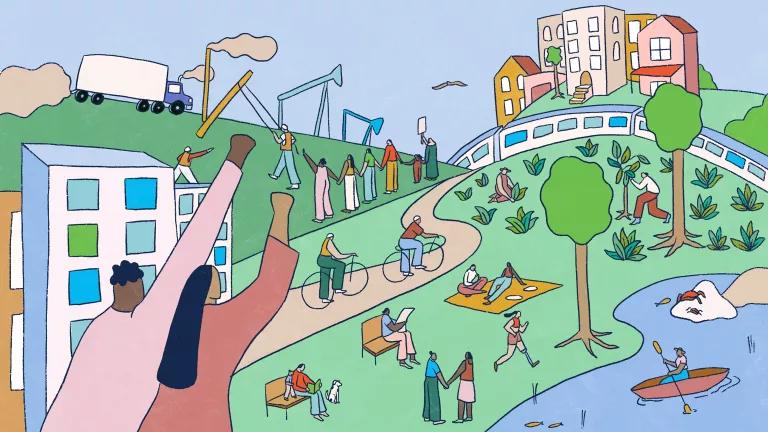
From mayors’ offices to Congress to international negotiating tables, we work at every level to persuade decision makers to adopt solutions for lasting environmental change. We mobilize strategic coalitions and the grassroots power of millions of activists to urge elected officials to put the public interest ahead of polluting industries.
Equity Partnerships
We are pursuing an integrated approach to addressing persistent and connected threats of environmental inequality, racial injustice, and socioeconomic insecurity. We work with frontline groups to advance community-driven solutions, to help build power in communities most harmed by inequities, and to push for long-lasting change.
Entertainment Partnerships
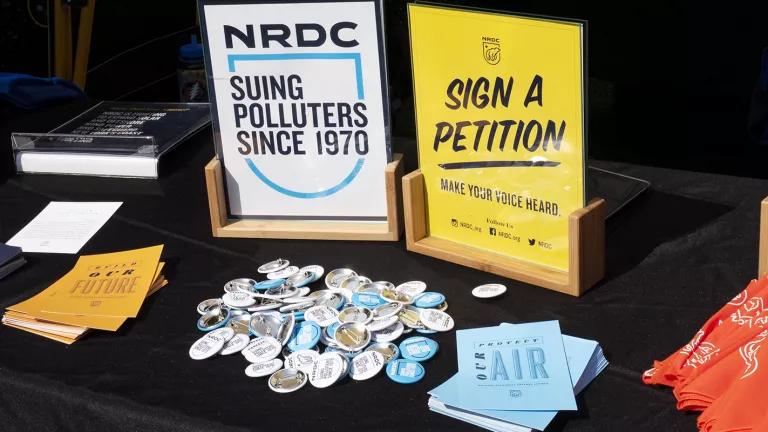
We aim to increase awareness and advocacy for our priority environmental issues by partnering with a wide range of media, brands, celebrities, musical and cultural festivals, art institutions, and social media platforms.
Global Collaborations
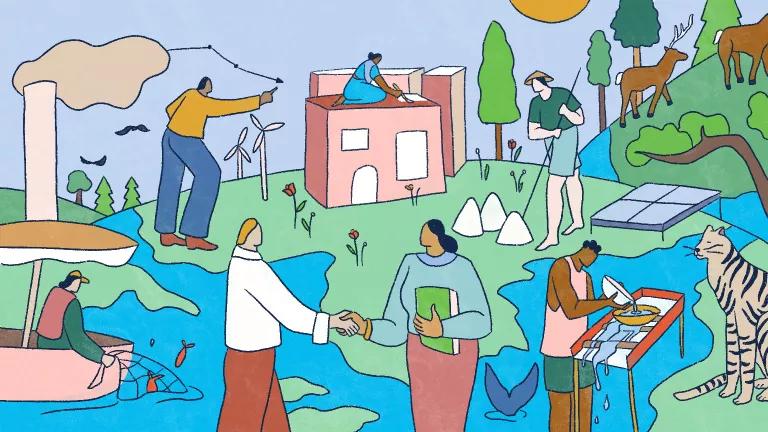
We have worked internationally for decades in select countries as well as global forums. We use scientific, economic, and policy expertise to spearhead crucial environmental breakthroughs around the world.
Litigation
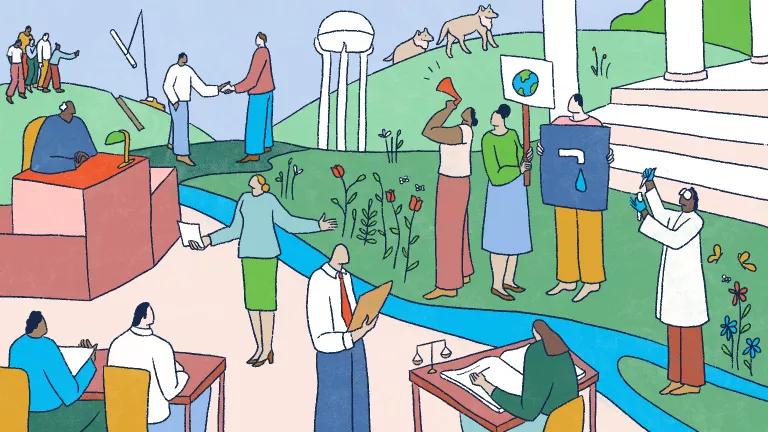
We litigate across a broad range of environmental and public health issues, often working closely with NRDC’s subject-matter experts. Our attorneys may also represent other nonprofit organizations, community groups, and individuals.
Science
Our Science Office bridges the gap between science and the people, wildlife, and ecosystems it serves. We aim to harness science as a tool to support a greater environmental movement that centers communities most harmed by environmental and climate impacts.
Financials & annual reports
NRDC (Natural Resources Defense Council) is a 501(c)3 nonprofit, incorporated under the laws of the State of New York in 1970. The top watchdog groups for charitable organizations annually recognize our commitment to transparency and efficiency, with a four-star rating on Charity Navigator and an A- grade on Charity Watch.
IRS FORM 990 FY25 FINANCIAL STATEMENT
2025 Financial Snapshot
2024 Financial Snapshot
For nearly 40 years, NRDC has relied on a robust direct-mail program to recruit and maintain the large Membership that gives us standing in court to bring legal action in defense of our environment. We communicate by postal mail—and other channels—not only to generate income but also to mobilize the public in direct-action campaigns that have produced millions of petitions to corporations and government agencies, thereby advancing our environmental mission. As a result, in accordance with the Financial Accounting Standards Board (FASB) guidelines, NRDC allocates a portion of our direct-mail costs to program services and to fund-raising.
Check out NRDC's past annual reports.
Sustainability
NRDC is committed to leading the green-building industry through action. We leverage widely respected sustainable building standards to ensure we are at the cutting edge of sustainable building practices across our global operations. These standards drive progress toward our visions. In all of our offices, we strive to reduce resource consumption and increase resource production. Since 2012, we have achieved:
Affiliates
- E2: We partner with this national, nonpartisan group that advocates for policies that are good for the economy and the environment.
- NRDC Action Fund: The Action Fund is the 501(c)(4) affiliate of NRDC whose mission is to build political support in the United States for protecting the planet and its people.