The Fight to Keep Oil and Gas Rigs Out of Our Waters. For Good.
NRDC played a key role in banning offshore drilling in the Arctic and Atlantic. Once again, it’s fighting to protect those oceans—and the rest of America’s waters.

Shell’s Arctic oil drilling rig in Elliott Bay, May 2015
Getty Images
In January 1969, an oil spill from an offshore drilling platform off California’s Santa Barbara County coast spewed an estimated three million gallons of crude, swiftly turning a 35-mile stretch of idyllic Pacific shoreline into a devastating oil slick. The oil killed thousands of seabirds, poisoned seals and dolphins, and destroyed delicate marine habitats.
It was an unprecedented event in American history. Yet ensuing decades would see offshore oil spills even bigger in scale. Oil still lingers today from the 1989 Exxon Valdez tanker spill in the waters of Alaska’s Prince William Sound, and impacts from the BP Deepwater Horizon offshore drilling disaster in 2010 topped both incidents, killing 11 workers and spreading millions of gallons of oil throughout the Gulf of Mexico.
These catastrophes garner big headlines—and for good reason: Dramatic in the short term, oil spills spell long-term devastation for coastal communities, ecosystems, and economies. But these disasters are only one way in which offshore drilling wreaks havoc. The oil and gas industry’s routine business practices imperil marine wildlife with deafening seismic airgun blasts, destroy habitats, emit toxic by-products and high levels of greenhouse gases, and lead to tens of thousands of smaller, less visible spills in U.S. waters annually.

A heavily oiled Kemp's Ridley turtle recovered near Deepwater Horizon spill site
Carolyn Cole/NOAA
“More offshore drilling is not worth the risks it poses to marine and coastal ecosystems, as well as the people who rely on those ecosystems,” says NRDC fossil fuels policy advocate Zanagee Artis. And as lawmakers consider whether—or in some cases, how fast—to auction off more of our ocean to drilling, they must keep in mind a basic truth, Artis adds: “Every offshore oil spill began with a lease sale.”
There remains no easy fix for these spills. Even the most advanced cleanup efforts remove only a fraction of the oil and use hazardous technologies. And scientists are still evaluating the health impacts of the oil dispersants used in these cleanups—a particular subject of concern among communities of the Gulf.
One step forward, two steps back: Trump’s return to office
To that end, NRDC has fought to defend the United States’ outer continental shelf from offshore drilling since the organization’s founding in 1970. Our most recent win was in January 2025, when our policy experts, attorneys, and marine scientists, together with our partners, helped secure a major victory as President Biden issued a ban on new oil and gas leasing in federal waters off the Atlantic coast; the Pacific coast of California, Oregon, and Washington; the eastern Gulf of Mexico; and an area in Alaska’s Bering Sea.
NRDC had successfully worked during the Obama administration to secure similar protections for smaller, yet no less vital, areas of the Atlantic and Arctic oceans from new oil and gas leasing. When President Trump attempted to reverse these protections during his first term, NRDC and our partners took him to court—and won. In 2019, the federal district court in Alaska held that the Trump administration lacked the legal authority to reverse the permanent protections from offshore oil and gas leasing put in place by President Obama in 2016. President Biden later reinstated the Obama-era protections in the Atlantic and Arctic oceans and protected another part of the Beaufort Sea in the Arctic in 2023.
Upon being sworn into office for his second term, President Trump wasted no time in returning to his old playbook. Just two weeks after Biden issued the new ocean protections from oil and gas leasing, Trump attempted to reverse all of them. One of his many January 20 executive orders moves to put more than 625 million acres of ocean waters in the Atlantic, Pacific, eastern Gulf of Mexico, and Alaska’s Beaufort, Bering, and Chukchi seas back on the drilling map.
Not only did President Trump attempt to reverse Biden’s protections, but he once again reversed President Obama’s protections for the Atlantic and Arctic—even though a court already decided that this action was illegal. NRDC wasted no time in fighting back.
On February 19, 2025, together with our partners at Earthjustice and a coalition of other environmental organizations, we filed a lawsuit in the District of Alaska court challenging Trump’s illegal order.
“Trump’s executive orders to repeal permanent protections for these places break federal law,“ says Irene Gutierrez, a senior attorney for NRDC’s Nature program. “NRDC will continue its fight to ensure that safeguards are kept in place.”
Our commitment to that mission hasn’t wavered despite the ongoing attacks on our ocean. In November 2025, the Trump administration put forth a proposal that would offer 34 new lease sales between 2026 and 2031 off the coasts of California and Alaska, as well as in the Gulf of Mexico. The proposal would open up untouched waters of Alaska to drilling, attempt to resurrect the offshore oil and gas industry in California, and offer up waters off the coast of Florida that haven’t been put up for leasing in decades—in addition to adding even more leasing in the Gulf of Mexico.
The same month, NRDC and several environmental groups filed a lawsuit against the Trump administration to stop the auctioning off of 80 million acres of the Gulf of Mexico to the fossil fuel industry. The plaintiffs note that in finalizing the sale, slated for December, the Bureau of Ocean Energy Management violated the National Environmental Policy Act by failing to complete an environmental review, putting coastal communities, endangered wildlife such as the Rice’s whale, and the gulf itself at risk.
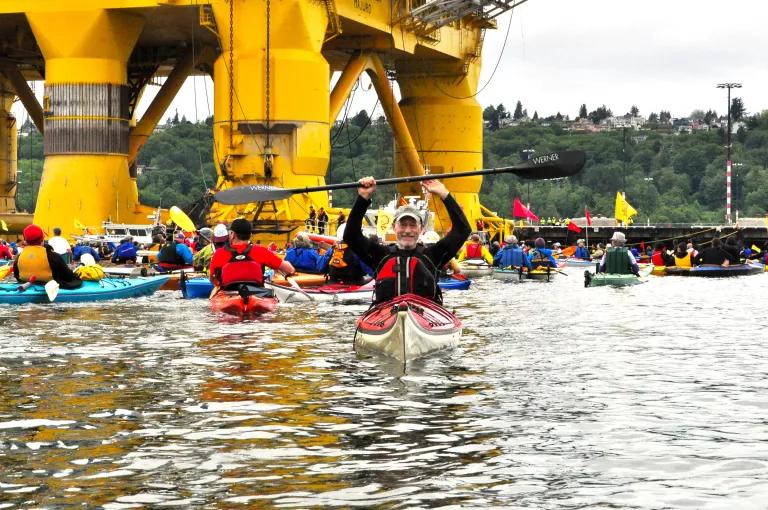
Niel Lawrence, a senior attorney and Alaska director at the time of this photo, joined kayaktivists against an Arctic-bound oil rig.
Courtesy Niel Lawrence
"Our coast is not for sale"
The need to intervene on behalf of both our climate and our oceans has grown increasingly urgent. And on the other side of that battle, the oil and gas industry has used its immense lobbying powers to open and expose new areas to drilling. In the decades since the Deepwater Horizon disaster, NRDC advocates have fought the industry on multiple fronts: contesting lease sales in Alaska’s Cook Inlet and along the South’s Gulf coast and challenging a faulty offshore oil and gas leasing plan.
“Communities don’t want to make the same mistake again, anticipating another oil disaster,” says Alexandra Adams, NRDC’s chief policy advocacy officer. Like most of the world, Adams, who grew up in southern Florida near the Atlantic, was horrified to see how the Deepwater Horizon oil spill—and its aftermath—played out. “We watched it have a direct, immediate impact on communities, livelihoods, and economies that depend on fishing, tourism, and recreation,” she recalls. “It still has an impact. After a disaster like that, people couldn’t believe we’d expose ourselves to that kind of risk again.”
What’s more, there is increased public awareness about climate change and the climate consequences of drilling, as well as greater interest in clean energy solutions for meeting domestic power and economic needs.
But the political muscle of the oil industry is undeniable. Back in 2015, a draft proposal for the Obama administration’s 2017–2022 lease plan moved to open a vast stretch of federal waters along the Atlantic coast. And in a particularly brutal blow that same year, Obama even gave Shell the go-ahead to drill in Alaska’s pristine Chukchi Sea, despite the energy giant’s history of pollution violations in Arctic waters.
The proposal to open these areas was met with massive public backlash. Up and down the Atlantic coast, local, state, and federally elected officials, communities, businesses, tourism associations, fishing groups, scientists, and conservation organizations stood up and said, “Our coast is not for sale.” Thousands of resolutions and letters opposing offshore drilling and seismic testing were submitted.
Meanwhile, NRDC engaged in direct advocacy with lawmakers, worked to debunk flawed data posited by pro-polluter lobbyists, rallied a range of allies to the cause, and focused on public outreach, aiming to ensure that the voice of every concerned citizen and community was heard.
NRDC also joined a coalition lawsuit challenging Shell’s risky and reckless drilling plan, co-litigated against seismic exploration in the Arctic with Earthjustice, and partnered with legislators on bills to cut off the oil industry from the Arctic and all federal waters more generally. And we demonstrated that any Arctic spill would have wide-reaching impacts on the entire region and that drilling infrastructure projects carried serious climate consequences.
These efforts paid off with the offshore leasing bans in the Atlantic and Arctic oceans issued by the Obama administration in December 2016 and, later, the larger offshore leasing bans issued by the Biden administration. And while the victory has proven tenuous, the ocean advocates standing up against the Trump administration’s determination to pillage these—and so many other—environmental protections are speaking on behalf of a broad swath of the country.
In 2023, NRDC members and activists helped submit more than 900,000 public comments demanding our lawmakers offer no new leases in the Biden administration’s offshore leasing plan. The sentiment was echoed in a letter sent to the Biden administration signed by more than 200 businesses and organizations. Loosening the grip of the oil and gas industry on our natural resources is also a priority for the vast majority of Americans, 66 percent of whom say they want to see our government take more climate action.
While President Trump has promised to “drill, baby, drill,” recognition is growing that we don’t need more oil, given the United States’ standing as the world’s leading producer of oil and gas and a leading exporter. The administration’s latest proposal is especially egregious because there is no need for a new offshore oil and gas leasing program right now. The current program, developed under the Biden administration, goes through 2029.
The proposal also remains out of sync with public opinion. During a comment period held last spring, when the administration was starting to prepare the plan for potential leasing in all federal waters, members of the public, advocacy groups, and many others weighed in to express their opposition.
“People are understanding that a fossil fuel economy does not have to be our reality,” says Artis. “And it is up to us to protect our coasts, our climate, and our futures because the fossil fuel industry and its political allies certainly won’t.”
This story was originally published on October 3, 2017, and was last updated with new information and links on November 24, 2025.
This NRDC.org story is available for online republication by news media outlets or nonprofits under these conditions: The writer(s) must be credited with a byline; you must note prominently that the story was originally published by NRDC.org and link to the original; the story cannot be edited (beyond simple things such as grammar); you can’t resell the story in any form or grant republishing rights to other outlets; you can’t republish our material wholesale or automatically—you need to select stories individually; you can’t republish the photos or graphics on our site without specific permission; you should drop us a note to let us know when you’ve used one of our stories.
The DOI is proposing to expand oil and gas drilling across ONE BILLION+ acres of U.S. waters.
This will threaten marine life, generate toxic air pollution, and put coastal communities and economies at risk of oil spills. Submit your comment saying no!

Say no to the Trump administration’s plan to open up our waters to oil and gas drilling!
The Interior Department is proposing to expand oil and gas drilling across more than ONE BILLION acres of U.S. waters. This will threaten endangered whales, generate toxic air pollution, and put coastal communities and economies at risk of oil spills and other drilling impacts. Submit your public comment now opposing this proposal.
Americans Red and Blue Unite Against Trump's Plan to Drill the Atlantic
We Are Here to Make a Difference: Our Litigators Are at the Ready
As Trump Moves to Expand Offshore Drilling, He Proposes Shrinking Safety Protections. What Could Go Wrong?