
Offshore Drilling 101
A look into how drilling for oil and gas in the oceans works—and why it’s time to make it history.
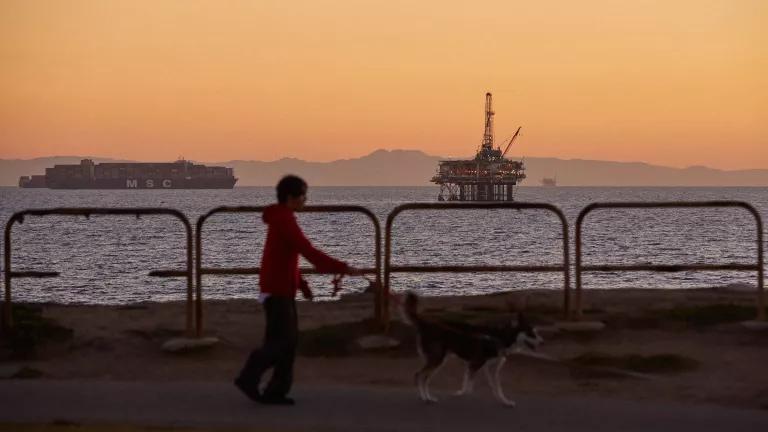
Huntington Beach, California
Wray Sinclair

Offshore drilling is risky business. It can have devastating impacts on oceans and coastal communities. It’s also expensive. But fossil fuel companies are willing to pay the price to access the potentially large reserves under the seafloor.
Although the United States is moving toward a clean energy future, large swaths of our federal waters remain for sale. Until we stop sacrificing public waters to fossil fuels, we’ll continue to see disastrous oil spills, exploratory activity that harms wildlife, and the acceleration of our climate crisis.
Here’s what you need to know about offshore drilling—and why new oil and gas leases are the last thing we need.
What is offshore drilling?
Simply put, offshore drilling is the process of drilling into the ocean floor to access pockets of oil and gas that lie underneath. About 14.6 percent of crude oil and 2.3 percent of gas in the United States were produced from offshore drilling in 2022. There are several stages to the whole process, and because of the challenging environment in the ocean, one site can take several years to build and hundreds of millions of dollars to complete.
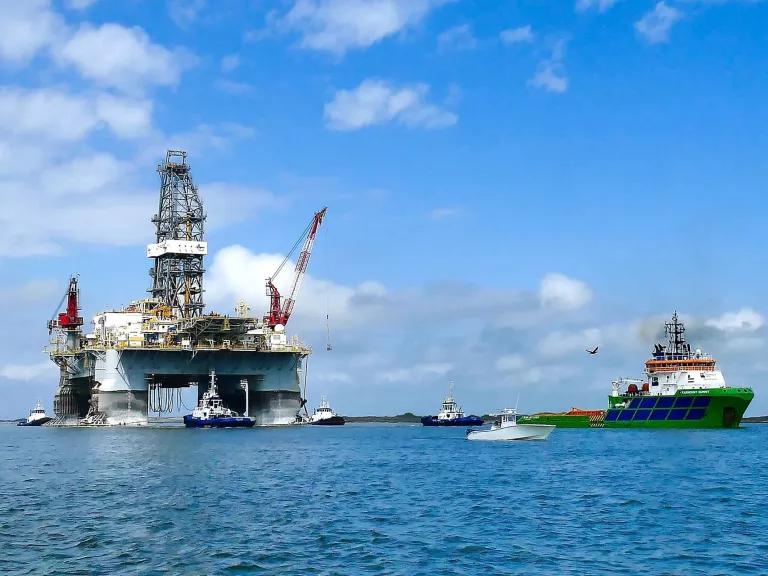
An offshore oil drilling platform being towed through Port Aransas, Texas, to the Gulf of Mexico, on March 5, 2017
Pond5
Leasing
In the United States, ocean and coastal waters belong to the public. As a result, before any other action occurs, fossil fuel companies must lease parcels of the ocean from the government. After making a purchase at a lease sale, the company (or lessee) then has the ability to explore the deposits under the ocean floor. Some companies will hold onto their lease for years before exploring or developing the area, waiting for the most lucrative time to drill and gain access to the infrastructure they need.
The Biden administration scheduled three major lease sales in the Gulf of Mexico between 2024 and 2029, which represented a record-low. But after Donald Trump was sworn into office for his second term, his administration announced an intention to dramatically expand offshore oil and gas leasing, consistent with the president’s Unleashing American Energy executive order and pro–fossil fuel policies. More on what we can expect next, below.
Exploration
After leasing an area of the ocean, fossil fuel companies launch operations to find the oil and gas pockets, or reserves, within the given waters. Seismic testing, one of the most common ways they hunt for these reserves, involves blasting an array of airguns, which are towed behind ships across large swaths of the ocean. Think of how a bat uses echolocation to find its prey, except imagine the bat is using an air horn. The airguns blast loud booms into the water every 10 seconds, and the returning echoes provide an outline of what lies underneath the seafloor.
Drilling and extraction
Once oil or gas is found, fossil fuel companies use mobile offshore drilling units (MODUs) to dig a well. There are different types of MODUs, often referred to as oil rigs or oil platforms, depending on the depth of the site, typical weather conditions, and other factors. Some are fixed to the seafloor with cables, concrete, and anchors while others float at the surface. These platforms can store equipment above the water, and some even provide dorms for the rig workers, who arrive at the site by helicopter. The first offshore oil well was built in 1897, and early developments took place in waters less than 300 feet deep, while wells today are built as far as 2 miles down.
Production
Once a well is up and running, the oil or gas is pulled from the wells to production platforms (either part of the same MODU or a separate one) to be stored and processed and then transported to the coast via pipelines for distribution.
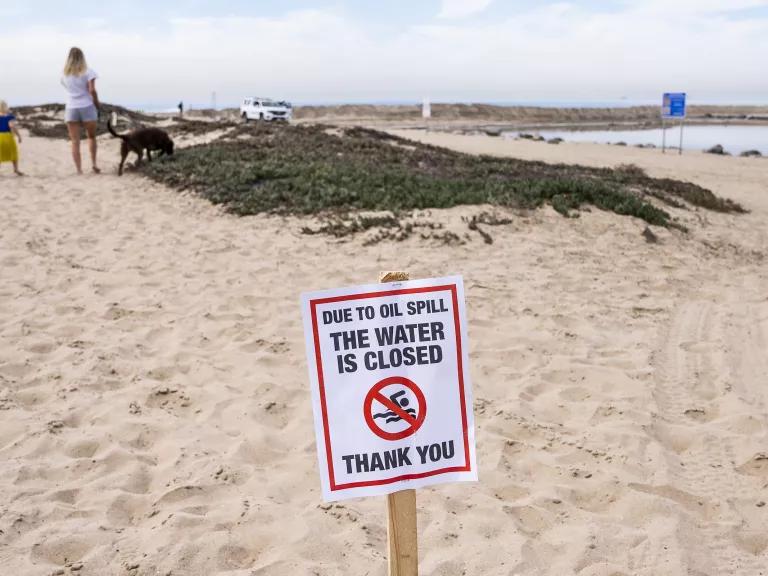
Newport Beach, California, on October 4, 2021
Getty Images
How is offshore drilling regulated?
The political borders of the United States actually extend 200 miles into the ocean in what’s referred to as the exclusive economic zone. In most states, waters that are 3 nautical miles (1 nautical mile = 1.15 regular land miles) out from the shoreline are under state jurisdiction. This means state governments can largely do as they please with their bit of shoreline: expand ports, protect areas for conservation, and yes, even sell leases to fossil fuel companies just off the beach. Past that 3-nautical-mile marker is the outer continental shelf (OCS), which falls under federal jurisdiction.
Under the Outer Continental Shelf Lands Act (OCSLA), passed in 1953, the U.S. Department of the Interior regulates exploration and development on the OCS, which it manages through a subagency, the Bureau of Ocean Energy Management (BOEM). This includes developing plans for oil and gas leasing every five years and determining which areas of our ocean waters are for sale. This is known as the National Outer Continental Shelf Offshore Oil and Gas Leasing Program, or the five-year program, for short. Typically, plans have included 10 sales—but BOEM has the ability to issue a plan with none. It can also include dozens, as it did under the first Trump administration, scheduling 47 lease sales in just five years. The current administration now appears intent on ramping this activity back up, and is seeking to offer 34 new lease sales between 2026 and 2031.
Before any lease sale can be held, BOEM must first publish a proposed five-year program, along with an environmental impact statement—taking into consideration the effect of leasing on the environment and communities—and then host a comment period for any member of the public to speak for or against the proposal. The agency must also invite and consider comments from the governors of coastal states that would be affected.
There have been many changes since the passage of the OCSLA, including significant environmental protections passed after the Santa Barbara, California, oil spill in 1969, one of the worst oil spills in U.S. waters. The tragedy partly inspired the first Earth Day in 1970 and spurred legislative action to try to prevent future spills—like the National Environmental Policy Act, which requires federal agencies to develop detailed environmental reviews before any major projects or policies are undertaken. The Interior Department is also responsible for maintaining safety standards to protect both workers and the environment.
Unfortunately, devastating oil spills continue to happen. Yet fossil fuel companies and their political allies want to see more lease sales—and fewer safety regulations.
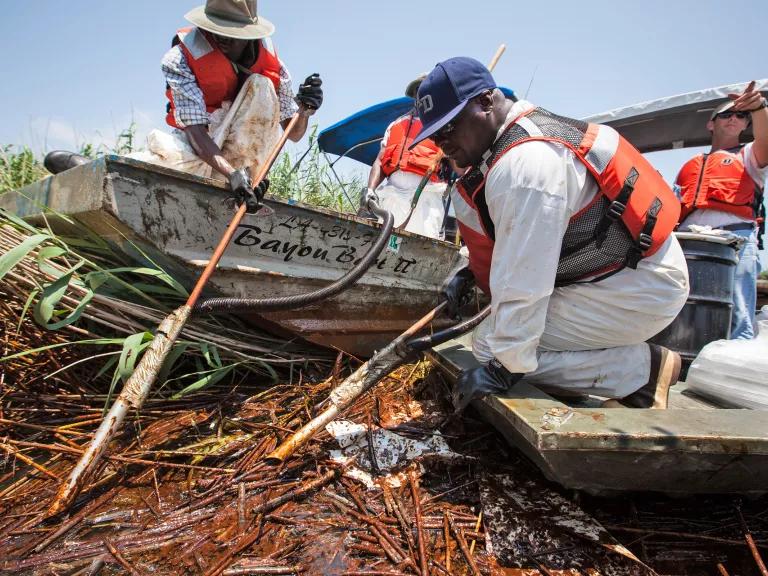
Members of Plaquemines Parish Inland Waterway Strike Force clean up oil on the water’s surface in the Jackass Bay of Plaquemines Parish, Louisiana, on July 10, 2010.
Julie Dermansky
Where is offshore drilling performed in the United States?
Alaska
Offshore oil and gas development in Alaska has long been contested—with lawmakers, oil and gas operators, Native peoples, fishermen, and environmental groups warring over how to balance development of offshore resources against protection of pristine habitats and profitable fisheries.
Some recent executive and regulatory actions have limited the areas offered for leasing in these waters. In 2016, President Barack Obama permanently withdrew portions of the Arctic Ocean (as well as the Atlantic Ocean) from new leasing. When President Trump later tried to reverse this ruling, NRDC and partners successfully challenged his action in court. President Biden reinstated protections for portions of the Arctic Ocean (in addition to withdrawing huge areas of the Atlantic, Pacific, and Eastern Gulf of Mexico from leasing). At the beginning of his second term, President Trump again purported to reverse all of President Obama’s and President Biden’s protections. NRDC and partners are again back in court to defend our waters from offshore drilling, with two lawsuits filed in February 2025.
BOEM’s 2024–2029 lease sale schedule did not include any areas for lease near Alaska. Yet the Trump administration is now gearing up to replace that five-year program with one that, among many other targets, opens up untouched waters of Alaska and the Arctic to drilling.
Gulf of Mexico
The vast majority of federal offshore oil and gas wells are in the Gulf of Mexico, accounting for 97 percent of all oil and gas production in the OCS. (An area off the coast of Florida, as well as the coasts of Georgia and South Carolina, is exempt from development, where a moratorium on offshore drilling stands until at least the end of 2032.)
The Gulf of Mexico remains a focal point for continued oil and gas development, despite the risks to local communities and the Gulf ecosystem. The Inflation Reduction Act mandated that several previously canceled lease sales be held (Lease Sales 257, 259, and 261) and BOEM’s five-year program for 2024–2029 includes three more sales scheduled in 2025, 2027, and 2029. The Trump administration’s current proposed plan would add even more leasing in the Gulf of Mexico and open waters off the coast of Florida that haven’t been put up for leasing in decades.
Pacific Coast
Developers have been tapping oil and gas resources off California’s coast since the late 1800s and increased their efforts in the 1960s. However, the Santa Barbara oil spill catalyzed both environmental activism and opposition to development off the California coast. Spurred by public advocacy, moratoriums on new federal leasing off the Pacific Coast stood from 1984 until 2008, when the last moratorium order was rescinded by President George W. Bush. While some older oil and gas operations continue, there haven’t been any new lease sales since. The Trump administration is now attempting to resurrect the offshore oil and gas industry in California.
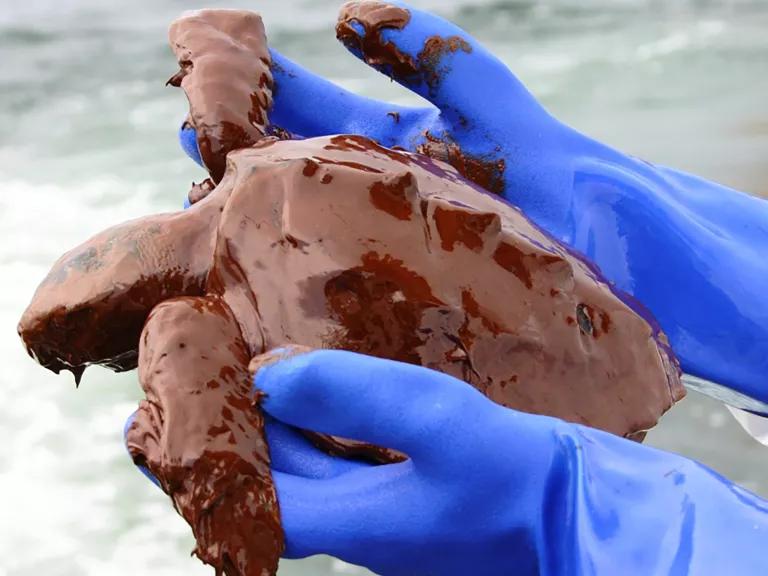
A juvenile Kemp's ridley sea turtle, heavily oiled from the BP disaster along the Louisiana coast in June 2010
Blair Witherington/Florida Fish & Wildlife Conservation Commission (FWC), CC BY-ND 4.0
What are the environmental impacts of offshore drilling?
Seismic blasting
Every stage of offshore drilling comes with harmful impacts. Let’s start with the seismic testing that fossil fuel companies use to find reserves. These blasts are the absolute loudest man-made sounds in the ocean—above 250 decibels—and can echo for miles in the water. (For reference, an ambulance siren is around 160 decibels.) A complaint filed by NRDC and partners details how dolphins, whales, and other marine animals that rely on sound—for communication, navigation, hunting, and finding mates—are harmed by the constant noise. The explosive sounds go off every few seconds and can even be lethal at a close range.
Oil spills and gas leaks
From the moment an oil or gas company starts drilling, there is a risk of leaks. Yet despite the frequency and scale of oil spills, the industry has not done nearly enough to lower the chance of future spills. These events wreak havoc on wildlife and coastal communities, and a big enough spill can change the entire ecosystem. And while we can plug a leak (usually), it is nearly impossible to collect all the escaped oil—tons of oil from previous spills remain in the depths of the ocean. And of course, it would be impossible to recapture the harmful gases that escape from wells and pipes.
There have been a number of news-making disasters in recent U.S. history (and so many more under the radar):
- The 2024 Huntington Beach spill spewed more than 126,000 gallons of crude oil into California waters, closing local beaches and tarring and killing birds, fish, and other marine life, while inundating sensitive wetlands and threatening ecosystems. The damages are likely to last for decades.
- In November 2023, a crude oil spill named the “MPOG11015 incident” was reported by the U.S. Coast Guard, southeast of New Orleans. Early response teams put the estimate at 1.1 million gallons.
- In 2021, a leaking gas pipeline sparked a swirling fire in the Gulf, which was dubbed the “eye of fire.” It took Pemex, which owned and operated the platform, five hours to extinguish.
- The same year, an underwater oil pipeline released at least 25,000 gallons of crude off the coast of Huntington Beach, California (aka “Surf City USA”)—prompting a two-month fishing ban that included 650 square miles of marine waters and 45 miles of shoreline. An anchor from one of the area’s many cargo ships is suspected to have ruptured the pipeline.
- In two instances in 2015 and 2018 at a Fieldwood Energy facility in Louisiana, two workers intentionally allowed oil to spill in order to avoid required shutdowns that would have hurt company profits. Workers on one of the company’s platforms are reported to have joked that their motto was “safe and sound until production’s down.”
- An explosion at the Deepwater Horizon drilling platform in 2010 (commonly known as the BP disaster) set off the biggest offshore spill in American history. The accident, which killed 11 people, is attributed to engineering failures and human error. The environmental impacts of 210 million gallons of oil spewing into the Gulf of Mexico were tremendous, including one million dead seabirds, the loss of about 17 percent of the Rice’s whale population, and more than 92,500 square miles of contaminated ocean water.
- In 2005, Hurricane Katrina, followed shortly by Hurricane Rita, set off a series of oil spills that largely went under-reported as recovery efforts focused on the devastation to communities on land. By some estimates, the back-to-back Category 5 hurricanes damaged more than 450 pipelines and 100 drilling platforms in the Gulf.
- Representing the longest-running oil spill in U.S. history, undersea wells owned by Taylor Energy have been leaking into the Gulf of Mexico ever since they were damaged by Hurricane Ivan in 2004.
In 1989, the Exxon Valdez oil tanker collided with a reef, spilling 11 million gallons of oil into the waters off Alaska. Considered the worst spill in U.S. waters until the BP disaster occurred, it killed an estimated 250,000 seabirds, 2,800 otters, and 250 eagles.
Abandoned and orphaned wells
Once an operator shuts down a well—usually because it is no longer profitable—the company is required to remove its equipment and help restore the area that was damaged by its operations. But in reality, this doesn’t always happen. Many abandoned wells (idle wells with a known owner) and orphaned wells (wells with no responsible owner to be found) remain uncapped and leak oil, methane, and other pollutants into our oceans and atmosphere every day. Researchers estimate that properly plugging the 28,232 permanently abandoned wells in our federal waters, along with the ones currently in use, would cost around $47 billion. That doesn’t even take into account orphaned and abandoned wells in state waters.
Greenhouse gas emissions
The burning of fossil fuels—whether that fuel comes from beneath the ocean, a hillside, or your community—is driving the climate crisis. We know this. And we know that our continued reliance on oil and gas for electricity, transportation, plastic manufacturing and incineration, and other industrial processes means more greenhouse gases will be pumped into our atmosphere. Some studies have shown that methane emissions from offshore oil and gas operations are even greater than those on land.
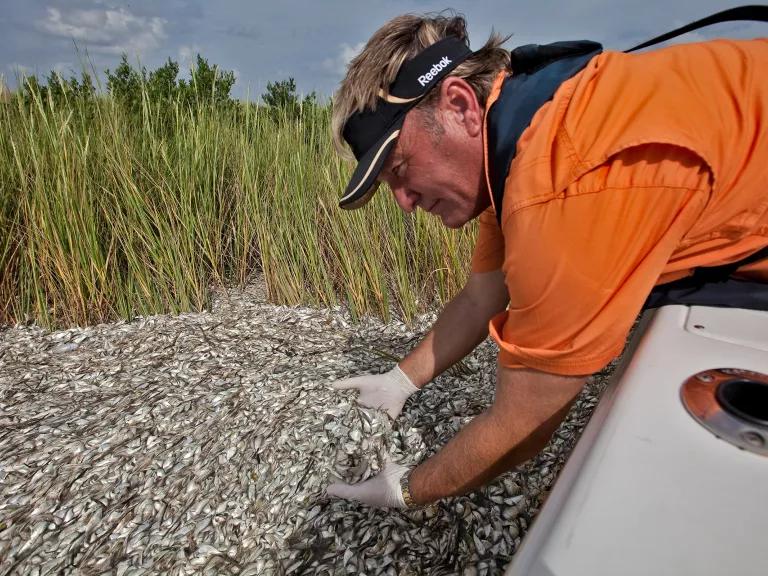
P.J. Hahn, then director of the Coastal Zone Management of Plaquemines Parish, collects samples from a fish kill so tests can be done to see if it was a result of the BP disaster in 2010.
Julie Dermansky
What are the economic impacts of offshore drilling?
Costs of oil spills and gas leaks
Oil spills and gas leaks hurt fishing operations, the tourism industry, and other coastal businesses. In the year after the BP disaster in the Gulf of Mexico, for instance, the region’s commercial fishing industry reported a $62 million loss in dockside sales and the tourism industry filed $1.5 billion in lost earning claims. In all, more than 174,000 claims were paid to individuals and businesses that suffered damages and costs related to the spill that year.
Costs of health impacts
According to a study in Environmental Research, the impacts of the fossil fuel industry on air quality alone cost the United States approximately $77 billion annually—and contribute to hundreds of thousands of early deaths. Respiratory issues, cardiovascular problems, and other serious illnesses are found not only in workers at offshore oil and gas facilities but among nearby residents. Because of a legacy of environmental racism and economic injustice in the siting of these facilities, the communities harmed by these toxic emissions are disproportionately low-income people and people of color.
BOEM’s program has routinely ignored the environmental justice impacts of leasing on Gulf Coast communities and its current calculation fails to account for increased risks for cancer and cardiovascular and respiratory conditions, as well as the increased risk of air and groundwater contamination in communities surrounding refineries.
Costs of climate change
In 2023, top oil companies Chevron, Exxon, and Shell continued their streak of high annual profits, netting a combined $76.6 billion. Contrast those profits with data from the National Oceanic and Atmospheric Administration that shows that extreme weather disasters cost the United States nearly $93 billion that same year. This price tag—which includes damaged property, crops, and infrastructure but doesn’t account for health harms—is likely an underestimate. Extreme weather and other effects of climate change (which, again, is driven by the burning of fossil fuels) are expected to intensify in the coming decades.
A report published by NRDC and partners found that U.S. residents collectively pay about $820 billion in physical and mental health damages from climate change–related events every single year. These include emergency conditions like heat stress, increased exposure to air pollution and wildfire smoke, and outbreaks of infectious diseases. And if we’re going to successfully adapt to the changing climate, we need to spend billions of dollars to build resilient infrastructure.
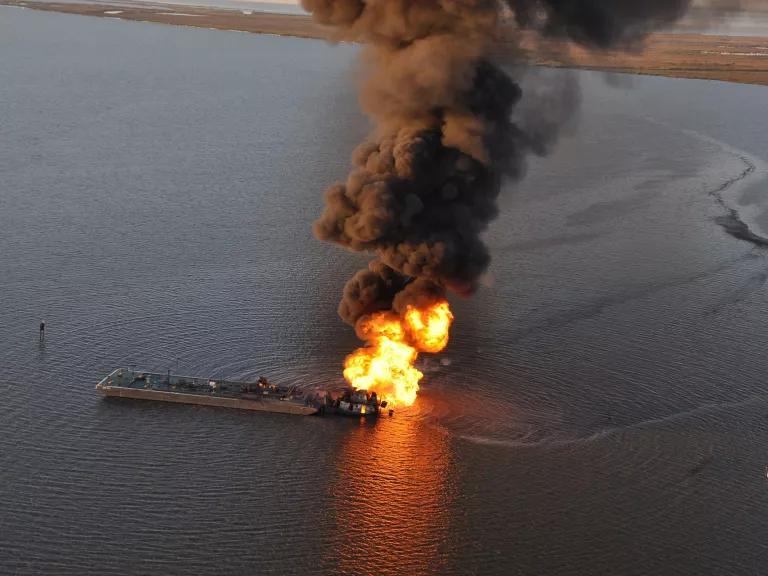
Flames rise from a burning oil pipeline near Bayou Perot, about 22 miles south of New Orleans, after a tug boat collided with the well head on March 13, 2013.
U.S. Coast Guard
Why are new oil and gas leases a bad idea?
Even when electricity costs are on the rise, drilling for more oil and gas will not lower gas prices. That’s because the production of U.S. oil does not set the price of gas; rather, it hinges on fluctuations in the global oil market.
When the federal government sets the five-year lease programs and includes new lease sales, it’s locking in fossil fuel infrastructure and climate pollution for years to come. Because of the long production process, oil and gas from new leases typically won’t hit the market for at least five years. Then, much of this fuel is exported to countries where companies can get a higher profit.
And why should we open more public waters to drilling when the fossil fuel industry is already sitting on 11 million acres previously leased to them—three-quarters of which remain unused? The current administration’s declaration of an “energy emergency” simply does not reflect reality. A brief commissioned by NRDC found that even without new leases, the country’s oil production rate will remain steady into 2035.
Transitioning away from offshore drilling is also an issue of environmental justice. Current pro-drilling ocean policies have left coastal communities exposed to the negative health effects and harmful port pollution of petrochemical development, as well asthe climate change impacts like sea level rise and intensifying storms. In 2022, the Ocean Justice Forum brought together grassroots and national nonprofit organizations from across the United States, including NRDC, to define what equity and social justice in ocean policy looks like. In its platform, the group concludes that ocean justice requires accountability, equitable representation in decision-making, and resources for conservation and climate adaptation for communities. It urges policymakers to end taxpayer support for offshore oil and gas drilling and instead promote a clean energy economy that sustains the ocean and the communities that rely on it. In 2023, the White House put out the first-ever U.S. Ocean Justice Strategy, building on its commitment to environmental justice and extending it to the ocean.
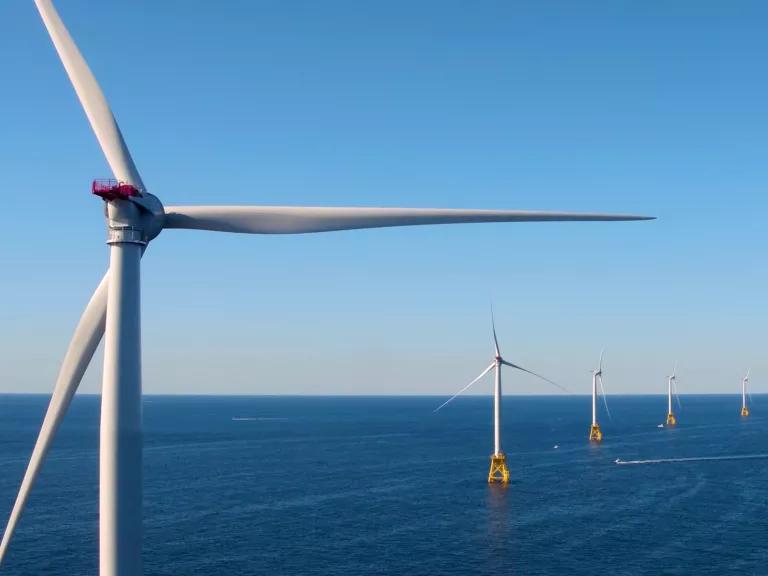
Turbines on Block Island Wind Farm in the Atlantic Ocean
Courtesy of Deepwater Wind
How do we stop offshore drilling?
The opportunity to submit public comments on the five-year program empowers coastal communities and others to collectively say loudly and clearly that we do not want more offshore oil and gas drilling. After the next leasing program is finalized, it will likely replace part of the existing Biden program, which was intended to run through 2029. From the request for information to a final program, this process can be lengthy and offers multiple opportunities for public input. To make your voice count while decision makers are listening, read our tips on delivering an effective public comment.
You can also stand with ocean advocates from NRDC and other environmental groups fighting to safeguard our coasts. Together with our partners, we’ve sued against three sales in the last five-year program for their impacts on human health, the environment, and climate change. Two of those cases have since been successfully resolved: Last year, an Alaska federal court suspended a Cook Inlet oil and gas lease, and this year, a federal court in D.C. found that a lease sale in the Gulf of Mexico failed to adequately assess the risks it posed.
And now we’re back in court. In February, we challenged the current administration’s unlawful attempt to reopen several areas of the Outer Continental Shelf to oil and gas drilling, undoing the permanent oceans protections put in place by Biden. And in November, NRDC and our partners sued to stop the auctioning off of 80 million acres of the Gulf of Mexico to the fossil fuel industry, a sale that violates the National Environmental Policy Act.
It’s not just the executive branch that makes decisions on offshore drilling. Congress also has the power to stop it. Lawmakers have introduced legislation that would ban offshore drilling in every Congress since the BP disaster, though they’ve yet to succeed. (Today, some members of Congress are also pushing agendas to expand offshore drilling in the Gulf. Montana Senator Steve Daines introduced the Supporting Made in America Energy Act, which would require the government to hold 20 lease sales in the Gulf of Mexico over the next decade and six lease sales in Alaska.)
States also have a say in drilling off state-controlled shorelines. New York, New Jersey, Oregon, and Virginia have all enacted bans, and since 202, California, Connecticut, Florida, Hawaii, Massachusetts, and South Carolina have introduced bills to block drilling as well.
Truly, one of the best ways to permanently protect ourselves from the volatility of the global oil market and fight climate change is to speed up the transition to clean energy sources with greater investments in our energy grid, advances in battery technology and electrification, and supportive state and federal policies. Despite setbacks from the Trump administration for the renewable energy trajectory in the United States, global renewable power capacity is expected to double between now and 2030, according to the International Energy Agency. And the clean energy revolution has already gained a solid foothold in U.S. states with abundant wind and sunshine, including across rural America. A zero-emission future remains in our reach—one that prioritizes people over polluters, and ocean habitats over oil company profits.
This story was originally published on January 31, 2023, and was last updated on November 24, 2025 with new information and links.
This NRDC.org story is available for online republication by news media outlets or nonprofits under these conditions: The writer(s) must be credited with a byline; you must note prominently that the story was originally published by NRDC.org and link to the original; the story cannot be edited (beyond simple things such as grammar); you can’t resell the story in any form or grant republishing rights to other outlets; you can’t republish our material wholesale or automatically—you need to select stories individually; you can’t republish the photos or graphics on our site without specific permission; you should drop us a note to let us know when you’ve used one of our stories.
The DOI is proposing to expand oil and gas drilling across ONE BILLION+ acres of U.S. waters.
This will threaten marine life, generate toxic air pollution, and put coastal communities and economies at risk of oil spills. Submit your comment saying no!

Say no to the Trump administration’s plan to open up our waters to oil and gas drilling!
The Interior Department is proposing to expand oil and gas drilling across more than ONE BILLION acres of U.S. waters. This will threaten endangered whales, generate toxic air pollution, and put coastal communities and economies at risk of oil spills and other drilling impacts. Submit your public comment now opposing this proposal.
Offshore Drilling in the Atlantic? “That’s Not Who We Are.”
The Biden Administration Cancels Its Offshore Drilling Plan for Alaska’s Cook Inlet—Let’s Keep It Off the Books
The Mother Who Became a Voice for the Gulf