
No, We’re Not in an Emergency Energy Crisis
But Trump wasted no time trying to justify opening newly protected federal lands in Alaska to drilling.

A liquefied natural gas tanker ship docked at Venture Global’s Calcasieu Pass export facility in Cameron Parish, Louisiana

UPDATE: On April 23, 2025, under the false premise of a “national energy emergency,” the U.S. Department of the Interior said it will fast-track oil and gas drilling and mining projects by sidelining the permitting requirements of the National Environmental Policy Act, the Endangered Species Act, and the National Historic Preservation Act. The move leaves public lands and waters wide open to dirty and extractive industrial activity with minimal oversight.
The United States is the world’s leading producer of oil and gas—and a leading exporter too. We ship out more oil than Saudi Arabia, Russia, Ecuador, Venezuela, and any other petro-state on the map.
Yet this week, President Donald Trump kicked off his new term by declaring a national energy emergency with plans to "fill our strategic reserves up again, right to the top, and export American energy all over the world.” On his first full day in office, Trump took aim at public land protections in Alaska, signing an executive order to open the Arctic National Wildlife Refuge to oil and gas drilling.
“There is a bit of a hypocrisy in declaring a domestic energy emergency while we flood international markets with fossil fuels,” says NRDC senior attorney Gillian Giannetti, who specializes in interstate gas transit and other federal energy issues. “We’re the world's number one exporter of oil and gas, and we have an energy emergency? What is this based on? There isn't a there, there.”
Unlike past energy declarations—for instance, one issued in 2005 in response to Hurricane Katrina’s toll on the Gulf’s offshore drilling operations—there’s been no sudden crash of oil and gas reserves. As for Alaska, huge amounts of oil are already set to begin flowing from the North Slope, where ConocoPhillips is constructing its massive Willow Project. And the U.S. fossil fuel industry has no dearth of resources for future growth: It retains access to 11 million acres of public waters previously leased to them—three-quarters of which remain unused. Even without new leases for offshore drilling, the country’s oil production rate is expected to remain steady through 2035.
The only thing certain about this so-called emergency is that it was preplanned, with Trump rehearsing it before a crowd at a December rally in Phoenix. And Trump has also made clear his intentions to shift the country away from clean energy policies enacted to address the true, staring-us-in-the-faces climate emergency.

Offshore near oil platforms near the Ports of Long Beach and Los Angeles in California
Eugene Garcia/AP Photo
“America First”…by selling U.S. energy overseas?
Trump’s call for “energy dominance” was a frequent talking point for the president’s first administration as well, but his ongoing quest seems to dismiss the record growth in energy production that ensued over the past four years. Under President Joe Biden, domestic production overall of crude oil, natural gas, and electricity rose, respectively, 17 percent, 11 percent, and 9 percent. Meanwhile, liquefied natural gas (LNG) export capacity is on track to more than double by 2028, from 2024.
“Since 2016, we've become number one in LNG exports in less than 10 years’ time,” says Giannetti.
And just who is buying all the fuel we export? There aren’t loads of takers. After all, as Giannetti points out, “international markets are not facing an energy emergency either.” China is the single-biggest purchaser of American LNG—but often resells it at a profit. Beyond the exports that the United States supplies, our trading partners in Europe have also made changes to lessen their dependence on foreign imports.
The war in Ukraine, for example, was a major wake-up call to the West about the need to be more energy independent and to cut ties to Russia, a huge exporter of crude oil and natural gas. A solar boom ensued across Europe, and according to the European Investment Bank, the continent now spends 10 times more investing in clean energy than it does in fossil fuels.
Learn More


And building more LNG terminals—as the gas industry is pushing for (in Gibbstown, New Jersey, in Southwest Louisiana, in the Gulf of California)—won’t benefit American pocketbooks either. Econ 101 tells us that through the law of supply and demand, reducing domestic reserves by shipping more overseas will increase prices at home. And a recent U.S. Department of Energy (DOE) report confirms it.
The report, commissioned to ensure LNG export reviews are compliant with the law, explains how more LNG terminals are not in the public interest. In addition to driving significant methane emissions, exacerbating the climate crisis, and harming frontline communities, “higher U.S. LNG export levels in 2050,” the report concludes, “are associated with higher U.S. residential natural gas prices."
Of course, the gas industry has its own motivations for finding more international buyers for its products while simultaneously putting pressure on domestic markets. “Natural gas is cheap relative to other fuel sources,” says Giannetti, “and it has been too cheap for the gas industry for a while. There were a couple of points just before COVID where its price was actually negative on the Henry Hub index, because there was so much.” Indeed, a mild winter combined with continued production growth contributed to especially high gas inventories by the end of the 2019–2020 heating season—a surplus that certainly didn’t benefit industry.
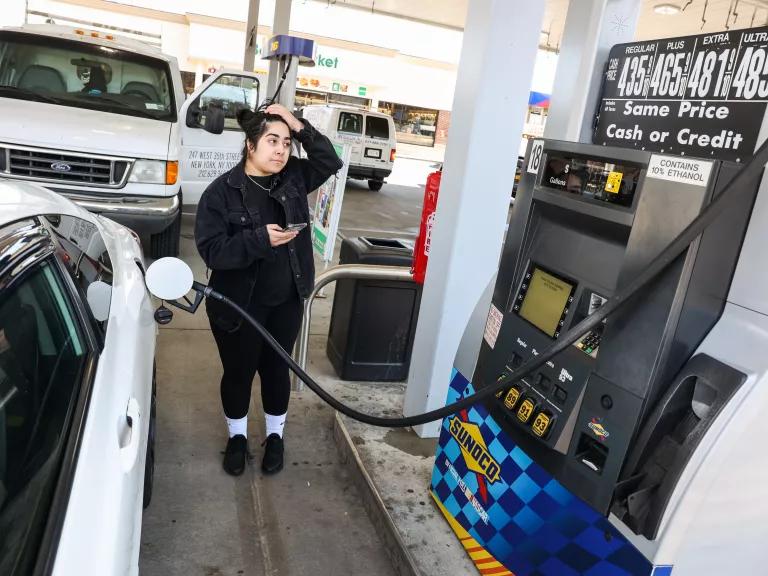
A Sunoco gas station in Hauppauge, New York
Steve Pfost/Newsday RM via Getty Images
Even when energy prices are up, drilling for more oil and gas doesn’t necessarily drive down gasoline prices. What we pay at the pump hinges on fluctuations in the global oil market—not on U.S. oil production. An energy emergency declaration would bring neither drops in heating nor gasoline costs, but that hasn’t stopped Trump from touting his agenda as one that would benefit consumers. “I will cut the price of energy and electricity in half, ready, 12 months from January 20th,” he promised at an October rally in Detroit.
Opportunity lost: Dominance in renewable energy
So U.S. ratepayers won’t benefit from Trump’s energy emergency, but what about those workers who are the backbone of the energy economy? These days, far more opportunities exist for, say, wind turbine technicians than coal miners. According to the most recent annual U.S. Energy & Employment Report, though the power sector is still adding jobs in fossil fuels, positions in renewables are climbing at a faster rate.
The growth is tracking a boom in solar and wind power, which is expected to keep going. Nearly all of the large-scale electricity capacity the nation added in 2024 came from solar (60 percent), wind power (10 percent), and battery storage to support renewable energy (23 percent). In its latest forecast, the U.S. Energy Information Administration expects solar generation alone to grow by 34 percent in 2025 and by 17 percent in 2026.
With record investments flowing into this sector from the Inflation Reduction Act and Bipartisan Infrastructure Law, America’s clean energy economy is poised to expand.
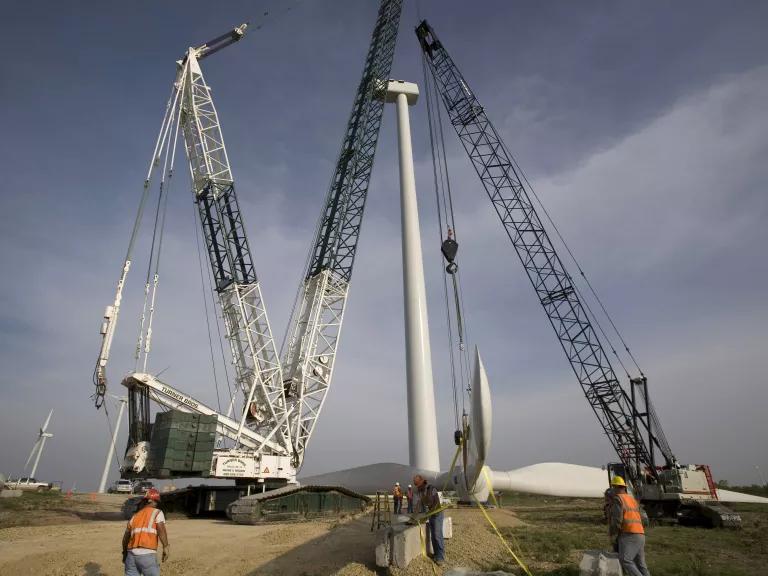
A wind turbine under construction at Lone Star Wind Farm north of Abilene, Texas
Robert Nickelsberg/Getty Images
“There is a natural opportunity here for the United States to redouble its efforts in being not the number one LNG exporter or oil exporter but to be the center of the world when it comes to developing solar panels, wind turbines, and battery technology,” Giannetti says. Instead, China has become the world’s renewable powerhouse, and Trump’s energy priorities are patently pointing in the opposite direction. “We are ceding that role to competitors.”
Trump’s first “energy emergency”
In the early days of Trump’s first term, he made a similar move to boost certain types of energy production via the “coal-nuke bailout.” The coal and nuclear companies had been fretting for years about the future of their aging and unprofitable power plants. Suddenly, industry leaders (like the late coal magnate and Trump donor Robert Murray) had a direct line to the president.
In September 2017, Rick Perry, then secretary of the DOE, sent a letter to the Federal Energy Regulatory Commission (FERC), the agency in charge of regulating wholesale electricity prices. In it, Perry ordered FERC to approve payment subsidies to the coal and nuclear industries. However, the directive came on the heels of a DOE study, commissioned by Perry, that showed no impact of these declining fuels on the stability of the grid. Perry pushed those study results aside and claimed that the country needed the bailout in order to guarantee the resiliency of an electricity system that was “threatened by the premature retirements of power plants.”
The intervention was unjustified, and FERC didn’t buy it. In a brave act of defiance, the agency responded that fulfilling Perry’s request was unlawful, explaining it would “disrupt decades of substantial investment made in the modern electric power system, raise costs for customers, and do so in a manner directly counter to the Commission’s long experience.”

Mountaintop removal mining at A & G Coal Corporation's surface mining operation in the Appalachian Mountains in Wise County, Virginia
Mario Tama/Getty Images
Still, the coal industry persisted. In March 2018, FirstEnergy Solutions (FES), another major coal-burning plant owner, asked the energy department to find that a “grid emergency” existed across a large swath of the East Coast and Midwest (regions that were home to several FES facilities). Through this scheme, an emergency determination would enable the DOE, via the Federal Power Act, to move forward with the coal-nuke bailout. But as with previous attempts, says Giannetti, “there was no demonstration that there was actually an energy emergency that needed to be addressed.” In the end, she notes, “it failed miserably.”
The real emergency: Climate change
While history repeats itself on the political stage, science marshals on. The hard evidence shows us that oil and gas development lead to climate emissions at every stage—not only when we burn these dirty fuels but as soon as we drill a hole in the ground to extract them. In addition to carbon dioxide, oil and gas production are also a major source of the climate super-pollutant methane, which invariably leaks from drilling and fracking as well as the industries’ transit and refining processes.
We know that increasing emissions will only accelerate the climate crisis, the impacts of which are being felt in the torched communities of Los Angeles right now, along with so many other American communities reeling from billion-dollar weather and climate disasters this past year. Those mounting costs are particularly worth reflecting on in the wake of an election that hinged on delivering economic progress.

The remains of homes destroyed by the January 2025 Palisades Fire in Malibu, California
Jae C. Hong/AP Photo
At last week’s testimony before a Senate panel, Chris Wright, CEO of fracking company Liberty Energy and Trump’s pick for Secretary of Energy, fielded questions by Independent senator Angus King of Maine on whether he accepts the scientific consensus that burning fossil fuels is the primary cause of climate change. Wright confirmed he did, but he also overstated the role of this combustion “to enable our modern world.” At the back of the hearing room, a protestor had a different take on our modern world, holding up a handmade sign stating: “Big oil profits, L.A. burns.”
This NRDC.org story is available for online republication by news media outlets or nonprofits under these conditions: The writer(s) must be credited with a byline; you must note prominently that the story was originally published by NRDC.org and link to the original; the story cannot be edited (beyond simple things such as grammar); you can’t resell the story in any form or grant republishing rights to other outlets; you can’t republish our material wholesale or automatically—you need to select stories individually; you can’t republish the photos or graphics on our site without specific permission; you should drop us a note to let us know when you’ve used one of our stories.
Venezuela’s Oil Resources Are Vast (and Should Stay Underground)
Fossil Fuels: The Dirty Facts
How to Spot—and Help Stop—Climate Misinformation