
Venezuela’s Oil Resources Are Vast (and Should Stay Underground)
The pursuit of the world’s dirtiest oil would cost more than $100 billion, involve the U.S. military, and sabotage climate efforts.

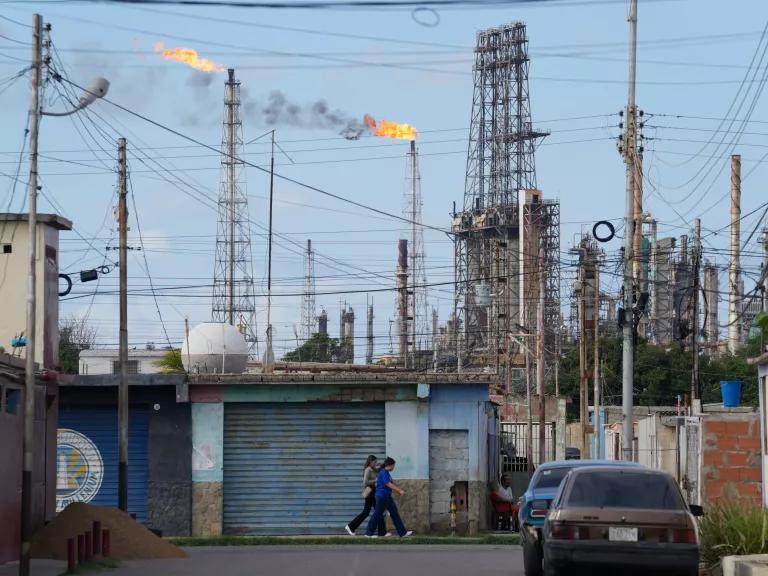
The outskirts of the El Palito refinery in Puerto Cabello, Venezuela, December 2025
A supposed war on drug trafficking was the initial reason President Trump gave for the U.S. military’s invasion of Venezuela at the beginning of the year. The raid, which happened in the middle of the night, killed more than 100 people and ended with the abduction of President Nicolás Maduro and his wife, Cilia Flores. By mid-morning, another motivation had emerged: oil.
“We’re going to have our very large United States oil companies, the biggest anywhere in the world, go in, spend billions of dollars, fix the badly broken infrastructure, the oil infrastructure, and start making money,” President Trump said in a press conference right after the invasion.
Setting aside very real concerns regarding the raid’s possible violations of international and U.S. laws, along with potential future political instability within the country, bringing this oil to market is a bad idea. In addition to fueling the climate crisis, investing billions in fossil fuel infrastructure in a foreign land could also exacerbate the affordability crisis in the United States.
The world’s dirtiest oil
The Orinoco River, the third longest in South America, cuts through Venezuela before emptying into the Atlantic Ocean. Home to 1,500 species of fish—including piranhas, electric eels, and enormous pirarucu—the river delta is one of the most diverse freshwater ecosystems in the world. Orinoco crocodiles, giant otters, caimans, anacondas, and endangered pink river dolphins also swim these waters while jaguars, capybaras, sloths, macaws, red howler monkeys, and toucans inhabit the surrounding wetlands. And lying beneath it all is much of Venezuela’s vast oil reserves, the largest in the world.
At an estimated 303 billion barrels, the Orinoco Belt contains more than six times the amount of oil known to be in U.S. reserves. But Venezuela crude is thick like tar, making it notoriously difficult to extract and refine.
“The heavier and dirtier the oil is, the more processing that’s going to be required,” says Dr. Laurie Geller, an atmospheric scientist in NRDC’s Science Office. Indeed, Venezuela’s oil production has the world’s second-highest carbon intensity.
ClimatePartner, a German consulting firm, examined what the climate repercussions might be for bringing Venezuela’s oil to market. The analysis, conducted for the Guardian, found that the resulting emissions would likely eat up 13 percent of the world’s “carbon budget.” The budget accounts for how much climate pollution the atmosphere could withstand in order to remain within 1.5 degrees Celsius of warming, the goal of the Paris Agreement.
Similar to the costly processes of extracting Canada’s tar sands oil, getting such viscous crude out of the Orinoco Belt would require very energy-intensive techniques, such as injecting steam into the ground. Once the oil is out of the ground, getting it to where it needs to go would release even more pollution. The crude’s high sulfur content not only demands more energy to refine but also quickly corrodes pipelines, which would require frequent repair to help prevent leaks and spills. Shipping the oil would also add to the already enormous toll the shipping industry is taking on the global climate and local air quality.
And where would this oil be going? Likely to the U.S. Gulf Coast for refining, where local, predominately Black communities disproportionately experience the brunt of negative health impacts caused by the petrochemical industry. Cancer rates near the region’s refineries and other industrial facilities are among the highest in the country.
Some residents of Pascagoula, Mississippi, where one of the few U.S. refineries ready to accept oil from Venezuela sits, are anticipating a sharp uptick in pollution. They’ve already asked Chevron, the refinery’s owner, to buy their homes so they can move elsewhere.

A fisherman with oil-covered hands on the shore of Lake Maracaibo in El Bajo, Zulia state, Venezuela, November 2023
Leaky pipes and busted wells: Venezuela’s aging oil infrastructure
Chevron is, in fact, the only U.S. oil company that has produced oil in Venezuela since 2007, when the country’s nationalized oil industry began demanding larger stakes in Orinoco Belt projects. Other companies, such as ExxonMobil and ConocoPhillips, left Venezuela at that time.
The industry, amid U.S. sanctions and general mismanagement, has declined precipitously from a daily production peak of 3.5 million barrels in the late 1990s to around 800,000 barrels in 2025. And with this plunge, Venezuela’s oil infrastructure deteriorated. Modernizing the infrastructure to operate at the scale that Trump seems to want would require considerable investment (and at least a decade of work).
Experts estimate, for instance, that out of the more than 12,000 oil wells in the Orinoco Belt, fewer than 2,000 are currently functioning.
Oil spills are another problem: Between 2010 and 2016, the country’s state-owned oil company, Petróleos de Venezuela S.A. (PDVSA), reported more than 46,000 oil spills. Although PDVSA stopped officially tracking spills in 2017, independent researchers have found that spills continue to contaminate drinking water, along with coastal and marine ecosystems.
According to the International Energy Agency (IEA), the oil industry in Venezuela also emits six times the global average of methane, a potent greenhouse gas. While drilling sites could choose to burn methane for fuel as “natural gas,” they often find it cheaper to release the greenhouse gas into the atmosphere. In addition to this flaring, methane also escapes through leaking wells, pipes, and other infrastructure.
Venezuela was responsible for 45 percent of all the methane emitted last year in both Central and South America, according to the IEA’s Global Methane Tracker. Modernizing the country’s aging infrastructure could potentially reduce such leaks, but climate advocates are skeptical that it would be a priority given the White House’s track record on pollution controls domestically.
The Amuay refinery in Los Taques, Venezuela, January 2026
Throwing good money after bad
At a White House meeting in January, President Trump asked executives from top U.S. oil companies to collectively spend at least $100 billion on restoring Venezuela’s oil infrastructure. So far, there haven’t been any official takers. ExxonMobil’s CEO, Darren Woods, called Venezuela “currently uninvestable,” though the company’s stance has since softened.
“To put that kind of money into old, aging infrastructure for a fuel the world is moving away from—that seems like a waste,” says Amanda Maxwell, NRDC’s global managing director. “It might wind up just being a terribly sunk investment.”
Some experts say that this high sum might not even be enough. According to a recent analysis by the independent research firm RystadEnergy, the price tag for returning Venezuela’s oil production to its glory days would be $183 billion over the next 15 years.
And fixing the infrastructure wouldn’t be the only hefty expense. “This was a military takeover, which may require a continual presence of the U.S. military for guarding these systems,” says Geller. Would Americans—a mere 26 percent of whom supported U.S. military action in Venezuela—have to pay for sustained military occupation of an entire country to obtain its fossil fuels?
This would further drive up costs to the climate. The U.S. military is the world’s largest institutional emitter of greenhouse gases, with a carbon footprint larger than more than three-quarters of the world’s nations. “Any significant military action has large consequences for increasing pollution,” says Geller.
And at this time, it’s unclear who the buyers of Venezuela’s oil would be. The oil’s large carbon footprint might deter some European countries with ambitious climate goals from purchasing it. And if the United States imports it, Americans already struggling to stay afloat could be saddled with paying higher energy prices. If Trump hadn’t rolled back clean energy policies from the Inflation Reduction Act, we could instead be on our way toward driving more electric vehicles powered by cheaper, cleaner renewable sources.

Photovoltaic solar panel arrays at Colorado's Sunnyside Community Solar Project, which generates an estimated 4.6 million kWh per year, enough to power an estimated 600 homes
Ignoring the real energy opportunity: Renewables
While President Trump has claimed—without evidence—that importing Venezuelan oil would decrease energy bills for Americans, he’s been thwarting certain domestic energy sources that would be a sure thing: wind and solar.
“Renewables are the cheapest source of energy pretty much everywhere,” Maxwell says. According to the International Renewable Energy Agency, 91 percent of all renewable projects commissioned worldwide in 2024 were more cost-efficient than their fossil fuel counterparts. A 2025 Lazard report on the levelized cost of energy (LCOE) found that onshore wind is the cheapest form of energy (between $37 and $86 per megawatt-hour), with utility-scale solar power following close behind (between $38 and $78); in contrast, combined-cycle gas turbine power plants cost between $48 and $109 per megawatt-hour.
Over the past year, the Trump administration has hamstrung clean energy development in the United States by freezing approvals for major onshore wind and solar projects, halting construction on all offshore wind farms (albeit briefly, thanks to a recent court ruling), and canceling almost $8 billion in grants to clean energy projects in 16 states, to name just a few examples.
Meanwhile, the rest of the world is ramping up clean energy capacity quicker than ever before. In the first half of 2025, China brought more solar online than all other nations combined. The country now has more installed generation capacity from solar and wind than it does from gas and coal.
In the Middle East and North Africa, countries with economies that were founded on fossil fuels are now constructing utility-scale solar farms and boosting energy storage. Saudi Arabia, for example, is building the largest-ever battery storage system for clean energy. The global assurance and risk management company DNV predicts that renewable energy capacity in the region could grow tenfold by 2040.
And many of Venezuela’s South American neighbors are emerging as leaders across the clean energy space. Latin America and the Caribbean already get a collective 70 percent of their electricity from renewables; in the past, much of this came from hydropower, but the region is now deploying other clean energy sources at grander scales. In less than a decade, Uruguay, for example, went from getting half of its electricity from fossil fuels to generating a whopping 98 percent of it from renewables, thanks to the swift construction of solar and wind farms. Others may be looking to make the switch as well: Next month, Colombia, the world’s sixth-largest coal exporter, is hosting the “First Conference on Transitioning Away from Fossil Fuels.”
There are so many unknowns about what lies ahead for Venezuela, but much of the world clearly sees a future in cleaner, more sustainable sources of energy. So, why should the United States go to great lengths and expense to cling to the past? Major investments in Venezuela’s oil would simply prolong our burning of fossil fuels when we need to shift away from them as fast as possible.
“We're setting up our national energy system so that we’re dependent on oil from far away, and it raises growing security questions,” Geller says. With renewables, on the other hand, “there's no transport required, it’s fully under our control, plus the obvious environmental benefits of no emissions. It just seems like a no-brainer.”
This NRDC.org story is available for online republication by news media outlets or nonprofits under these conditions: The writer(s) must be credited with a byline; you must note prominently that the story was originally published by NRDC.org and link to the original; the story cannot be edited (beyond simple things such as grammar); you can’t resell the story in any form or grant republishing rights to other outlets; you can’t republish our material wholesale or automatically—you need to select stories individually; you can’t republish the photos or graphics on our site without specific permission; you should drop us a note to let us know when you’ve used one of our stories.

READ NEXT: When Energy Security Is a Casualty of War
The U.S. war with Iran makes one thing perfectly clear: Depending on fossil fuels is neither safe nor smart.
What Are the Solutions to Climate Change?
A Consumer Guide to the Inflation Reduction Act
Climate Change Progress