
Can the Environmental Justice Movement Survive Trump’s Attacks? This EJ Warrior Says Yes.
“We will recover. We will rebuild. It will be better,” says Matthew Tejada, NRDC’s senior vice president for environmental health.

Matthew Tejada, NRDC's senior vice president of Environmental Health, speaking at a rally outside EPA headquarters in Washington, D.C.

On a cold morning in early February, Matthew Tejada, NRDC’s senior vice president for environmental health, stood outside the Washington, D.C., headquarters of the U.S. Environmental Protection Agency (EPA). He was there, alongside elected officials and fellow environmental advocates, to protest the dismantling of the agency’s environmental justice (EJ) office. In the first weeks of the second Trump administration, the event was political, but it was also personal. Before coming to NRDC in 2023, Tejada spent more than a decade running the EPA’s EJ office. “Eleven years a fed and [I’ve] never heard about members of Congress protesting outside EPA’s headquarters…ever,” he wrote after the rally.
In the weeks since, the Trump administration has announced sweeping rollbacks of environmental protections, gutted investments in environmental justice programs, and ordered the shuttering of all 10 of the EPA’s regional environmental justice offices. Tejada describes this political atmosphere as a “breathtakingly ugly, harmful, and hurtful blitzkrieg moment.” But he also says his academic background in history helps him take a long view of such dark times.
“As hard and as devastating as what we're living through right now is, we will come through it,” Tejada goes on. “How much devastation we'll have to recover from, how much destruction we're going to have to rebuild from, is yet to be seen. But we will recover. We will rebuild. It will be better.”
No turning back on environmental justice
The country did, after all, survive the first Trump administration. And even as the current Trump administration seems set on giving polluters a free pass, Tejada says the environmental justice wins achieved in recent years motivate him and fellow advocates to keep up the fight.
Learn More

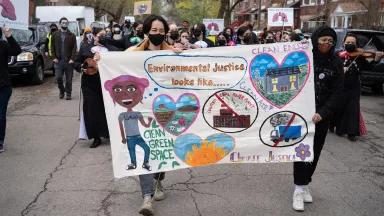

The Justice40 Initiative, for instance, was a crowning achievement of the Biden administration. The program directed 40 percent of the administration’s massive climate investments to benefit communities that are living on the frontlines of our pollution and climate crises. With a goal of dismantling inequities to create a more just society, the initiative made huge strides in a relatively short time.
“It helped create awareness with our local governments in a way that I don't think we could have done before,” says Tricia Cortez, executive director of the Rio Grande International Study Center (RGISC), a nonprofit in the fast-growing Texas border city of Laredo. By opening up a new stream of funding for the group, Justice40 also helped level the grants playing field for this small organization in a city with one of the country’s highest poverty rates. “It allowed us to get creative and become aggressive in pursuing partners, to dream, to think really big,” Cortez says. “We thought, ‘We need this, we can apply for this, we deserve this.’”

A RGISC member holding up a map of the EPA National Air Toxics Assessment during a town hall meeting to inform residents of the dangers of ethylene oxide in Laredo, Texas
Julie Dermansky
RGISC, once almost exclusively focused on Rio Grande basin restoration, expanded its work to address the community’s disproportionate pollution issues. In addition to the port city’s growing diesel truck traffic and rising methane emissions from rampant fracking, Laredo is home to one of the country’s largest commercial sterilization plants, which uses carcinogenic ethylene oxide, a chemical used to sanitize medical equipment. Ethylene oxide is produced by an industry that has received vigorous support from the state of Texas, in spite of the health threats it poses.
But thanks to the work of RGISC and other environmental advocates, the EPA announced a rule in March 2024 that would cut emissions from ethylene oxide by 90 percent—“rulemaking that probably went further to advance environmental justice concerns than any other in the history of the EPA,” Tejada says. According to an analysis by the Union of Concerned Scientists, a disproportionate number of facilities that emit ethylene oxide exist in areas with residents who are mostly people of color, have low incomes, and speak limited English. In the end, the small organization from Laredo was able to help make the case for better health protections for many other industrial communities like its own.
"[We] have a responsibility to the people in our community, and to the environment, to speak up and be a voice To be level-headed. To push for and demand what's still needed. To say we are worthy of this."
Tricia Cortez, executive director of the Rio Grande International Study Center
More broadly, the federal government’s prioritization of environmental justice at the time played a critical role in validating Laredo’s needs, helping to draw attention to the city’s plight from fellow Texans. “They were in a completely different reality of being able to advocate for the health and future of their community,” Cortez says. “I don't think any of that would have happened without the advances during the last administration.”
And now, as the second Trump administration seeks to reverse the progress of the EJ movement, she refuses to stand silent. “Groups like ours have a responsibility to the people in our community and to the environment. To speak up and be a voice. To be level-headed. To push for and demand what's still needed. To say we are worthy of this,” she says. “There’s no turning back for us.”
Confronting the environmental justice backlash
The breadth and aggressiveness of the current backlash, Tejada says, is directly proportional to the amount of progress the country has made on climate, equity, and justice over the past five years. The second Trump administration assumed power not with a plan to just push the federal government in the opposite political direction, as is often the case with a change in party, but with a plan to destroy it. “They chose to try to kill it instead of trying to engage with it,” he says.

A cargo ship carrying a multistory furnace to the site of a $10 billion petrochemical plant under construction at the Port of Corpus Christi, Texas
Eddie Seal/Bloomberg via Getty Images
For Tejada, one of the most powerful ways to fight back is to combine NRDC’s legal and policy background with the firsthand knowledge and experiences of grassroots organizations. One place he sees for this collaboration is in the Gulf Coast, especially in his home state of Texas. As NRDC doubles down on the fight to phase out fossil fuels, partnering with Gulf communities that are on the frontlines of both Big Oil’s pollution and the effects of climate change just makes sense.
And never underestimate the power of data as an engine for change. During his time at the EPA, Tejada oversaw the development of EJScreen, a transformative environmental justice screening and mapping tool. (The Trump administration scrubbed EJScreen from the EPA’s website in February, but Public Environmental Data Partners worked quickly to get a copy online just a few days later.) For EJ communities, data can be very empowering, helping them underscore the government’s obligation to intervene on behalf of areas rife with pollution. And Tejada sees vast opportunities for data gathering and sharing among community scientists, thanks to the increasingly lower costs of monitoring technologies. He calls it a future horizon for environmental health protection and climate action.
Given the scale of the current federal threats, EJ advocates like Cortez are ready to dig in on defense. “It’s not the time to back down or shrink or downsize,” she says. “This is a time to grow and spread the light. To showcase the best of what we do in our country—with innovation, with the rule of law. Those pieces are critical to keep strong and hold the line.”
This NRDC.org story is available for online republication by news media outlets or nonprofits under these conditions: The writer(s) must be credited with a byline; you must note prominently that the story was originally published by NRDC.org and link to the original; the story cannot be edited (beyond simple things such as grammar); you can’t resell the story in any form or grant republishing rights to other outlets; you can’t republish our material wholesale or automatically—you need to select stories individually; you can’t republish the photos or graphics on our site without specific permission; you should drop us a note to let us know when you’ve used one of our stories.
Why Redistricting Could Lead to More Pollution, Sickness, and Death
The Environmental Justice Movement
When Customers and Investors Demand Corporate Sustainability