
Why Redistricting Could Lead to More Pollution, Sickness, and Death
The new wave of racial gerrymandering ushered in by Louisiana v. Callais threatens the ongoing struggle for environmental justice.

Pastor Harry Joseph with fellow members of RISE St. James—which was founded to oppose ongoing siting of polluting industry in the parish, particularly the majority Black community of the 5th District—in a Rise Up for Cancer Alley march through St. James Parish, Louisiana
The struggle for environmental justice in this country just got harder. The U.S. Supreme Court ruling in Louisiana v. Callais et al. this past spring dealt a severe blow to the political representation of people of color, who are more likely to live in areas that are polluted by industry or vulnerable to climate effects, such as extreme heat.
While the Court’s majority attempted to frame its decision as a racially colorblind acknowledgement that state legislatures can legally favor one political party over another when drawing congressional maps, the net effect is clear: Callais allows state lawmakers to disenfranchise voters of color by redrawing districts in ways that significantly diminish these voters’ electoral power.
The decision is a disturbing step backward, resurrecting a terrible chapter in American history. “I remember the Jim Crow system that restricted every aspect of Black life: education, employment, health care, even burial sites,” says Dr. Robert Bullard, director of Texas Southern University’s Bullard Center for Environmental & Climate Justice and long considered the “father of environmental justice.”
“Historically, Black tax dollars were siphoned to build infrastructure for white wealth, while Black communities were targeted for polluting facilities,” a scheme that Bullard himself documented in his 1990 book Dumping in Dixie. The movement he helped found has made great progress in countering this injustice over the decades. That progress is now under grave threat.
The Louisiana v. Callais decision
In Callais and other recent moves to dilute the minority voting power of people of color, Bullard sees a loud, intentional echo of past attempts to dismantle the progress made during the Reconstruction and Civil Rights eras. The decision effectively gutted a key provision of the Voting Rights Act of 1965 that outlaws discriminatory voting practices, which were still common a full century after the Civil War. In addition to efforts by the current U.S. Department of Justice and local law enforcement to harass and intimidate election officials and get-out-the-vote organizations, other threats to political representation include the so-called SAVE America Act. This proposed package of legislation would install new barriers to voting, potentially keeping more than 20 million people away from the polls.
Within 24 hours of the Callais decision, states such as Louisiana and Tennessee were already taking dramatic steps to redraw their districts in order to lock in victories in the upcoming midterm elections—efforts that, practically speaking, meant halving or even ending Black representation in these states’ congressional delegations. Three weeks after the ruling, South Carolina’s statehouse called for a special legislative session to reconfigure its map, with the ultimate (and ultimately unsuccessful) goal of giving all seven of its seats in the U.S. House of Representatives to Republicans.
Doing so would have meant unseating the lone Democrat in South Carolina’s delegation: the long-serving Black representative James E. Clyburn, himself a pioneer of the Civil Rights Movement. Clyburn chaired the Congressional Black Caucus’s Environmental Justice Braintrust for seven years straight, starting in the late 1990s. In 2015, the National Environmental Justice Conference honored him for “consistently support[ing] the growth and development of the field of environmental justice, and [bringing] together diverse stakeholder groups together to resolve complex environmental justice concerns.”
Effectively gerrymandering Black lawmakers out of office removes a crucial line of defense in the fight for environmental justice. Whether because of their own lived experiences or that of their family members, neighbors, or larger community, these decision-makers are far likelier than their white counterparts to understand the plight of those grappling with high rates of air pollution, contaminated drinking water, a paucity of green spaces, or the stresses of summer in an urban heat island. People of color are now poised to lose representation from such powerful allies in Washington.
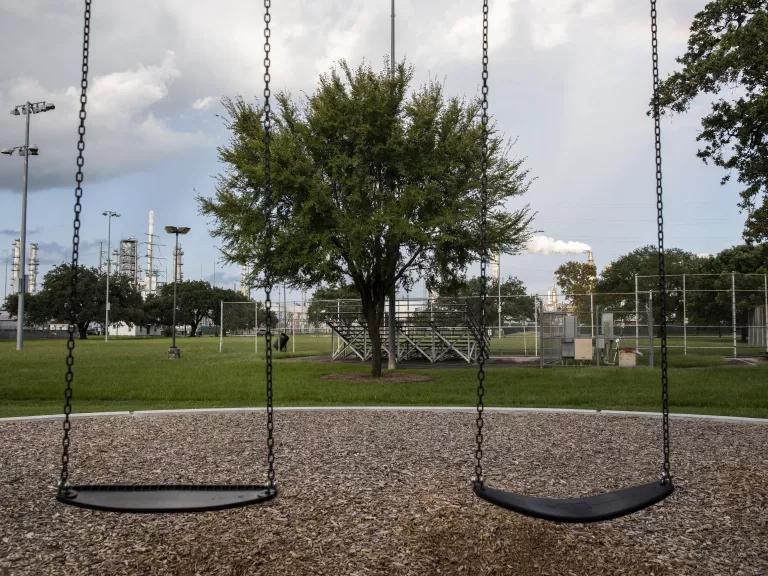
A playground at Hartman Park in the Harrisburg/Manchester neighborhood, a majority Latine fenceline community located beside the Valero Houston Refinery and the Houston Ship Channel in Houston, Texas
Lingering disparities and looming threats
At special risk of under-representation are those living inside fenceline communities. These are neighborhoods located adjacent to industrial centers or hazardous facilities—think chemical plants, power plants, refineries, or factories—that face near-constant streams of harmful pollution. And a disproportionately high percentage of the those living within them are people of color and low-income.
“In environmental health, if you could only use one demographic indicator to identify communities that are suffering from the greatest disparities across health outcomes—such as differences in lifespans or childhood asthma rates—you would look at race and ethnicity,” says Matthew Tejada, NRDC’s senior vice president for environmental health. “That’s because race and ethnicity are still the strongest predictors in the United States of communities whose health has been, and continues to be, significantly negatively impacted by sources of pollution in our air, land, and water.”
Statistics bear out the connection:
- People of color throughout the United States are 54.2 percent more likely to live in a county with failing grades in ozone and particulate pollution.
- Black children are twice as likely as white children to be hospitalized for asthma due to air pollution.
- In general, Black Americans are exposed to 38 percent more air pollution than white Americans.
- According to the U.S. Environmental Protection Agency (EPA), drinking water systems found to have been violating the law for years were 40 percent more likely to occur in places with a high percentage of residents who are people of color.
And what could be the effect of the disenfranchisement of fenceline neighborhoods? In the short term, Tejada says, “it will mean that children growing up in these communities today will be breathing more dirty air and drinking more contaminated water than they have to.”
Tejada points to two predominantly Black and Latine communities in Charlotte, North Carolina, and Richmond, Virginia, where nearby medical sterilizer facilities spew ethylene oxide, a carcinogen, into the air. Last year, the Trump administration exempted 40 such facilities nationwide from complying with hard-won protections under the Clean Air Act that would have cut this pollution by 90 percent.
Environmental groups (including NRDC) are currently challenging these exemptions in court. But for communities with already fewer resources, the burden of holding polluters accountable only grows heavier in the absence of congressional champions. The aggressively deregulatory agenda of the current EPA, combined with a U.S. Supreme Court majority that consistently rules in favor of weakening clean water and air regulations, means congressional representatives may be among the few advocates working for environmental justice communities within the federal government.
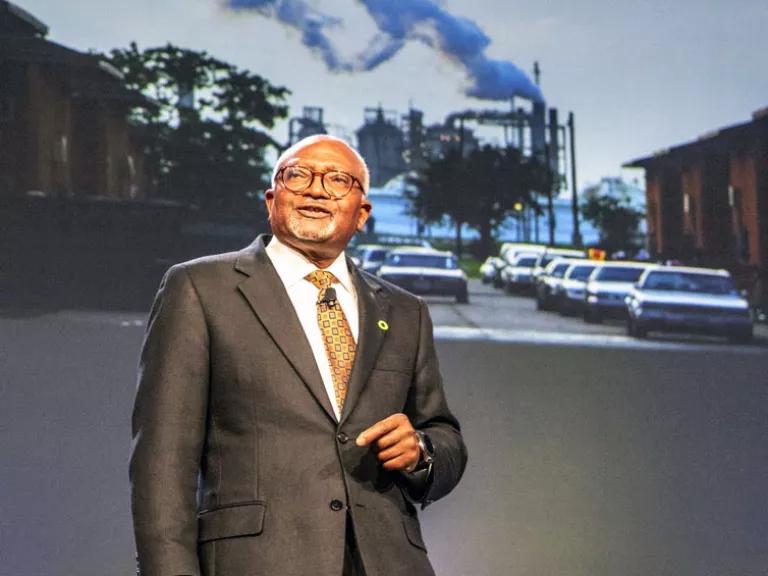
Dr. Robert Bullard speaking at a climate reality training during A Moral Call to Action on the Climate Crisis, a historic interfaith mass meeting held at the Ebenezer Baptist Church in Atlanta, March 14, 2019
Organizing the response
Over the longer term, Callais could also be detrimental to the health of American democracy writ large. Tejada worries that “these communities that have been sacrificed for so many generations will continue to be sacrificed, because they don’t enjoy the same constitutional right to vote—and to project their members’ power and influence—that other communities have so long enjoyed.”
The stakes couldn’t be higher, Tejada says. Disenfranchisement of this sort and to this degree “means that our society is halting our long and very much unfinished struggle to achieve equality—the ideal that gave spark to the entire experiment of the United States.”
For Dr. Bullard, countering the dilution of Black votes will require mass, multiracial, cross-coalitional mobilization. It’s worth remembering, he notes, that the movements for civil rights and environmental justice weren’t created by the government in the first place. “While administrations may cancel grants or federal funding,” Bullard says, “they cannot cancel our movement.”
This, in other words, is no time for despair. People of color are projected to comprise the majority of Americans by 2045. The mission, Bullard says, must now be to inspire as many as possible toward “reversing the slide toward authoritarianism and continuing the fight for environmental and climate justice.” Such goals, of course, would benefit all Americans, irrespective of race, income level, or degree of political power.
“We must not let cruelty crush our spirit,” Bullard says. “We must organize to finally make ‘justice for all’ a reality rather than just an aspiration.”
This NRDC.org story is available for online republication by news media outlets or nonprofits under these conditions: The writer(s) must be credited with a byline; you must note prominently that the story was originally published by NRDC.org and link to the original; the story cannot be edited (beyond simple things such as grammar); you can’t resell the story in any form or grant republishing rights to other outlets; you can’t republish our material wholesale or automatically—you need to select stories individually; you can’t republish the photos or graphics on our site without specific permission; you should drop us a note to let us know when you’ve used one of our stories.
Mutual Aid and Disaster Justice: “We Keep Us Safe”
The Environmental Justice Movement
Can the Environmental Justice Movement Survive Trump’s Attacks? This EJ Warrior Says Yes.