Framing Planned Relocation as a Human Health Issue
As more governments are having to relocate communities due to climate change, there must be increased efforts to incorporate health considerations throughout the process.

Sailosi Ramatu—whose home was destroyed by flooding caused by sea level rise, storm surge and high tides—stands where his house used to be at the old village site in Vunidogoloa, Vanua Levu, Fiji.
This post was written by Hema Baniya, NRDC’s climate mobility intern for summer 2025. She is pursuing a master of public health in global health policy at the Milken Institute School of Public Health at George Washington University and is interested in migration, climate mobility, and their implications for health.
The escalation of climate change has led to increased movement of people, creating a major public health challenge. Health is deeply intertwined with policy development and access to resources; therefore, for a successful planned relocation, health must be an integral part at every stage, not an afterthought.
What is planned relocation?
Climate change impacts intertwine with other factors influencing human mobility, such as socioeconomic, political, demographic, and environmental factors, although climate is rarely cited as a primary reason for migration. Planned relocation is a specific type of human mobility and refers to the organized movement of people and settlements, typically with the support of a partner agency and/or the state, due to environmental or climate-related risks.
For example, Fiji has a government-led process for planned relocation, with its government issuing a living document that provides a framework for climate resilience and migration guidelines. Vunidogoloa, in the Cakaudrove Province, is known for being the first village to relocate with government support. There have also been many communities within the United States that have undergone various forms of planned relocation. For instance, Harris County, Texas, has relocated hundreds of households from highly flood-prone areas. This highlights how planned relocation is not limited to low-income countries but is also a strategy being adopted by high-income countries such as the United States.
The importance of connecting health to mobility
Planned relocation has been positioned as an adaptation response and a strategy to prevent future displacement. It can have positive effects by reducing risks for those involved, but it may also lead to unintended consequences and new dangers.
Planned relocation directly and indirectly affects people’s physical and mental health. Relocation has been linked to psychological distress, caused by the loss of home and community. People often need to change their livelihoods, impacting their daily activities and their ability to support themselves. These changes can, in turn, influence diet and substance use.
For communities dependent on fishing and agriculture, food security is a concern after relocating. For example, due to the limited access to coastal fishing sites, relocated Fijian villagers consumed more processed and packaged foods. This has led to an increase in tooth decay and diabetes cases. Additionally, after relocating, the communities experienced an increase in tobacco and alcohol consumption, which can have adverse health consequences due to their association with lifestyle changes, diet, and substance use. These factors can contribute to noncommunicable diseases like diabetes and obesity.
Furthermore, changes in living conditions, livelihoods, and social networks can have negative repercussions on mental health. Studies in Fiji, Ghana, and Japan showed that relocation leads to the loss of traditions, cultural practices, and a sense of community, affecting people’s overall well-being. Because health impacts are complex and involve many layers, it’s difficult to attribute these changes solely to planned relocation—but they cannot be ignored.
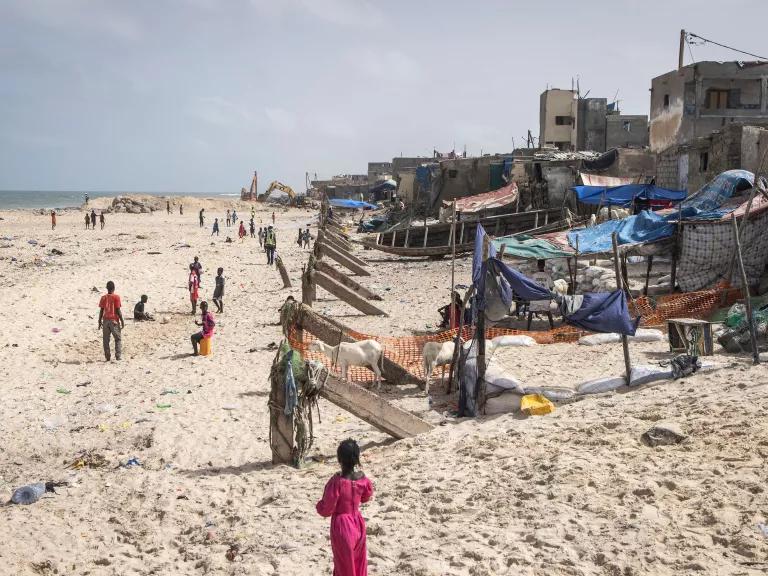
People gather along the beach of the partially destroyed seaside fishing neighborhood of Guet NDar in Saint Louis, Senegal, where rising seas have displaced hundreds of people.
Research gaps
Planned relocation is connected to mental health, food security, water and sanitation, exposure to violence, lifestyle changes, and access to health care. However, establishing clear conclusions—and, therefore, policy solutions to address gaps—is challenging, due to limited research on its direct impact on health.
While there is a well-established body of research linking climate change to health risks, there is limited work focused on mobility aspects. Among 38 policy frameworks for planned relocation that I reviewed, 13 mentioned health outcomes, and only 10 provided details on addressing health impacts. A few scholars, such as Celia McMichael at the University of Melbourne, have specifically addressed these issues, but their work on mobility and planned relocation made me realize that more people should invest in this area. It's not that others aren’t linking health to planned relocation, but more careful consideration and possibly post-assessments are needed to ensure residents are truly better off at the new site.
Future directions
As a student of global health policy, I find myself interested in understanding the intersection of climate displacement and human health and what systems are in place to support affected communities. When I think about these issues, I think of my family and their early resettlement in Nepal after they fled from Bhutan in 1991. My dad shares stories of tuberculosis, cholera, and malaria, some of the most devastating diseases that overwhelmed the camps and affected him and his siblings. My family faced these challenges in the 1990s; however, such situations still exist today in regions facing conflict and environmental crises, and the burden on those who are displaced is devastating.
Moving forward, relocation efforts must incorporate health considerations throughout the process to ensure sustainable and equitable climate adaptation. Climate change affects everyone, regardless of race or class, though the impacts are not equal: Systemic inequities combined with climate hazards compound existing problems, creating new vulnerabilities in a pattern that describes a vicious cycle.
The saying “the rich get richer, and the poor get poorer” holds especially true in the wake of disasters, due to wealth inequality that is reinforced by the way that disaster spending and assistance are distributed. These vulnerabilities can both force people to move and trap them in risky locations. It will be critical to conduct deeper research and integrate health considerations as more planned relocations take place.
Related Blogs
The Inequitable Health & Economic Burdens of Climate Change
Lancet Offers Grim Assessment of Climate Change and Health