
From Planning to Action: How Two Indian Cities Are Building Resilience to Extreme Heat
With heat waves on the rise, more cities are taking urgent action to safeguard vulnerable communities and save lives.


Coauthored with Ritika Kapoor, Anshima Mishra, Rohan Mishra, and Abhiyant Tiwari
As India grapples with yet another season of intense heat, the cities of Churu, Rajasthan, and Varanasi, Uttar Pradesh, are taking action to strengthen local preparedness and resilience. These cities launched their comprehensive Heat Action Plans (HAPs) in May of this year. Developed in collaboration with city authorities, health experts, and our partners—Mahila Housing Trust (MHT) and Indian Institute of Public Health-Gandhinagar (IIPHG)—the Churu Heat Action Plan and Varanasi Heat Action Plan represent a significant milestone in advancing local heat resilience, particularly for vulnerable communities. Churu and Varanasi HAPs consist of notable advancements, such as integrated historical climate trends, hyperlocal vulnerability assessments, and future climate projections. These advancements will allow the cities to design targeted, data-driven interventions that address the unique heat-related risks of different populations. Although many other cities in India have designed such plans, only a few cities—such as Ahmedabad, Gujarat; Jodhpur, Rajasthan; Thane, Maharashtra; and now Churu and Varanasi—have these next-level plans that are proven to save lives and reduce suffering from extreme heat.
Living in extreme heat is more than just a physical discomfort—it can impact your livelihood and overall health and well-being. NRDC’s director of cooling and climate resilience, Prima Madan, talks about how India is adapting to rising temperatures and what the rest of the world can learn from them.
Churu and Varanasi are particularly at risk for heat
For Varanasi and Churu, building resilience to extreme heat is critical. Varanasi, a city of significant cultural and spiritual importance, gets more than 85 million tourists and pilgrims every year and has been grappling with worsening heat waves, year over year. In 2024, the city recorded a scorching 47.2 degrees Celsius (117 degrees Fahrenheit)—the highest temperature in 140 years. Churu, often referred to as the gateway to the Thar Desert, is not only one of the hottest places in India, but it is also particularly at risk for extreme heat events. Based on data from 1969 to 2022 for the months of March to June, Churu experienced the highest mean frequency of heat wave days in the state of Rajasthan, averaging 6.6 days.
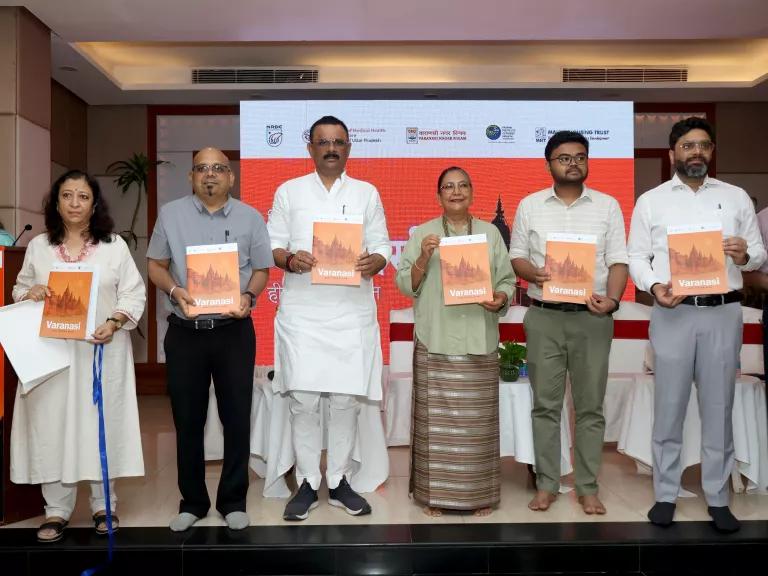
Representatives from NRDC, MHT, IIPHG, Nagar Nigam Varanasi, and Shri Kashi Vishwanath Temple Trust launch the Varanasi HAP on May 16, 2025, in Varanasi.

Abhishek Surana, district collector of Churu addressing the audience at the Churu HAP launch
From past trends to future risks: These HAPs are built on robust climate analysis
Historically, HAPs did not include climate projections to highlight the future increase in temperatures to assess risk. However, without concrete data on future projections, it’s hard for city officials and policy makers to move from planning to long-term action. Including robust climate analysis in HAPs strengthens the scientific credibility of the HAP, as well as helping city officials and urban planners to justify budget allocations for long-term heat resilience. It also builds a case for investment in public health and infrastructure to plan for not just saving lives today but reducing the risk over the long run.
Both the Churu and Varanasi HAPs include tailored climate analysis in addition to a detailed assessment of historical trends (typically included in HAPs), highlighting rising baseline temperatures during both the day and night. The climate analysis for the two cities revealed that, by 2049, the temperatures in Churu are projected to increase by approximately 3.89 degrees Celsius and in Varanasi, by an additional 3.29 degrees Celsius. This could imply more days above 45 degrees Celsius, longer heat waves, and more nighttime heat stress. These HAPs also incorporate the U.S. National Oceanic and Atmospheric Administration Heat Index, which combines air temperature and relative humidity to indicate how hot it actually feels to the human body and thereby highlight the human thermal discomfort more realistically.
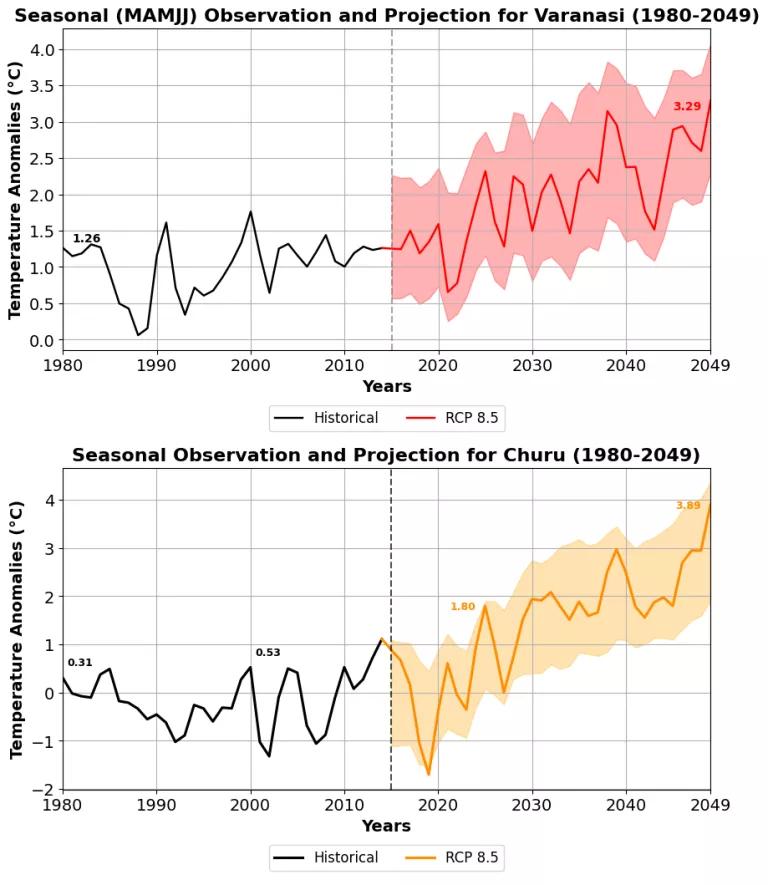
Temperature projections for Varanasi (top) March– July and Churu (bottom) March–June (1980–2050). The black line shows historical observations, and the red and orange lines indicate future projections for RCP 8.5 scenario.
Local data enhances understanding of heat vulnerability in Churu and Varanasi
Based on hyperlocal analysis, these HAPs also identify specific hot spot areas or account for localized vulnerabilities; they also include ward-level geographic information system (GIS) spatial vulnerability assessments, offering a detailed view of how extreme heat impacts different parts of each city differently. These assessments will help local authorities target interventions more effectively and equitably as they work on implementing each HAP. This is unlike earlier versions of HAPs, which have typically assumed uniform levels of heat risk across the study and do not account for variance in vulnerabilities.

GIS-based heat vulnerability risk assessment for Varanasi

GIS-based heat vulnerability risk assessment for Churu
NRDC India
Institutionalizing heat resilience: Governance, funding, and local action
Over the years, HAPs have played a key role in mainstreaming and institutionalizing heat response and preparedness action in city governance mechanisms. While structural and policy interventions take shape over time, immediate coordination among government bodies, civil society, and local institutions is something that the HAPs are successfully able to trigger. Timely early warnings, joint response protocols, and localized capacity building are essential to reducing heat-related morbidity and mortality and maintaining critical services during peak summer months. Keeping up with this expectation, the Churu and Varanasi plans embed institutional accountability by outlining a detailed stakeholder responsibility matrix. This framework defines clear roles, timelines, and coordination mechanisms across state, district, and municipal levels, ensuring that each actor—from government departments to civil society—knows when and how to act.
Keeping up the momentum with implementation
NRDC and partners are committed to continue working with the cities in implementing the measures outlined in these plans and will also continue to strengthen these plans based on assessment and evidence.
Related Blogs
Women, Skills and Green Economic Growth in India

Video: Leadership in Urban Climate Action―Beat the Heat
