
World Ozone and Climate Treaty Needs More Eyes on the Sky
The Montreal Protocol protects the ozone layer and helps slow climate change. We rely on a complex atmospheric monitoring network to know how well this treaty is working. That network needs an upgrade.
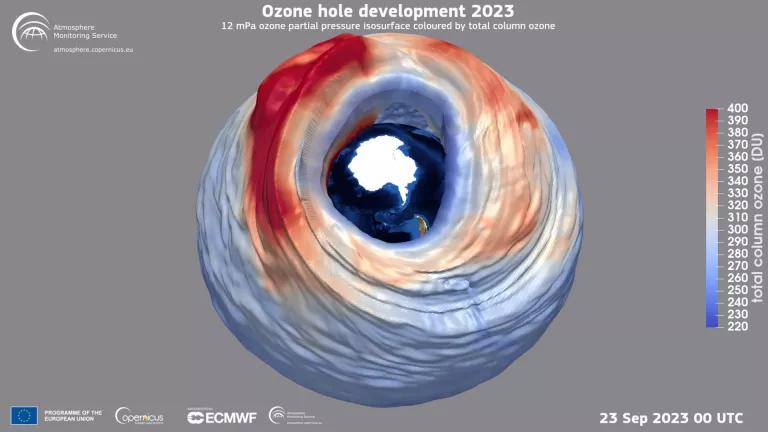
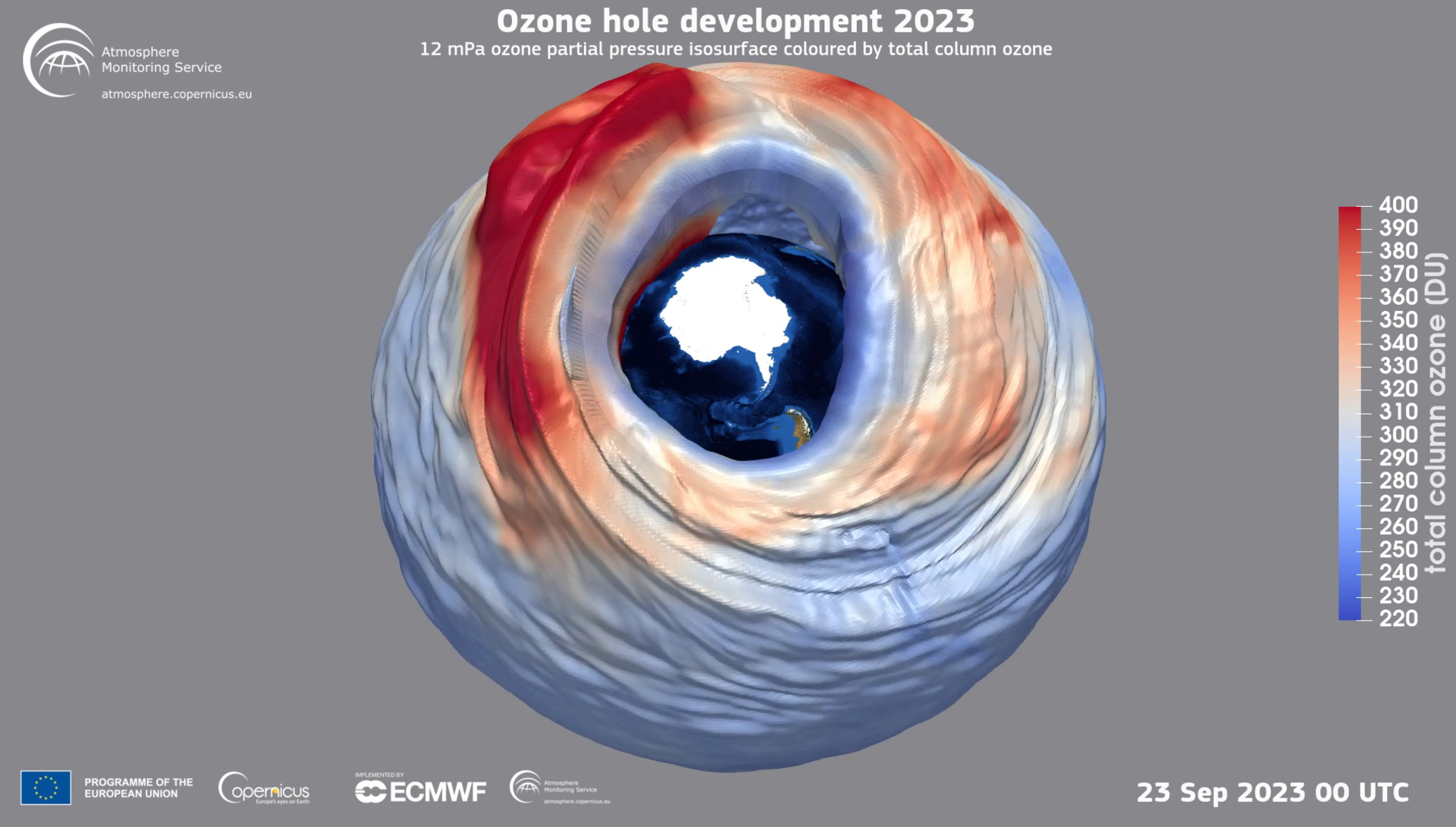
A 3D rendering of the ozone hole above Antarctica


The Montreal Protocol—a nearly 40-year-old treaty joined by every country on the planet—has curbed more than 100 chemicals that are dangerous to the ozone layer and the climate. We explain here how it has protected the fragile stratospheric ozone layer that screens out dangerous ultraviolet radiation, saving millions of lives and avoiding untold harm to agriculture and other vital natural systems. The Montreal Protocol is also one of the biggest steps we've taken to reduce the speed of climate change.
But the Protocol does not operate in a vacuum, and its success depends on multiple external institutions. Among those are national and international science institutions that need to be maintained and strengthened. This is a focus of attention as country representatives, scientists, and observers gather in Bangkok in July for the semiannual meeting of the Montreal Protocol.
Successes and ongoing challenges
The Protocol relies on these institutions for one of the most critical scientific capacities: atmospheric measurement and monitoring. That is how we discovered the threat to the ozone layer in the first place. And continued monitoring capacity is essential to our understanding of evolving dangers and effective remedies.
The monitoring network we have today shows that the Protocol is, for the most part, working effectively. Atmospheric levels of most of the long-lived chemicals controlled under the Protocol are dropping at the rates scientists expected. And that’s critical to closing the hole in the ozone layer later in this century and safeguarding the billions of people living on our planet.
But the monitoring network has identified outliers—chemicals whose concentrations are not declining as expected. This has raised concerns about noncompliance and prompted responses to get back on track.
Nothing illustrates this better than the detection of unexpected emissions of CFC-11, the powerful ozone-depleting substance (and potent greenhouse gas) whose production was supposed to have stopped in all countries by 2010.
In 2012, an atmospheric monitoring station atop a volcano in Hawaii, operated by the National Oceanic and Atmospheric Administration (NOAA), began detecting unexpectedly high concentrations of CFC-11. Atmospheric levels should have been steadily dropping. Instead, NOAA researchers calculated that emissions of CFC-11 had increased 25 percent after 2012, compared to 2002–2012 average levels. These findings, later confirmed by other independent monitoring stations, were traced back to sources in eastern China.
Thankfully, the Parties to the Montreal Protocol reacted promptly to this alarming data. The Chinese government took action. The banned emissions appear to have largely ceased, and the monitoring stations are seeing atmospheric CFC-11 levels drop again as they should. Indeed, studies found that CFC-11emissions across eastern China in 2019 had returned to pre-2012 levels.

Air samples collected at South Korea's Gosan Global Atmosphere Watch Regional Station show that CFC-11 emissions from eastern China have dropped substantially since 2018, contributing to a global decline in CFC-11 pollution.
This detective story relied upon atmospheric measurements taken by NOAA’s Global Monitoring Laboratory (GML) and the Advanced Global Atmospheric Gases Experiment (AGAGE), which is supported by the National Aeronautics and Space Administration (NASA). Data from other monitoring stations in South Korea and Japan also played a vital role.
Without the atmospheric monitoring network, the excess CFC-11 production could have remained undetected. At a minimum, it would have been extremely difficult to localize. And it would have threatened recovery of the ozone layer and accelerated climate warming.
More recently, a similar story is unfolding regarding HFC-23, a greenhouse gas with a global warming potential of 14,800, which is more than three times the climate punch of CFC-11. HFC-23 is emitted primarily as a by-product of HCFC-22 production. The Montreal Protocol and the Kigali Amendment phased out HCFC-22 production for use as a refrigerant. Production is only allowed now for use as a feedstock (i.e., for non-emissive conversion to other chemicals), and only if the plants destroy the HFC-23 by-product emissions with incinerators or other methods.
Learn More

Over the last several years, Parties had been reporting high levels of HFC-23 destruction from these facilities. But once again, the global monitoring stations told a different story, detecting much more HFC-23 in the atmosphere than should be there, given reported emissions. By 2019, the emissions gap totaled some 15,000 metric tons of HFC-23. That’s equivalent to 222 million metric tons of carbon dioxide, or the annual emissions of roughly 60 coal-fired power plants. Data from the AGAGE station in Gosan, South Korea, suggested that eastern China may have been responsible for up to 50 percent of the global emissions gap.
Fortunately, as with CFC-11, shining a light on the problem is the first step to solving it. Under international scrutiny, countries appear to be taking steps to reduce their excess HFC-23 emissions. Recent scientific papers, which reflect an increase in atmospheric monitoring within China, appear to be showing reductions. And current international measurements are showing that atmospheric levels have started to fall, though there is still an emissions gap to find and close.
What are the lessons?
First, the global atmospheric monitoring network—our eyes on the sky—is absolutely crucial. Scientific data, peer-reviewed and publicly available, have allowed us to verify that most of the ozone-destroying chemicals are being curbed. And the data have identified and pinpointed two major exceptions. When the monitors rang the alarm, the Parties to the Montreal Protocol responded.
Second, the monitoring network is incomplete. While we have eyes on part of the sky, large areas of the earth remain in the dark, unmonitored. Indeed, a 2020 report from the Ozone Research Managers noted that “…[station] coverage of eastern Europe, western, southern, and central Asia, all of South America, portions of North America, large parts of Southeast Asia, Australia and New Zealand, and most of Africa is largely absent.”
These gaps can be covered in two complementary ways. Countries can set up more monitoring stations like those in the AGAGE network. Countries can also expand the use of flask measurements—the GML network is based primarily on air samples collected in vacuum containers and shipped to central laboratories for analysis.
Recognizing the gaps in monitoring, the Protocol Parties have taken several steps to help bolster the existing network. Last year, they allocated $400,000 to evaluate potential sites for new monitoring stations. This May, the executive committee of the Multilateral Fund agreed to consider establishing a funding window for three pilot projects to enhance regional atmospheric monitoring. NRDC strongly supports these efforts and looks forward to seeing a progress report on site evaluations this July in Bangkok.
Third, countries that fund the existing network need to continue doing so, and other countries need to pitch in. NRDC is concerned about deep budget and personnel cuts that the U.S. administration has proposed for essential NOAA and NASA earth science programs, as well as for the U.S. Environmental Protection Agency. These cuts are just a part of a wider, deeply troubling attack on public scientific data systems and, indeed, on scientific research itself. In the United States, however, Congress has the last word on funding, and it has rejected these kinds of deep cuts to scientific and environmental programs before. NRDC strongly opposes such cuts and will work hard to ensure that these essential programs are maintained.
This should remind other countries that although U.S. science has been and still is indispensable, it is precarious to over-rely on one country for the technical underpinnings of the Montreal Protocol and other agreements. Other countries need to maintain and increase their contribution to the scientific data collection on which these efforts depend, both internationally and within their own borders. Many countries are doing so—all need to do more.
NRDC looks forward to working with countries in Bangkok to solve these problems and build on the Montreal Protocol’s enormous achievements.
Related Blogs
10 Years After Kigali: What Comes Next for the Global HFC Phasedown?

Addressing Energy Efficiency and Hydrofluorocarbon Pollutants Through Regional Centers of Excellence
