
Busting the Myths of New York's Congestion Pricing Program
New York’s congestion pricing infrastructure is ready for its January 5 start—to the benefit of mobility, public health, and the economy throughout the city and beyond.


America’s first congestion pricing program—the long-envisioned motor vehicle tolling measure that promises to transform transportation in the nation’s largest city—is set to launch on January 5, 2025. New York governor Kathy Hochul has flashed the green light, the Federal Highway Administration after completing one final review has given its final sign-off, and the Metropolitan Transportation Authority (MTA) is ready to roll.
And while litigation challenging the program is not over, federal district court judges Lewis Liman in Manhattan and Cathy Seibel in White Plains have both declined to issue injunctions that could have blocked the congestion pricing startup.
The expected implementation of this strategy represents one of New York’s most significant advances in decades for traffic congestion management, motor vehicle air pollution reduction, and public transit financing.
Under the new scheme—a scaled-down version of an earlier plan that the governor paused last June—autos entering Manhattan’s Central Business District (CBD) below 60th Street will be charged $9 during daytime hours and $2.25 during off-peak periods. Tolls for small and large trucks crossing into the congestion zone will be set at $14.40 and $21.60, respectively, during peak hours (with steep discounts for nighttime travel). All rates reflect a 40 percent reduction in the congestion fee originally approved last spring. The plan envisions an increase in the tolling fees after three and six years.
Most importantly, funds generated by the congestion fee will enable the MTA to issue $15 billion in bonds and empower the transit agency to undertake critically needed capital expenditures to rebuild and enhance New York’s subway, bus, and commuter rail network, even if on a longer time horizon than originally planned.
Among the many capital investments to be funded from this program are the extension of the Second Avenue subway to East Harlem; replacement of antiquated signal systems; construction/repair of elevators to make stations accessible to persons with disabilities; purchase of hundreds of state-of-the-art electric buses; modernization of the Long Island Railroad’s Main Line track; and delivery of new rail cars for Metro-North commuter trains.
In addition, the tolling program is expected to ease traffic bottlenecks in the region’s largest business district—shortening the time needed for emergency vehicles to arrive at their destinations and saving businesses billions of dollars every year in time no longer lost to congestion-related commuting and delivery delays.
The disincentive to travel by motor vehicle into Manhattan's CBD is also expected to cut traffic volumes and stop-and-go driving—major sources of localized air pollution in the city and contributors to climate-destroying greenhouse gas emissions.
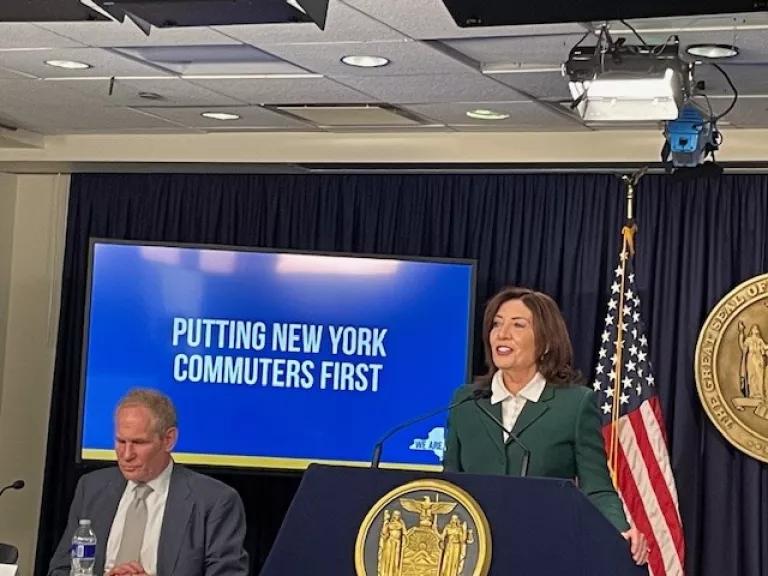
Governor Kathy Hochul, the MTA, and State and Federal officials have given the green light to the nation’s first congestion pricing program.
Despite these and other benefits, opponents of congestion pricing have continued to paint a distorted picture of the impacts of this innovative program in New York. Here are four of the most frequently repeated myths about congestion pricing followed by short, fact-based responses:
Myth #1: Congestion pricing is regressive and will hurt the poor and working class.
Fact: Congestion pricing will be broadly beneficial to persons at all income levels and will be particularly helpful to low-income commuters.
Simply stated, congestion pricing will help the vast majority of travelers to Manhattan’s Central Business District because the overwhelming majority of commuters get into the area via public transportation. About 85 percent of all daily commuters venture into the CBD via subway, bus, and commuter rail. And these transit travelers will benefit from billions of dollars in otherwise unavailable public transit capital investments that will make their daily subway, bus, and commuter rail trips safer, faster, and more reliable.
Indeed, the city’s oldest and most respected anti-poverty organization, the Community Service Society, has embraced congestion pricing precisely because of its overwhelming benefit to low-income New Yorkers. The society analyzed commuter patterns into the CBD based on travel mode and income level. Its review found that only 2 percent of the city’s working poor would end up paying the congestion fee.
According to the Community Service Society study, “257,000 working poor New Yorkers would benefit from a congestion pricing plan that funds transit upgrades, compared to just 5,000 [working poor] New Yorkers who would regularly pay a congestion fee.” The study concludes: “In other words, working residents in poverty will benefit by a margin of more than 50 to 1 from congestion pricing.”
Additionally, the MTA has adjusted its pricing structure to accommodate this small percentage of low-income New Yorkers who must commute into the CBD via automobile. Under the final program rules, all motor vehicle owners with incomes under $50,000 a year can apply for a 50 percent discount on the congestion pricing fee, applicable for every peak hour drive after the first ten trips of every calendar month.
Myth #2: Congestion pricing is bad for business.
Fact: Congestion pricing will help New York City businesses by reducing commuting time for business travelers and for goods shipments and deliveries, and by improving transit services, which is how most people travel to and from the Central Business District.
To figure out whether congestion pricing will help or hurt New York businesses, just look at the business groups spearheading support for this measure: The Partnership for New York City, the Real Estate Board of New York, the Citizens Budget Commission, the New York Building Congress, and the Association of a Better New York.
One reason for their enthusiasm is that New York’s notorious traffic congestion imposes enormous costs on businesses and consumers. According to a recent analysis by former NYC traffic commissioner Sam Schwartz, the average speeds of midtown travel have slowed to 4.8 miles per hour. And the city’s leading business organization, the Partnership for New York City, has concluded that the cost of delay in commuting time and work-related travel is $9.2 billion a year.
Congestion pricing is part of the solution. In Singapore, London, and Stockholm, where congestion pricing programs has been in place for years, traffic bottlenecks have smoothed and vehicle speeds have increased. According to one Federal Highway Administration report, traffic speeds in the congestion zones of these three cities jumped by 10 percent to as much as 30 percent following the startup of congestion pricing. And even a 10 percent decrease in Manhattan CBD traffic could by itself result in significant times savings for business deliveries, as well as for workers and shoppers who must drive in the congestion zone.
As the chair of the business-friendly Association for a Better New York recently stated in referring to the need for the congestion pricing startup: “Let’s get this done as if the City’s future depends upon it. Because it does.”
Myth #3: Congestion pricing doesn’t help those who must drive in the congestion zone.
Fact: Congestion pricing will benefit drivers directly by cutting traffic congestion and saving them from hours stuck in traffic. And it will aid them indirectly by generating funds to help rebuild the region’s transit system—keeping millions of daily commuters on subways, buses, and commuter railroads and out of private motor vehicles that would otherwise be competing for limited highway and street space.
Those who drive in the CBD don’t need to be reminded of the frustration of it all—vehicles often creeping along in stop-and-go-traffic, delays and unpredictability, wasted time. According to the MTA, New York’s traffic congestion ranked as the worst among U.S. cities in 2020–2021. And post-COVID driving and congestion have spiked in New York City by an additional 10-15 percent.
As noted above, congestion pricing should reduce these burdens, as has been the case in London, Stockholm, and Singapore. And as the New York program rolls out, government officials have committed to address issues that arise and adjust the program to ensure that it achieves its congestion-busting goals.
Finally, congestion pricing will help drivers of ambulances, fire trucks, and police vehicles to navigate narrow city streets and avenues so that they can arrive more swiftly at their destinations and render assistance to those who live in, work or visit the heart of Manhattan.
Myth #4: Congestion pricing won’t help New Jersey residents.
Fact: The overwhelming majority of New Jersey commuters to Manhattan arrive via public transit, not private automobiles; they won’t pay the congestion fee and will benefit from the transit investments the program will fund.
Nearly 3 out of 4 New Jersey residents who regularly commute into Manhattan travel by public transportation: buses, NJ Transit, PATH, or ferry. And a large portion of those travelers complete their journeys to work via subway or NYCT buses. These commuters will be helped by the MTA’s congestion pricing investment in enhancements, including more reliable subway signals and tracks, more modern trains, and cleaner, more accessible stations.
As for the small percentage of New Jersey automobile commuters to the CBD, they will also receive a $3 dollar “crossing credit” during peak hours if they use EZ-Pass and enter Manhattan via the Lincoln or Holland Tunnel. (A similar credit is also available to New York commuters who use the Queens-Midtown or Hugh L. Carey Tunnel.)
An even broader group of New Jersey residents could see the benefits from congestion pricing implementation. There is a chance that New York’s congestion pricing could help rescue New Jersey’s own transit services, including NJ Transit, PATH trains, and Port Authority bus facilities. NJ Transit riders are facing fare increases of up to 15 percent at a time of ongoing mechanical failures and near record train cancellations.
New York governor Hochul and her team are reportedly willing to fork over what could be hundreds of millions of dollars for transit capital improvements for the Garden State, in what has been described as a very generous offer to settle the legal challenge to congestion pricing filed by New Jersey governor Phil Murphy.
So far, Governor Murphy has refused to come to the bargaining table. He appears willing to appease his state’s Manhattan-bound auto commuters at the cost of turning down a large infusion of funds that could directly benefit a much larger core of New Jersey transit riders.
But if Murphy is willing to work with Hochul and the MTA to resolve the litigation, beleaguered NJ Transit riders and bus commuters around the state could be big winners.
A final thought. Officials in suburban areas and the Garden State who continue to oppose congestion pricing are overlooking one central fact. The MTA’s subway, bus, and commuter rail system is the beating heart of the entire region. If this transportation system is not nurtured back to good health, the mobility, economy, and environment of the entire region are sure to decline. It is no exaggeration to say that the fate of the nation’s most densely populated metropolitan area is dependent upon efficient, safe, and reliable public transit service. And implementation of congestion pricing is today the best medicine we have.
Related Blogs
Environmental Wins Abound in NY’s 2022 Legislative Session

New York Is All in on EVs
