Rethinking the Price of Water in the West
It’s time to modernize the antiquated water pricing system and create one that factors in resilience, capital improvements, and efficiency.

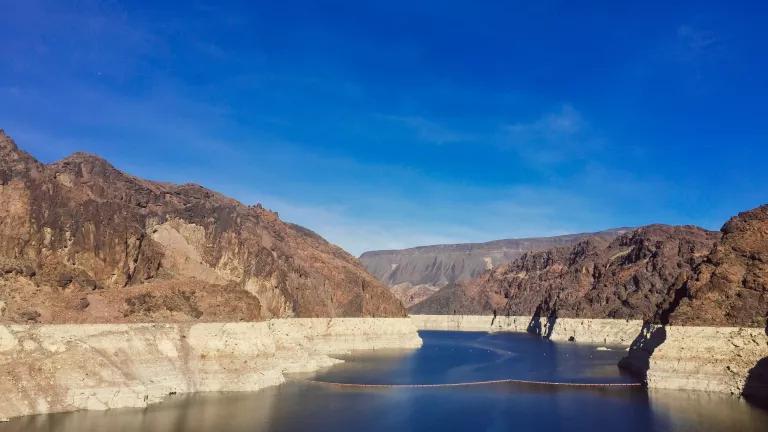
Low water levels—18 percent capacity—at San Luis Reservoir, a major Central Valley Project facility, during drought conditions in Merced County, California, in August 2021

Americans have long romanticized the settlement and land grabs of the West through stories of cowboys riding through a rugged land. In old Western films, dust clouds would swirl behind their horses’ hooves as they beat down on the tough, arid land. These romanticized stories and the decisions that precipitated in Washington, D.C., ignored the long history of the people who already lived on this land, putting a first-come, first-serve sign on the land and natural resources of the region. Settlers in the 19th and early 20th century laid claim to parcels of land and the rivers that flowed through them. To them, the federal government doled out water free of charge, relying on these resources to drive the rapid development of the West.
This foundation was cemented in 1922 when seven states and the federal government signed the Colorado River Compact, which divided the river that supplies much of the West into the upper basin (Colorado, New Mexico, Utah, and Wyoming) and the lower basin (Arizona, California, and Nevada). The resulting water allocations were predicated on early-20th-century hydrological studies of the river’s flow, conducted during a period of unusually high precipitation. Most important, the estimates did not account for the impacts of climate change and the prolonged periods of drought that have become synonymous with life in the West. Though there have been numerous updates to the original compact, the foundational system that priced water remains largely unchanged. Today, just as it was 100 years ago, substantial volumes of water in the Colorado River Basin are sold or diverted at little to no cost. California’s Central Valley Project, another massive federal water resource that was first envisioned in 1921, still allocates water under similarly antiquated pricing systems that allow water to be diverted for next to nothing, incentivizing inefficiency and overuse.
Learn More

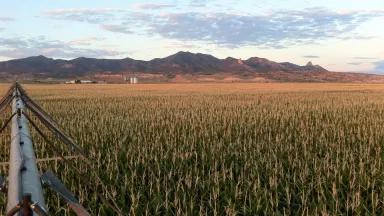
Free or nearly free water is an arcane approach that incentivizes water waste at an enormous scale.
These very systems and agreements of pricing water for next to nothing are hundreds of years old—from a bygone era before widespread plumbing and in which the term global warming was still 50 years away from being used for the first time in a scientific journal—and they don’t support a sustainable future in which everyone has access to water.
A new NRDC–University of California, Los Angeles report underscores the scale of this challenge. It reveals that 7.26 million acre-feet (MAF) of water is obtained for less than $1 per acre-foot (AF) from the federal government each year. That’s the amount of water consumed by roughly 21 million households annually. More than half of that is received by five agricultural districts for $0/AF: the Coachella Valley Water District, Imperial Irrigation District, Palo Verde Irrigation District, Truckee-Carson Irrigation District, and Unit B Irrigation & Drainage District. This comes in sharp contrast to the 1.88 MAF of water purchased by municipal districts for more than $1,000/AF, all of which is located in California. People living in areas that don’t benefit from historic federal contracts end up paying three times: once for their own water, again through taxes that subsidize other regions, and finally, through the mounting costs of water shortages that are materializing across the West.
The last quarter century of drought has shown that it is unsustainable for the seven basin states and Mexico to use water at the current rates. Free or nearly free water is an arcane approach that incentivizes water waste at an enormous scale. Our research recommends adding a reliability and security surcharge to federal water deliveries that would provide funding for system resilience and capital improvements while providing a price signal to reduce inefficient uses of water and drive down demand.
We can no longer hang our hats on the excuse that our broken water system is “just how water rights work.” After having contended with two decades of the worst drought in more than 1,200 years and record-low reservoir levels, we cannot afford to leave any conservation tool off the table. We need a long-term strategy that recognizes water as a limited resource and prices it as such. After two years of failed negotiations over the future of the Colorado River, the first federal deadline for states to reach a consensus has come and gone. The new deadline is February 2026. A successful and resilient water management plan must include the modernization of how water is bought and sold in the West.
Related Blogs

Momentum Is Growing for Restoring Freshwater Ecosystems

Partnering with Beavers to Adapt to Climate Change