
Battleground Pennsylvania: What We’re Really Talking About with Energy Affordability and Data Centers
Wawa vs. Sheetz is divisive—energy affordability isn’t.

A solar array in Brodheadsville, Monroe County, Pennsylvania. The county is facing a surge in proposals for large-scale data center development.

During Governor Josh Shapiro’s budget address in February, he unveiled GRID: the Governor’s Responsible Infrastructure Development standards. GRID’s goal is to manage the data center boom so that Pennsylvania families aren’t saddled with higher electric bills.
Under GRID, data center developers must do the following:
-
Bring or fully pay for the new power they need
-
Be transparent and engage directly with communities
-
Hire local workers and enter into community benefit agreements to support the municipalities that host them
-
Meet environmental and water conservation standards to qualify for state support and faster permitting
GRID is an important first step. But it comes at a time when Pennsylvania just lost one of its biggest tools for lowering bills and speeding up clean energy deployment: participation in the Regional Greenhouse Gas initiative (RGGI). Because Pennsylvania withdrew from RGGI, the commonwealth will continue missing out on its many benefits, including a declining, binding cap on power plant carbon pollution and recurring investment opportunities to promote energy efficiency and cut utility bills. RGGI uses market-based pricing on carbon to drive consumer savings, clean energy investment, and better public health—an approach that has already been working in neighboring states for more than 15 years.
Learn More

RGGI is not just about cutting pollution. It is an effective tool to help lower bills, modernize the grid, and incentivize onboarding more clean energy…now.
But the November 2025 budget deal ended Pennsylvania’s participation in RGGI without a comparable replacement; a misstep that NRDC called “unprecedented.” Given that data centers’ electricity demand is rising so fast, removing that tool exacerbated a growing affordability gap, and Pennsylvania now has fewer proven tools to address it.
And to state the obvious, the federal government is not stepping in to help. In fact, federal leaders have been openly hostile to clean energy and affordability policies, which makes state action even more critical. If Washington, D.C., is pulling back from solutions that lower bills, enacting new energy taxes, and arbitrarily blocking tens of gigawatts of new electricity waiting to supply the grid, Pennsylvania must lead and move forward on its own.
At the same time, Pennsylvania is seeing major tech and AI investments, including a $20 billion data center project from Amazon and additional commitments from Microsoft and Google. That momentum makes GRID’s “pay your own way” guardrails timely—and necessary.
In a state as proudly diverse and swingy as Pennsylvania, new polling shows broad agreement on this key issue: People realize that data centers are straining the grid, and they want fair, clean solutions that lower bills.
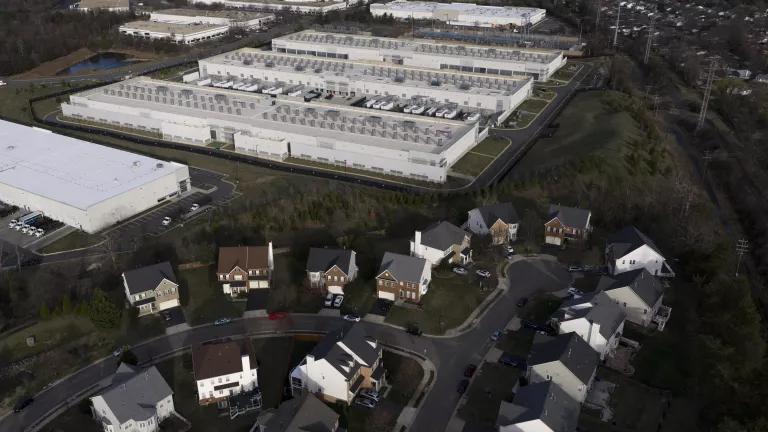
Asking ChatGPT a quick question might feel innocuous, but you might end up paying for it in the long run. The massive data centers that are popping up around the country to support the AI boom are using up enormous amounts of energy and water and creating noise and air pollution. NRDC’s Ben Schaefer, senior manager of strategic communications, and Jackson Morris, director of state power sector policy, dive into how these centers can impact nearby communities and your energy bill.
What Pennsylvanians told us: Affordability first
NRDC commissioned Global Strategy Group to survey likely 2026 voters across the commonwealth (600 statewide plus large oversamples in the congressional districts of PA-1, PA-7, PA-8, PA-10; ±4 percent statewide margin of error and ±4.9 percent in each district). These districts represent a mix of urban, suburban, and rural communities whose electric bills are rising. There are data center projects proposed in all of them.
The message from Pennsylvanians is clear: Affordability comes first.
Pennsylvanians prefer new clean energy over new gas (i.e., fossil fuel) plants to meet growing energy demand (55 percent versus 38 percent statewide, with majorities in each target district). They say clean energy is more sustainable and effective at reducing pollution, improving health, and keeping bills lower. Views are more divided on reliability and speed to add capacity—but support for clean energy grows after they hear a balanced debate.
When asked what is driving higher prices, the top answer statewide is “increasing demand for electricity, including from data centers” (46 percent). The second is “utility companies seeking to maximize profits” (30 percent). In PA-10 (Harrisburg), Pennsylvanians blame utilities almost as much as data centers.
Most Pennsylvanians (74 percent) agree that when data centers are built, local bills go up. And 64 percent would not support one near their community.
The solutions strongly supported
Policy solutions test extremely well—and people believe these lower bills:
- Require data centers to pay for the extra electricity they need: 95 percent support; +78 net “positive impact on bills”
- Upgrade the grid with storage and transmission: 83 percent support; +53 net positive on bills
- Require tech companies to fund new clean energy to meet their demand: 81 percent support; +48 net positive on bills
- Offer efficiency incentives for households and businesses: 81 percent support; +50 net positive on bills.
When these steps are combined into one clean energy affordability agenda, support reaches 70 percent statewide, with majorities in each district.
Pennsylvanians also say this agenda would improve air and water quality (+56 net), help the economy (+35), boost reliability (+34), and lower their own bills (+29).

A coverage map of PJM
NRDC
Why this is urgent and why it’s on Pennsylvania now
PJM is the organization that operates and coordinates the country’s largest electrical grid that spans across parts or all of 13 states, including Pennsylvania; it serves as an air traffic controller to balance electricity supply and demand and keep power reliable. PJM also operates a competitive wholesale electricity market that includes a day-ahead and real-time energy market and uses annual capacity auctions to pay electricity generators on a three-year forward basis to commit to being available to provide electricity when the grid needs it most.
When energy demand rises faster than supply, those auction prices, and ultimately, customer bills, go up. The three most recent PJM capacity auctions (since July 2024) and long-term load forecasts show surging electricity demand across the 13-state grid, driven heavily by data centers. Against this backdrop—and with supply chain hurdles in new energy, bottlenecks in PJM’s interconnection queue, and a hostile federal government—new generation is not keeping up with the significant pace of new demand.
Expert testimony in Pennsylvania has warned of tens of gigawatts of new data center load happening within this decade—and flagged bill impacts if large loads do not bring new, clean, firm power and fully fund the grid upgrades they trigger.
When demand rises faster than supply, prices go up. That’s not partisan—it’s math.
The mandate from voters couldn’t be louder: 95 percent say data centers should cover their own energy costs, period.
What’s adding to frustrations is that, as bills rise, Washington is not delivering durable affordability solutions. Instead, people see:
- The blockage of energy projects that are almost 80 percent completed because it involves a windmill
- Rollbacks and weakening of federal tools aimed at cutting power-sector pollution and modernizing the grid
- The opposition of transmission build-out and clean energy deployment
- No clear national framework ensuring that massive new electricity users pay the full cost of their grid impacts
From a voter’s perspective, it feels like this: Big new energy users are moving in. Bills are climbing. And the federal government is hostile, stupid, or prioritizing Big Tech’s profits over affordability for voters.
That frustration is real—and it’s bipartisan.
The mandate from voters couldn’t be louder: 95 percent say data centers should cover their own energy costs, period. This means the responsibility shifts to the states.
If Washington isn’t going to guarantee that new large loads pay their way and that new demand is met with fast, affordable, clean supply, Pennsylvania has to write those rules itself.
What Pennsylvanians want instead
Polling shows voters connect clean energy and efficiency with lower bills. They prefer building new wind, solar, and battery storage over new gas plants by a 17-point margin statewide. They respond strongly to evidence that renewables can be deployed faster and often at lower cost than new gas infrastructure.
Politically, the incentive to act is clear: An official who supports a clean energy affordability agenda outperforms one who opposes it—especially among swing voters.
Voters are not asking for ideology. They are asking for three things:
- Growth that creates jobs
- Protection from hidden cost shifting
- Faster, cheaper energy solutions—not slower, more expensive ones
How to talk with communities near a data center (poll-tested, NRDC-aligned)
Residents understand the power sector impacts of data centers, so focus on these three clear, voter-backed points:
- “Data centers—and not us—must pay for their power.”
This policy is the most popular statewide (95 percent support) and scores highest for lowering bills. Make it clear: no hidden costs or cross-subsidies to households. - “Clean energy plus grid upgrades keep costs and outages down.”
Voters prefer new clean energy over new gas to meet growing demand (55 percent versus 38 percent) and support grid upgrades and storage (83 percent) for reliability. Frame it as the fastest, cheapest way to meet new demand without raising bills. - “Communities deserve real benefits in writing.”
Call for local jobs, enforceable community benefit agreements, and strong water protections. Make sure commitments are not just promises—they should be legally binding conditions of approval.
The bottom line
Federal failures increase state responsibility.
If the governor’s GRID standards remain open-ended, Pennsylvania households could end up subsidizing hyperscale load growth. If, instead, they translate into airtight statutory and regulatory language, the state can welcome economic development while protecting ratepayers and accelerating clean, affordable power.
The frustration that Pennsylvanians feel isn’t abstract. It’s about rising bills. It’s about fairness. And it’s about whether anyone is actually in charge of making sure growth doesn’t come at their expense.
Pennsylvania can answer that question, but only if it writes rules clearly. Pennsylvanians see the same problem—fast‑growing data center demand and rising bills if we don’t set fair rules. The path they support is practical and popular: Make large users pay their way; build more clean energy, storage, and transmission; protect water and communities; and stop cost shifting to families. That’s how we keep the lights on, lower bills, and secure the benefits of new investment…no matter where you land on Wawa versus Sheetz.
Related Blogs

Pennsylvania Takes a Crack at Making Virtual Power Plants a Reality
Accounting for AI: Environmental Transparency for a Responsible Digital Future
