California Jobs at Risk After Energy Department Cancels Manufacturing Grants
This move comes at a time when investment in decarbonization is critical in order to ensure that the state can deliver on its emission reduction requirements while ensuring energy affordability.
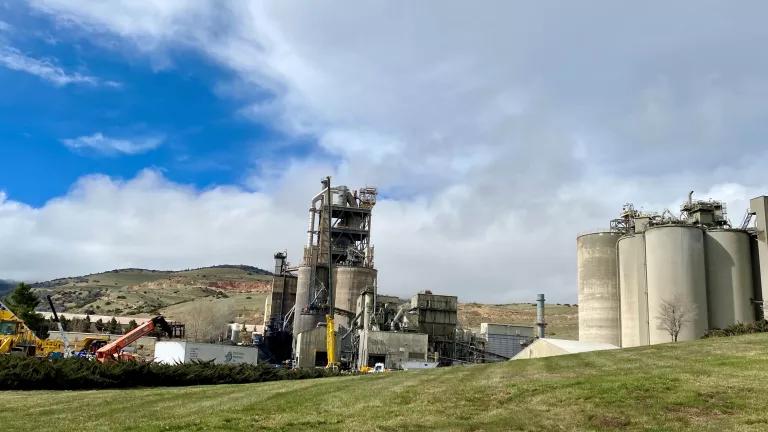
The National Cement plant in Lebec, California
Lauren Kubiak

The U.S. Department of Energy (DOE) in May announced its intention to terminate funding for 24 advanced manufacturing projects, including two innovative California-based cement companies, Brimstone and National Cement. If these projects are fully cut, California will lose a crucial opportunity to modernize its manufacturing base, create high-quality jobs, and to be among the first states to produce net-zero emission cement. This comes at a time when investment in decarbonization is more important than ever to ensure that California can deliver on its emission reduction requirements while ensuring energy affordability.
These projects, to which funding had been obligated earlier this year, are already delivering benefits to their local communities. In Southern California, where National Cement had planned to use its $500 million grant to retrofit its cement plant to produce net-zero emission cement, the company has already successfully demonstrated the viability of a cleaner cement blend, LC3 (limestone-calcined clay). In June, National Ready Mixed Concrete Company completed test pours of walls and slab and found strong performance and strength while reducing emissions up to 34 percent. By replacing some conventional cement—which is very emissions-intensive to produce—with calcined clay, LC3 reduces emissions while increasing the volume of cement that a plant can produce. California imports 20 percent of its cement, some of which could be offset by in-state production of LC3.
Brimstone (headquartered in Oakland) and Gallo Glass (in Modesto) are two other California companies with projects on the DOE’s cancellation list from May. Brimstone secured a $189 million grant to build a facility to manufacture cement without process emissions at commercial scale. Gallo Glass was awarded $75 million to install a demonstration hybrid electric furnace to reduce its use of natural gas and increase recycled content in its glass bottles.
The effect of these supply-side cuts is compounded by the Republican reconciliation package clawback of nearly $32 million that had been awarded to California to help the state build highway infrastructure with clean, innovative, resilient American-made cement.
By cutting funding to these projects, the DOE is putting manufacturing jobs at risk, jeopardizing the commercialization of advanced technologies, and reducing California’s—and the United States’—economic competitiveness.
Background
In March 2024, the federal government announced a significant investment in curbing greenhouse gas emissions from heavy industry. The DOE’s Office of Clean Energy Demonstrations (OCED) planned to give 33 projects up to $6 billion to demonstrate technologies that decarbonize the production of steel, cement, aluminum, and other materials with carbon-intensive production processes.
Brimstone and National Cement were central to the announcement, securing award negotiations for nearly $700 million to demonstrate decarbonized cement production processes. Successful adoption of such technologies would have been crucial to meeting California’s zero-emission cement law, SB 596, which requires all cement used in the state to be net-zero emission by 2045.
Cement, the binder in concrete, is crucial to nearly all our infrastructure but responsible for about 8 percent of global emissions. Its emissions come from its super-high heat requirements that are met via fossil fuel combustion, as well as the chemical reaction where limestone decomposes into CO2 and lime (CaO), the key component of cement. While the combustion emissions are difficult enough to address, the chemical decomposition emissions, or process emissions, are responsible for more than half of cement’s emissions and must be addressed either through carbon capture or a different cement production process. Neither method has been demonstrated at commercial scale, which is where OCED demonstration money came in.
Novel cement production processes: $189 million for Brimstone’s technology
Brimstone was selected for negotiation for an up to $189 million award to build a commercial-scale facility that would demonstrate the startup’s novel technology at scale for the very first time. The company developed a new cement production process that uses a different source rock to produce the same ordinary Portland cement that has been used for the past 200 years. Instead of limestone, Brimstone’s process uses calcium silicate rocks like basalt. Brimstone turns the calcium silicates into CaO. This different source rock eliminates CO2 process emissions inherent in incumbent cement production processes.
Brimstone has been producing its cement at pilot-scale for the past several years. While a promising technology, making the jump from pilot to commercial scale is a difficult hurdle for any nascent company to overcome. The OCED funding was the key to enabling Brimstone to scale its technology to commercial production levels and begin to develop a market for its low-carbon cement. NRDC had cosponsored SB 1073 by Senator Nancy Skinner, with Brimstone and other innovative low-emission cement and concrete companies that would enable California state agencies to purchase these ultra-low-emission cements and thus help create a stable and predictable market for these new products.
Retrofitting existing cement plants: $500 million to retrofit National Cement’s facility
National Cement, which operates a plant in Lebec, California, was the other big project highlight, securing an award negotiation of up to $500 million to decarbonize its existing plant. In operation since the 1960s, the plant has supplied Southern California markets for decades, and its owners had recently begun investing in technologies to reduce emissions. Their OCED application included a suite of emission-reduction technologies that address emissions at each step of the production process:
The first decarbonization lever that can be pulled to reduce emissions from incumbent cement production technologies is through clinker substitution. Clinker, the most carbon-intensive ingredient in cement, makes up around 95 percent of a final cement product by mass and around 10 percent of the final concrete. Yet it is responsible for 90 percent of emissions from concrete.
Other materials that aren’t so emissions-intensive to produce can be substituted to replace up to 40–50 percent of clinker, while increasing performance and durability of the final concrete product. One such material is known as limestone calcined clay, or LC3. National Cement proposed building an LC3 production facility onsite that it can blend with its cements or concretes to address 30–40 percent of emissions.
The second decarbonization lever National Cement proposed was substituting higher levels of biomass into their its. Cement kilns burn notoriously dirty fuels like coal, petroleum coke, and tires to generate the high temperatures required for cement production. National Cement’s kiln currently burns a mix of agricultural waste—including pistachio shells—as well as tires, other types of waste like used carpet, and fossil fuels.
The company's OCED application proposed installation of a kiln technology that can burn higher levels of biomass. While certain types of biomass reduce emissions and air pollution, other types might emit pollutants or have land use impacts, so it would have been important for National Cement to focus on the types of biomass fuels with the lowest emissions, air pollution, and land-use impacts like agricultural wastes in order to realize potential benefits of a biomass-fueled kiln.
The third and final decarbonization lever was post-combustion carbon capture and sequestration, or CCS. Cement’s process emissions cannot be eliminated simply by electrification alone and instead require either innovative technology or carbon capture to abate. National Cement had proposed installing a post-combustion CCS system on its plant, which would have been the first time such a CCS system was installed on a commercial cement production facility in the United States.
Other nascent technologies
There are additional cement decarbonization technologies that are at earlier technology readiness levels but may emerge as viable emission reduction strategies in the coming years. Such technologies include kiln electrification and capture of only process emissions (as opposed to post-combustion CCS, which captures both process and combustion emissions). While neither of these technologies were selected for OCED funding, it will be important to continue to invest in those technologies to ensure we have a full suite of cement decarbonization technologies ready for commercialization.
California policy climate
It’s no coincidence that these two cement companies are located in California. With the adoption of SB 596 (Senator Josh Becker) in 2021, California became the first state in the country to require all cement used in the state to be net-zero emission by 2045. These OCED projects represented a giant step forward. If the state can achieve robust implementation of SB 596, California can play to its strengths as a climate leader and innovator, pushing the envelope on new technologies that will be crucial to meet our climate goals.
But by cutting funding, the DOE is putting jobs at risk and blocking the commercialization of innovative technologies. The DOE should follow through on the commitment it made to U.S. industry and reverse the cancellation of these funds.
This expert blog was originally published on April 11, 2024, and has since been updated with new information and links.
Related Blogs

California on the Frontlines

Caltrans Secures $32 Million for Concrete Decarbonization Programs