After 30 Years, Biodiversity COP16.2 Delivers Hope for Vulnerable Countries
Though more work must be done, the decision on a biodiversity finance mechanism may chart the right course to begin closing the biodiversity finance gap.
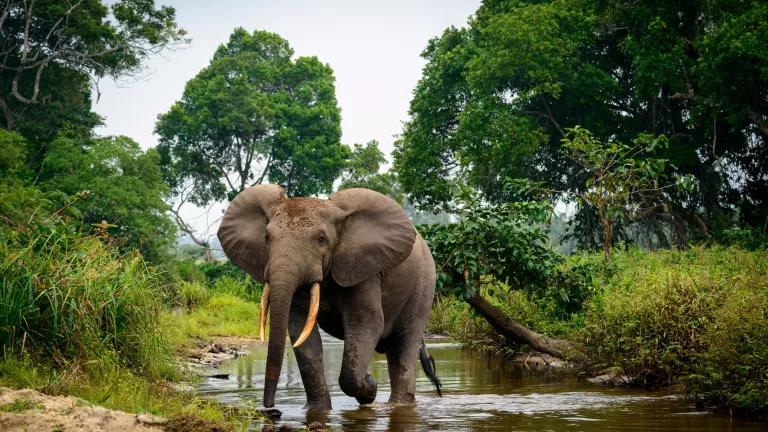
An African forest elephant in Odzala-Kokoua National Park, Republic of the Congo
Education Images/Universal Images Group via Getty Images
This week at a resumed session of the 16th United Nations Conference of the Parties (COP16) to the Convention on Biological Diversity (CBD) in Rome, the world’s governments (minus the United States, which isn’t a Party to the treaty) finally agreed to create the permanent funding mechanism for the conservation and sustainable use of biodiversity that was demanded more than 30 years ago at the 1992 “Earth Summit” in Rio de Janeiro.
Since that time, countries in the Global South have been fighting for an effective, transparent, and equitable mechanism to provide them with badly needed funding to restore and protect their natural ecosystems—their wildlife and wild spaces upon which all life depends—both for their own benefit and for the benefit of all humanity.
Article 21 of the biodiversity treaty adopted in Rio required the creation of a “mechanism for the provision of financial resources to developing country Parties for purposes of this Convention.” The mechanism will be accountable to the Conference of the Parties, which “shall determine the policy, strategy, programme priorities and eligibility criteria relating to the access to and utilization of such resources.” Further, Article 39 of the treaty established a deadline of the first Conference of the Parties to create the financial mechanism, which was held in 1994.
That mechanism has remained elusive, however, as developed countries—which are the most responsible for the biodiversity crisis—have for decades chosen to stick with existing funding mechanisms outside of the CBD over which they assert more control.
But this week in Rome, at a resumed session of COP16, that finally started to change.
Learn More


Nothing is agreed until everything is agreed
COP16 began in Cali, Colombia, in November of last year, and it was the first COP held since the landmark 2022 Kunming-Montreal Global Biodiversity Framework (KMGBF) set out biodiversity goals and action-oriented targets to be achieved by 2030. And while the Parties made several important decisions in Cali, tensions rose as the meeting ultimately failed to reach consensus on the foundational topics of the financial mechanism and mobilization of resources, particularly for the world’s poorest, most vulnerable, and most biodiverse countries.
Frustrated that developed countries were not adequately addressing the Global South’s concerns, the Democratic Republic of the Congo (DRC), with the support of the Africa region, blocked consensus during negotiations on the monitoring framework for the KMGBF until the biodiversity finance issues were decided. But since many Parties had already left Colombia by the next morning, the meeting was suspended because it had lost quorum, necessitating the resumed session in Rome.
As a result, the financial mechanism and mobilization of resources were not the only items on the agenda in Rome. As noted above, the Parties in Cali failed to reach consensus on the monitoring of progress toward the KMGBF goals and targets, and they did not discuss the relationship of the biodiversity treaty with other relevant treaties, including those on climate change, high seas biodiversity conservation, and plastic pollution, among other critical issues, leaving a lot on the table in an uncertain time.
At the outset of the Rome meeting, Susana Muhamad, Colombian president of the COP, assured the DRC and all Parties that nothing would be decided until everything was decided in a bid to ensure progress would be made on all the key pending issues, even while the financial mechanism issues were still being negotiated.

Delegates in the plenary hall during the COP16 biodiversity conference as Susana Muhamad, president of the conference's negotiations speaks, February 25, 2025
Alberto Pizzoli/AFP via Getty Images
We’re 15 COPs too late
Frustrations mounted throughout the meeting as Muhamad’s proposals failed to clearly establish the financial mechanism that should have been created 15 COPs ago or to provide an adequate path to closing the biodiversity funding gap, which is estimated to be around $700 billion per year. It also left out reference target 19(a) of the KMGBF, which calls on developed countries to increase funding for developing countries to $20 billion per year by 2025, something else the developed world has failed to achieve.
Negotiations went back and forth until the last day of the meeting, when Brazil proposed draft text on behalf of the BRICS coalition (originally Brazil, Russia, India, China and South Africa, and more recently, Egypt, Ethiopia, Indonesia, Iran, and United Arab Emirates), which formed the basis of the final text worked out by a small group of countries in the last few hours of the meeting.
Key elements of the COP16 compromise on resource mobilization
The resource mobilization decisions agreed to at COP16.2 essentially create two workflows: one that works to close the biodiversity finance gap and, importantly, one that potentially creates and operationalizes a permanent structure for the provision of financial resources to developing countries, as called for in Article 21 of the treaty, if necessary.
The details of the operation of the permanent structure will be ironed out by the Parties over the next three COPs, or six years, based on certain criteria—including transparency, equity, inclusivity, efficiency, and fairness—and guided by and accountable to the COP.
Parties also agreed to identify impediments to closing the biodiversity funding gap by COP17 and to take steps to remove those impediments by COP18, recognizing that biodiversity funding must be scaled up dramatically if there is any hope of accomplishing the goals and targets of the KMGBF, including the 30x30 target, and taking steps to disrupt the biodiversity and related climate crisis currently gripping the planet.
Erase the phantom of the final plenary in Cali
Once the decision was adopted on resource mobilization, Parties were free to agree to final indicators on pollution from pesticides, consumption of natural resources, and a process to evaluate the suite of indicators being used to measure progress toward KMGBF goals and targets, along with a plan to monitor, review, and report on that progress at upcoming COPs.
Unfortunately, however, the Parties failed to agree on a decision to solidify the biodiversity convention’s collaborations with other biodiversity and climate treaties, due to objections by Japan on including the newly adopted high seas biodiversity treaty and by Russia to adding the agreement on plastic pollution, which is still being negotiated by the U.N. Muhamad withdrew this decision to renegotiate at COP17.
While Muhamad seemed content that the negative vibes from Cali had been erased (the “phantom” of Cali, as she put it), countries have a long way to go and precious little time to achieve any of the 2030 targets agreed to in the KMGBF. Countries are still submitting their National Biodiversity Strategies and Action Plans (NBSAPs) and aligning their national biodiversity targets to global targets—only 46 of the 196 Parties had done so by the close of the meeting—and it’s feared that the global stocktake agreed to in Rome for COP17 in 2026 will show a glaring lack of progress, including toward reaching the biodiversity funding commitment of $200 billion per year, let alone the $20 billion that was promised to developing countries by the end of this year (Global South countries are banding together and demanding accountability in reaching this target).
The next U.N. Climate Change Conference (COP30) in Belém, Brazil, is just a few months away, and the focus will be on safeguarding forests through connecting biodiversity and climate action. Parties to the United Nations Framework Convention on Climate Change and the Paris Agreement have already committed to securing at least $300 billion per year by 2035 for developing countries, but key agreements will need to be reached if any progress is to made. Overall, however, the general feeling at the close of the meeting was one of guarded hope. In this latest test of multilateralism, parties were able to prove that they can still work together to find a common path forward and to do what is necessary to bend the curve on biodiversity loss before it is too late.
Related Blogs

Priorities for Success at the Biodiversity COP
6 Pros of the Wildlife Conservation and Anti-Trafficking Act