
Addressing Energy Efficiency and Hydrofluorocarbon Pollutants Through Regional Centers of Excellence
What CoEs are and why they matter.

Cooling technology, such as air conditioning, is now vital for life as the world gets warmer and warmer.

This blog was written by Akash Goenka with contributions from Prima Madan and Gerry George.
Regional Centers of Excellence (CoEs) serve as collaborative hubs for governments, industries, researchers, and civil society. Regional CoEs that serve a group of countries instead of just one can offer unique benefits. These centers can encourage strategic cooperation, achieve economies of scale, help harmonize policies, and facilitate knowledge sharing across countries. They can also increase funding opportunities by attracting support from donors, multilateral organizations, and private partners, which is especially beneficial for smaller or less-resourced countries. If designed and implemented effectively, regional CoEs will help improve the energy efficiency of cooling equipment alongside the phasing down of hydrofluorocarbons (HFCs), a type of greenhouse gas, in developing countries.
A new report coauthored by NRDC and Alliance for an Energy Efficient Economy (AEEE), Regional Centers of Excellence for Sustainable Cooling: A Strategic Guide for Developing Countries, will be launched at the 37th Meeting of the Parties to the Montreal Protocol (MOP37) in November 2025. It provides an adaptable framework for establishing and managing regional CoEs for cooling in developing countries. It outlines key considerations while allowing for customization based on regional context, geopolitical factors, priorities, available resources, and timelines. The framework emphasizes the importance of avoiding duplication and aligning efforts with existing centers while acknowledging that a one-size-fits-all solution is not feasible. Given the complexity of establishing and sustaining these centers, the guidance encourages thoughtful exploration of various options, enabling relevant stakeholders to choose approaches that are most feasible, streamlined, and flexible.
Evolving discussions on regional Centers of Excellence under the Montreal Protocol
Cooling has become vital for life in a warming world. It helps preserve food and vaccines and keeps homes comfortable during extreme heat. However, inefficient systems that use harmful refrigerants like HFCs worsen the climate crisis.
The Montreal Protocol on Substances that Deplete the Ozone Layer, adopted in 1987, was originally intended to protect the stratospheric ozone layer but expanded its scope to GHG emissions with the 2016 Kigali Amendment. The Kigali Amendment addresses phasing down HFCs and improving energy efficiency. The Multilateral Fund (MLF) of the Montreal Protocol supports developing countries in meeting their obligations through technical and financial assistance.
For several years, developing countries have deliberated over ways in which the Montreal Protocol can help improve the energy efficiency of cooling equipment, a topic traditionally left out of the scope of the protocol, to enhance the climate benefits of phasing down HFCs. In 2022, the MLF approved a $20 million fund for pilot projects integrating energy efficiency into HFC phasedown activities. Then, in May 2024, the MLF approved another $100 million fund to enhance energy efficiency in priority cooling equipment during HFC phasedown. These decisions are a big win for proponents of improving energy efficiency alongside HFC reduction, since they dedicate and operationalize funds for energy efficiency through the MLF in a way that has not been done before. At its 93rd meeting in August 2023, the MLF Secretariat suggested creating regional CoEs, and the MLF Secretariat was eventually assigned to explore the specific functions and sustainable business models for such regional CoEs.
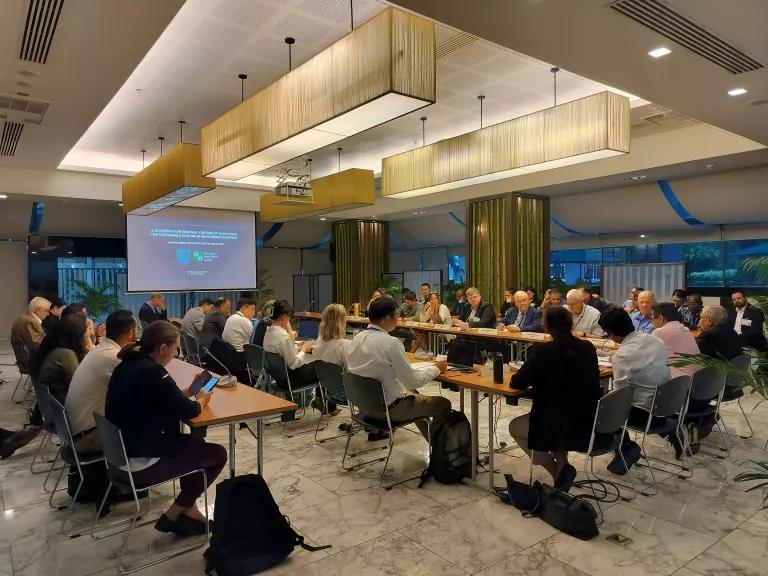
NRDC and AEEE hosted an event at the 47th meeting of the Open-Ended Working Group of the Parties (OEWG47) in July 2025 in Bangkok, sharing early insights from their new report and inviting feedback.
A blueprint for building future regional CoEs
NRDC’s new report provides a blueprint, outlining practical considerations for designing these regional CoEs. It covers everything from governance and funding to staffing and activities while recognizing that each region’s path will differ. It emphasizes avoiding duplication, aligning with existing initiatives, and keeping approaches flexible and context-driven. Based on insights from international experts and lessons learned from current energy efficiency and cooperation models, the report aims to assist stakeholders in choosing options that are practical, efficient, and resilient.
So, what would make a regional CoE effective? From our research, successful CoEs don’t just deliver technical outcomes—they create networks of trust, knowledge, and collaboration. Here are a few simple but important ingredients to achieve that:
- Government leadership is vital. Each participating country needs a dedicated team to assess local needs, identify opportunities, and collaborate on a shared regional plan. This ensures that the CoE addresses real priorities on the ground instead of a one-size-fits-all approach.
- Governance of these centers is equally important. A transparent and inclusive structure, such as a governing council with representatives from governments, academia, and international partners, helps keep things fair, accountable, and responsive. Whether a CoE takes the form of a single hub or a network of smaller centers, flexibility and collaboration should guide operations.
- Of course, none of this can happen without consistent and diverse funding. CoEs should combine multilateral and national support, along with contributions from host countries and income from services like training or testing. Over time, this mix can help the centers become financially self-sufficient while maintaining independence and transparency.
- Finally, people are the most important factor. Skilled local teams and strong organizational structures ensure that the CoE operates smoothly and stays relevant. When the work aligns with larger goals—such as linking energy efficiency with the HFC phasedown, building local capacity, and fostering regional innovation—the results can be immediate and lasting.
As the world progresses with implementing the Kigali Amendment, we are excited to work closely with the MLF and developing-country parties to strengthen regional cooperation and explore the details needed to support developing regions. This next step will help pave the way for establishing effective regional CoEs and connecting energy efficiency, refrigerant transition, and policy coordination to meet growing cooling demands while also reducing emissions. The path ahead will require collaboration, commitment, and creativity, and NRDC is ready to support it.
Related Blogs
10 Years After Kigali: What Comes Next for the Global HFC Phasedown?
World Ozone and Climate Treaty Needs More Eyes on the Sky
