
Communities and Workers Deserve Robust Protection from Chemical Disasters
The EPA’s proposed Risk Management Program revisions roll back crucial safeguards against chemical disasters for people living near and working in industrial facilities.
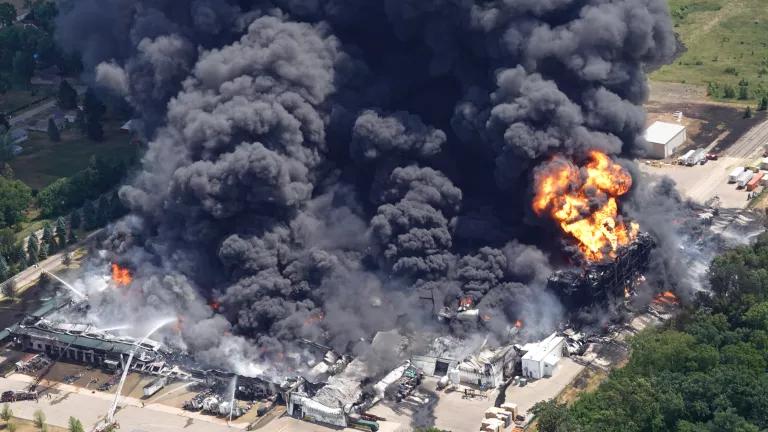

Imagine waking up to a cloud of toxic gas—it hampers your breathing, impairs your vision, makes it difficult to think clearly. Your only recourse might be to shelter in place or to evacuate your home for who knows how long; you don’t know how this will affect your job, your kids’ schooling, or even your family’s survival.
This is what the people of West, Texas, faced in 2013, when a fertilizer storage facility explosion killed 15 people and leveled a whole neighborhood, and it’s a risk that millions across America live with every day. Disasters like this one prompted Congress to pass legislation in 1990 requiring the U.S. Environmental Protection Agency (EPA) to oversee a Risk Management Program (RMP) to avoid such disasters. The RMP requires owners and operators of facilities handling certain toxic or flammable chemicals in the United States to implement a risk management plan that will detect and prevent chemical releases and otherwise minimize their consequences on human health and the environment.
The RMP is meant to protect the estimated 177 million Americans who live in worst-case scenario zones near industrial facilities that handle hazardous chemicals. Communities of color and low-income communities face disproportionate harm from industrial chemical releases. For years, groups like the Environmental Justice Health Alliance for Chemical Policy Reform (EJHA) have been fighting hard to ensure that the EPA regulates industrial facilities to protect these communities. In 2024, EJHA and NRDC participated in a rulemaking to further strengthen the RMP; while the result was not perfect, it incorporated crucial protections for workers and communities living near industrial facilities. Improvements included making sure that workers were involved in facility planning for disaster management and had the authority to stop work if they notice something amiss, as well as requiring the implementation of stricter safety standards for petroleum refineries and chemical manufacturing facilities. Earlier this year, EJHA, Texas Environmental Justice Advocacy Services, and Coming Clean released a report profiling six RMP-regulated facilities in Texas to show exactly why workers and communities still desperately need these updated protections.
The Trump administration is now trying to roll back these critical protections. President Trump’s EPA proposed a regulation earlier this year that would undo the progress we made in 2024; it claims, without basis in fact, that the hard-won requirements of that rule are too burdensome for industry. This proposed rule, which the administration misleadingly calls the “Common Sense Approach to Chemical Accident Prevention,” not only abandons the safety measures instituted by the 2024 rule, but it also fails to fulfill the RMP’s preventative purpose.
Learn More


The proposed rollbacks would exempt many operations from the Safer Technologies and Alternatives Analysis (STAA) that was previously required for any facility undertaking chemical manufacturing or petroleum refining. Under the Trump rule, this more rigorous analysis would only be conducted for new processes entering the program—letting numerous existing processes and facilities with known risks completely off the hook. Facilities like the Pemex Refinery in Deer Park, Texas, would no longer be required to conduct STAA analysis, even though that refinery has had a history of fires and malfunctions since 2023. In 2024, the Pemex Refinery released approximately 27,000 pounds of toxic hydrogen sulfide, which killed two contract workers, injured 35 people, and forced nearby residents to shelter in place. This is the type of preventable harm that the proposed rollbacks would permit unchecked.
The proposed rollbacks would also remove explicit requirements to assess natural hazards and power loss, even though these issues are increasing in frequency and severity with our changing climate. For instance, there are multiple facilities like the ExxonMobil Baytown refinery and the Valero refinery that are located in areas facing extremely high risks of hurricanes and flooding but have not planned for such natural hazards in their RMP submissions. Power loss is often a direct result of natural hazards, like when Hurricane Harvey caused a power outage that led to a fire and explosion at the Arkema Chemical Plant in 2017. Loss of power to the equipment that ensures safe storage and handling of chemicals, as well as loss of power to monitoring equipment that checks for early signs of potential releases, can magnify the preventable harm these releases cause.
The proposed rule would further rescind provisions that give employees agency to protect themselves at work and weigh in on risk management planning. These provisions are crucial to worker safety because workers are closest to the processes involving hazardous chemicals; they both hold expertise and face the most immediate risk of harm. Not only would the proposed rule cut out workers, but it would also withhold vital information from local officials, including first responders and emergency services who need this information to effectively plan how best to protect their communities.
These are just some of the ways in which the Trump administration’s proposed rule fails to protect those who are most vulnerable to harm from chemical disasters. In solidarity with EJHA and many other environmental justice organizations, NRDC submitted comments strongly opposing these rollbacks and urging the EPA to restore the crucial protections of the 2024 RMP Rule. You can read our comments here and stay tuned as we monitor the EPA’s forthcoming response.
This NRDC.org blog is available for online republication by news media outlets or nonprofits under these conditions: The writer(s) must be credited with a byline; you must note prominently that the blog was originally published by NRDC.org and link to the original; the blog cannot be edited (beyond simple things such as grammar); you can’t resell the blog in any form or grant republishing rights to other outlets; you can’t republish our material wholesale or automatically—you need to select blogs individually; you can’t republish the photos or graphics on our site without specific permission; you should drop us a note to let us know when you’ve used one of our blogs.
Related Blogs
New Analysis: Building Material Pollution Harms Communities

Political Control of Research Funding Threatens Sound Science
