
A Glass Half Full? The State of New York’s Lead Pipes in the '27 Budget
There is a very clear need to invest in lead pipe replacement in the state, and the budget should do just that.


In her State of the State address and 2027 executive budget (NRDC '27 budget testimony), Governor Kathy Hochul doubled down on cleaner, safer, more affordable drinking water for New Yorkers as a win-win for health and the economy. She appropriately deemed investing in water infrastructure as something that can “deliver the optimistic and thriving future our children deserve.” The governor’s initial announcement of a robustly expanded fund for clean water drew applause from advocates who know this is a critical year for investment, especially in replacing dangerous lead pipes. However, after diving into the details, we are left wondering exactly what, if any, expansion of investment really lies beneath.
Why do lead pipes matter in New York or its state budget, and why now?
For the 555,000 households in the state getting their drinking water through a lead service line, any serious effort to speed up removing them can bring meaningful relief. These pipes are dangerous: They leach lead—a potent neurotoxin without any safe level—into drinking water.
At a state-policy level, New York has often been ahead of other states in the fight against lead pipes, establishing programs to find these pipes and to begin the process of fixing the problem of lead in school drinking water. These “first generation” laws in New York undoubtedly contributed data and momentum to efforts that have culminated in an EPA safeguard that has utilities throughout the country finally cataloging their pipe materials and making plans to get them out by 2037. Yet there are communities that are suffering ongoing lead-in-water crises and others that are one water-chemistry error away from a catastrophe.
Learn More


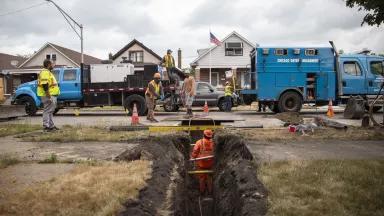
Homes across New York are disproportionately older and have suffered from divestment, leaving residents with outdated infrastructure. Governor Hochul’s announcements of additional state funding to remove lead pipes could be a boon for more affordable and safer water. Replacing these legacy pipes improves health and can provide good, local work, and it does so at a time the federal government threatens to pull back support.
In this year’s budget documents, Governor Hochul makes prescient observations about the need for state government to be a steadying force. “With so much uncertainty coming out of Washington, that plan must be resilient enough to navigate a range of potential detours. We are confronting two truths at once: We have real momentum here in New York, and we face real volatility ahead.” With respect to finally removing lead pipes from distribution systems, this sentiment is playing out in Albany and Washington, D.C. Although there is wide bipartisan support for removing lead pipes, Congress is nonetheless considering wrongheaded rollbacks of the funds to do the replacements that would impact New Yorkers if the state fails to bridge the gap. Families have never needed steady support from their state government more.
The investment of $3.75 billion—$750 million per year—over five years announced in the governor’s State of the State address for clean water infrastructure programs, which includes the important program that addresses lead service line replacement, seemed to be just what was needed to fill any gaps. But after digging into the budget documents, we are concerned that without careful guidance and perhaps even some corrections, this budget falls short of its own aspirations.
While an annual investment of $500 million in the state’s clean water fund is maintained (and we applaud that), it appears additional funds are restricted to housing-related water infrastructure: new development and preservation of existing housing. Preserving and expanding housing are critical moves, and a budget that reflects the values championed in the State of the State does not pit those worthwhile goals against one another. Careful guidance and strategic implementation of these ideas could, for example, leverage the need to remove all sources of lead—including lead service lines—from existing housing stock in the state in the most burdened communities. But the document as written is concerningly far from such a position. There is a very clear need to invest in lead pipe replacement, and the budget should do that.
What does it take to fill up the cup?
The first step is clarity, which the upcoming budget hearings can provide. Advocates and other stakeholders engage in these hearings to understand the budget proposals and advocate for the legislature to propose changes in their respective “one house” budget proposals. In this case, there needs to be clarity on which funds are actually allocated for cleaner and safer water infrastructure and which projects would be eligible for them. There is a long-standing need to create room within clean water funds to allocate dollars to specific types of projects, like lead pipe replacement. We also need clarity and changes for the new money so that preserving the safety of existing housing gets the investment it deserves while removing long-standing hazards like lead pipes.
Investing in lead pipe replacement now, at the beginning of the 10-year window in which utilities must make these changes, will work to ensure that New Yorkers’ dollars go further and that the state starts to realize the benefits of these measures sooner. But more money sooner, while needed, is not sufficient to solve the problem. Officials in charge of distributing funds must do a better job getting funds out the door so they can be more efficiently used for actual pipe removal.
On top of that, there is a huge opportunity in the Lead Pipe Replacement Act, which the New York legislature should pass without delay. This bill would codify best-in-class policies with a proven track record, again leading the way on drinking water. It is also needed to ensure that the replacements are paid for fairly and that the pipe removals are done safely. These measures are both significant and attainable, and it starts with cleaning up the clean water provisions of the 2027 budget. After all, cleaner drinking water is something that everyone can agree is worth raising a glass to celebrate.
Related Blogs

New Map Shows Syracuse Lead in Tap Water Hot Spots

New York State Legislative Session Wraps Up: What’s In and What’s Out?
