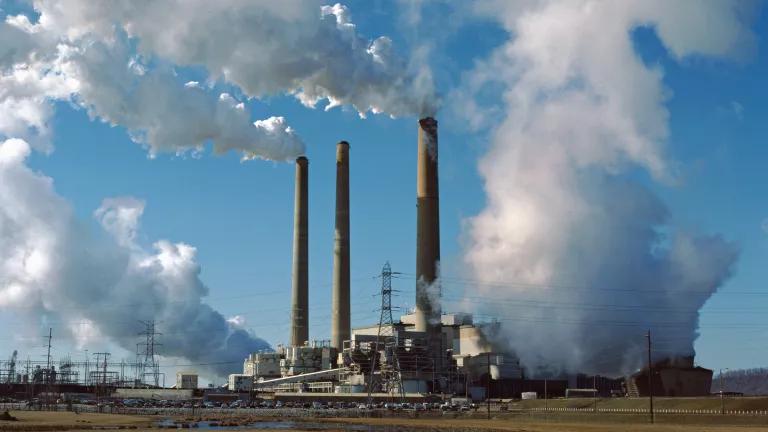
Clean Air Act Rollback Proposal Would Harm People's Health While Denying Basic Rights to Public Participation
Federal and state governments must not risk communities' health by letting wealthy corporations and major polluters build first and ask permission later.

Media Contact
The U.S. Environmental Protection Agency (EPA) issued a rulemaking proposal on May 11 to weaken Clean Air Act permitting requirements and speed the development and construction of data centers and other large industrial polluters before they obtain preconstruction air pollution permits long required by the Clean Air Act. The Clean Air Act rollback proposal touted that the EPA is carrying out a “deregulatory action” under President Trump’s Executive Order 14192: Unleashing Prosperity Through Deregulation.
NRDC opposes the harmful proposal
Isabel Friedman, an environmental health advocate at NRDC, testified at the EPA’s May 28 virtual public hearing, opposing the harmful and unlawful proposal. Here's what she said:
Brenna Williams is a Box Elder County, Utah resident and the sponsor of the citizens referendum on Kevin O’Leary’s proposed 9-gigawatt Stratos data center. At a recent public forum, she discussed her concerns about harmful air pollution that would result if this facility were built. She spoke about her grandchildren who already have asthma and how the Stratos facility would worsen existing air pollution in the county.
Utah residents and other communities fighting similar battles across America are united by one recurring reality: These facilities are being built next door without their consent and often without their knowledge.
The proposed Utah data center would nearly double the entire state’s annual peak electricity demand, the same amount of energy used by all of New York City. It’s likely this energy would come from methane gas combustion, which emits pollutants linked to asthma, respiratory and cardiovascular disease, and premature death.
The EPA’s proposal would allow construction activities to begin before air pollution permitting and threaten the health and well-being of people like Brenna’s grandchildren by denying Utah residents—and all Americans—the rights guaranteed by the Clean Air Act.
For the first time in nearly 50 years, major sources of air pollution, like power plants and data centers, would be allowed to begin construction of their facility without first obtaining required preconstruction permits.
There are three fundamental rights guaranteed by law that the EPA is proposing to bulldoze:
First, the proposal attacks the right of the public to participate in a permit process before any part of the facility is built. The permitting process is a key opportunity for communities to engage in the development of a facility in their neighborhood. The EPA’s illegal proposal would let massive polluting facilities start and finish major construction under the noses of communities before legally guaranteed public input on health and air quality impacts is submitted.
Second, the proposal subverts the Clean Air Act’s right to demand that facilities not be sited in communities at all. The permitting process requires regulators to assess adverse impacts to air quality and lets the public demand a higher standard of air pollution controls and monitoring. However, if this only occurs once the bulk of the project is built, any negative impacts are much likelier to be ignored and swept aside. In this case, Kevin O’Leary would effectively be able to build the entire data center, aside from the polluting generators, all while keeping communities in the dark and not allowing them to voice their concerns.
The proposal undercuts a third right at the core of the Clean Air Act: the unencumbered right that permitting authorities have to deny air pollution permits. If hundreds of millions of dollars are sunk into a project, even in the face of community opposition and harms to air quality, regulators will face too much pressure to approve permits, despite threats to public health. The EPA disingenuously asserts that the appropriate permitting process will continue and this deregulation would just speed things up. But once hundreds of millions of dollars are invested into a project, the political willpower to change course evaporates.
Click here for the full testimony.
What happens next?
The day after the EPA hearing, Utah Governor Spencer J. Cox signed Executive Order 2026-03: Establishing a Higher Bar for Data Center Development in Utah. The order establishes a data center framework that includes a principle to “[p]rotect air quality and airsheds across the state, including not impacting existing non-attainment areas.” The order continues on to acknowledge that “Utahns have expressed legitimate concerns regarding the potential impacts of large data centers on water resources, air quality, utility rates, local communities, and quality of life, and those concerns must be carefully considered.”
What the order and accompanying media do not mention, however, is that Governor Cox signed a law on March 26 that “prohibits certain rules related to environmental health and waste management from being more stringent or extensive in scope, coverage, or effect than any federal law or regulation” in the state of Utah. A “rule involving environmental health and waste management” is specifically defined to include a rule that relates to “air quality.”
In other words, Governor Cox and the Utah legislature now prohibit state agencies from having air quality rules that are “more stringent or extensive in scope, coverage, or effect than” EPA regulations. This would include the scenario where the EPA adopts a harmful rule that lets data centers and other major polluters construct much of their facilities before they obtain preconstruction air pollution permits through the Clean Air Act. The EPA is breaking the law and rolling back decades of Clean Air Act permitting safeguards due to a harmful agenda to let data centers evade public scrutiny and make their siting and air pollution hazards a done deal.
Federal officials sitting in Washington, D.C., must not harm people’s health and quality of life while denying their basic rights to public participation. State officials in Salt Lake City should not sacrifice the air quality, health, and right to public participation of Utahns to speed the unchecked construction of data centers like Stratos—just because federal officials at the EPA want to roll back clean air safeguards. The federal and state governments must not risk Americans like Brenna Williams and her grandchildren and communities like Box Elder County by letting wealthy corporations and major polluters build first and ask permission later.
Related Content

The Data Is Clear

How EPA Rollbacks Will Cost Us—in Dollars and Lives