Community Wins Fight for the Illinois Environmental Justice Act
For the first time, the people who breathe the air get a real seat at the table.
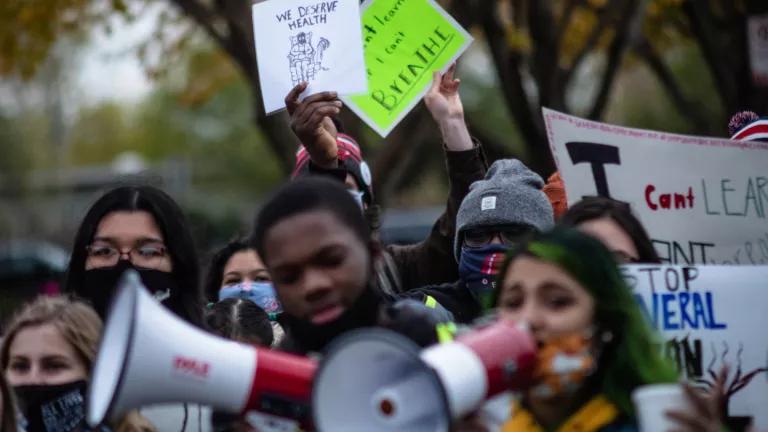
Activists protesting and demanding clean air at the Youth Rally Against General Iron in the South Side of Chicago, October 2020
Sebastián Hidalgo for NRDC

Media Contact
On those precious few Chicago spring days with perfectly warm, crisp winds—when most of the city is rolling its windows down to catch the breeze—my neighbors and I are rolling ours up, in our cars and at home. We have to stay on guard about the air we breathe. Air pollution travels across the whole city, but the concentration of nearly 200 industrial facilities on the Southeast Side threatens our health in a particular way. When all these facilities and the toxic chemicals they emit pile up in one place, the impacts on people accumulate and multiply too.
So when the Illinois House and Senate passed legislation requiring the state to weigh the health of overburdened communities before green-lighting new polluting facilities, I felt relieved—relieved that our state is moving in the right direction, even as the federal government heads the opposite way. This bill came from neighborhoods like mine that refuse to be sacrifice zones any longer.
A fight that started with a car shredder
If you want to understand why this law matters, you have to understand General Iron.
In 2018, a massive metal-shredding operation announced plans to leave a gentrifying, wealthier North Side neighborhood to make room for a multibillion-dollar development and relocate to my working-class community of color on the Southeast Side. My neighbors and I heard the message loud and clear: Pollution that Lincoln Park wouldn’t tolerate was apparently fine for us.
What happened next was the most intense environmental justice fight of my life. My neighbors became investigators, zoning experts, and air quality watchdogs. We organized. We filed a civil rights complaint with the U.S. Department of Housing and Urban Development and the Illinois Environmental Protection Agency (EPA). We stood through a month-long hunger strike. Organizations like the Southeast Environmental Task Force, People for Community Recovery, United Neighbors of the 10th Ward, Alliance of the Southeast, and so many others poured years into this.
In 2022, the city denied the permit. Those civil rights complaints led to historic settlements. We won. But here’s what that victory really exposed. We had to fight that hard, for that long, just to stop one polluter from piling onto a neighborhood already drowning in them. The system wasn’t broken by accident—it was built to let pollution accumulate quietly in Black and Latine communities, one permit at a time.
That’s the gap this new legislation finally begins to close.
What the law actually does
The new law amends the Illinois Environmental Protection Act to require something that should have been obvious all along: Before the Illinois EPA approves a new or expanding source of air pollution in an overburdened community, it has to look at the whole picture.
- The law defines “areas of environmental justice concern” not by a single smokestack but by cumulative burden—combining environmental indicators like fine particulate matter, ozone, diesel exhaust, and toxic releases with socioeconomic realities like poverty, unemployment, and limited English proficiency. The communities scoring in the worst 25 percent statewide finally get the scrutiny they’ve always deserved.
- For permits filed, starting in 2027, the state will have to notify residents and elected officials, hold the door open for public hearings, and ask the questions we’ve been screaming for years. Can these emissions be reduced? What does the applicant’s compliance record look like? Is there a school, a hospital, or a day care next door?
- The Illinois EPA can require stronger monitoring, dust and odor controls, enforceable operating limits, and—when it finds disproportionate harm—prioritize inspections, enforcement, and mitigation. The new law even creates a dedicated Office of Environmental Justice inside the agency, with language access and outreach built in.
It’s not everything. But it shifts the burden of proof. For the first time, the people who breathe the air get a real seat at the table.
Illinois steps up as Washington steps back
This victory lands at a moment when it could not matter more. As the federal EPA retreats—rolling back protections, weakening enforcement, and dragging its feet on the very air quality standards that keep families safe—states are being forced to decide who they answer to.
Illinois is choosing to prioritize communities, not polluters.
When the federal government walks away from the most polluted neighborhoods in America, leadership has to come from somewhere. It’s fitting that in Illinois, it’s coming from the ground up, from the communities that have carried this burden the longest. We are showing the country that you don’t protect public health by gutting the rules. You protect it by listening to the people living next to the problem.
None of this would have happened without the leadership of State Senator Celina Villanueva and State Representative Lilian Jiménez, who carried this fight in Springfield and never let our communities’ voices get lost in the process.
For the next generation
I’ve spent so much of my kids’ childhoods fighting polluters. As their mother, I want to protect them, and for too long, that meant rolling up the windows and hoping. This law is a step toward a different inheritance, where Southeast Siders have a seat at the table and see the state respond to our decades of advocacy by moving in the right direction.
We fought our way here. Now let’s make sure Illinois continues on this path.
Related Content
Pritzker Announces Two Year Suspension of State Tax Incentives for New Data Center Developments
Impact of Chicago’s Environmental Justice Executive Order