Environmental Groups Outline Flaws with Caltrans Highway Expansion
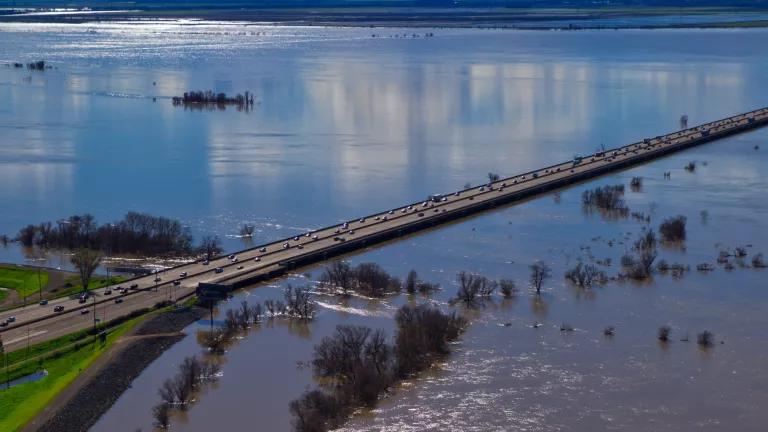
Among the concerns are the impacts on the Yolo Bypass Wildlife Area, home to nearly 200 species of birds, dozens of threatened and endangered species, and critical wetland ecosystems.

Media Contact
Flawed impact analysis is plaguing Caltrans’s highway expansion efforts along California’s Interstate 80 (I-80) corridor from Davis to Sacramento known as the Yolo 80 Corridor Improvements Project. The state agency plans to add lanes in both directions, a move that’s expected to generate more than 100 million miles of additional vehicle travel each year.
If these plans proceed, residents and local wildlife will be left paying the price as congestion, greenhouse gas emissions, and air pollution skyrocket.
The environmental risks that this project poses are of particular concern in the Yolo Bypass Wildlife Area, a 25-square-mile home for almost 200 species of birds, dozens of threatened and endangered species, and important wetland ecosystems.
Legal challenge to Yolo 80
In May 2024, NRDC, the Planning and Conservation League (PCL), and Center for Biological Diversity (CBD) filed a lawsuit under the California Environmental Quality Act (CEQA) to challenge the approval of Caltrans’s planned expansion to I-80.
The suit alleges that the agency used flawed models overstating the traffic benefits that lane expansions may offer, leading Caltrans to artificially favor lane expansions over more environmentally friendly alternatives. These models resulted in significant undercounts of vehicle miles traveled, greenhouse gas emissions, air pollution, and energy impacts. Consequentially, Caltrans failed to disclose and adequately analyze the project’s true environmental impact in its Environmental Impact Report (EIR), so the project will lack adequate mitigation measures.
Further, the complaint addressed Caltrans’s decision to inappropriately use highway repair money and obscure the overall environmental impacts by first widening the corridor through a so-called maintenance and rehabilitation project. The first project, already underway, is using maintenance-only transportation dollars to strengthen the shoulders of the highway so they can accommodate heavy vehicle travel. The second project would restripe the road to accommodate the additional lane of traffic in each direction.
Groups lay out their arguments
In January, the groups filed their opening brief in the case, outlining key arguments and facts.
- First, Caltrans excluded from its analysis the version of the project that was included in the regional transportation plan, featuring more than one tolled lane in each direction, which would have fewer impacts and generate more funding for beneficial investments in regional rail, local public transit, and biking and walking paths.
- Second, Caltrans relied on flawed modeling tools and assumptions that oversold the project’s benefits and undersold the environmental harms, misleading the public and decision-makers.
- Third, while the EIR acknowledges that the project will have significant transportation impacts, Caltrans has declined to mitigate more than half of those impacts.
Public documents related to the project show internal concerns about key traffic assumptions that were used by technical experts in projecting environmental impacts, and they reveal that Caltrans was under pressure to rush the environmental analysis to avoid missing a critical federal grant deadline.
Changes sought
NRDC, PCL, and CBD are asking the court to invalidate Caltrans’s EIR and project approvals and to not open any new lanes until it fixes its EIR and complies with CEQA.
Court date set
A court hearing date is set for May 15, 2025, at 10 a.m. in Alameda County Superior Court.
RELATED CONTENT
Environmental Groups Challenge Highway Expansion Project in Court
Caltrans Offering 1950s-Style False Hope to I-80's Challenges