
LNG Export Projects Threaten a World Heritage Site in Mexico
Three liquefied natural gas terminals on the Gulf of California coast are the last thing this biodiversity hot spot (and the climate) needs.

Balandra Beach in La Paz, Baja California Sur, Mexico

UPDATE: In March 2026, the utility company Sempra announced it would not move forward with its proposed Vista Pacífico LNG export terminal. The move was a win for the coalition of environmental advocates, including NRDC, that have long urged Sempra to abandon the risky project.
In the 1940s, Novelist John Steinbeck described the Gulf of California as “ferocious with life.” World-famous oceanographer Jacques Cousteau reportedly dubbed the gulf the “the world’s aquarium.” They were right. Known locally as the Sea of Cortez, the gulf’s crystal blue waters, which stretch about 700 miles between mainland Mexico and the Baja California peninsula, showcase rich ecosystems of coral reefs, seagrass beds, and mangrove estuaries. Together, they provide habitat to more than 800 types of fish and nearly 40 percent of marine mammal species. Majestic fin, humpback, and blue whales, playful sea lions, enormous pods of dolphins, and the critically endangered vaquita, the world’s smallest porpoise, all live, feed, and nurse their young here. Sadly, overfishing has plagued this ocean paradise for decades, and now the fossil fuel industry aims to further sully this seascape by building three liquefied natural gas (LNG) terminals along its eastern coastline.
“They basically want to use the Gulf of California’s coast as a gas station, piping gas from Texas to Asia,” says Sujatha Bergen, the director of global energy transition within NRDC’s International program.
Pablo Montaño, director of Mexico-based environmental organization Conexiones Climáticas, talks about the importance of protecting the Gulf of California—a biodiversity hot spot that Big Oil wants to turn into a liquefied natural gas terminal that will export dirty fossil fuels all over the world.
And the LNG industry has a ready political ally in President Trump. On his first day in office, Trump lifted the Biden administration’s freeze on LNG export permits and directed the U.S. Department of Energy to restart permit reviews “as expeditiously as possible.” Less than a month later, he gave conditional approval to Commonwealth LNG, an enormous export plant proposed for Louisiana that still needs adequate evaluation from the Federal Energy Regulatory Commission (FERC).
The three proposed terminals in the Gulf of California would obtain LNG from the Permian Basin, a hotbed of fossil fuel activity that spans an area across southeastern New Mexico and western Texas. The plan is for the industry to send its large surplus of natural gas across the southern border via pipeline to the terminals. From there, processors would cool it into a liquid state (a very energy-intensive undertaking) before shippers would export it across the Pacific Ocean. (An alternative would be to ship the LNG from existing terminals on the Louisiana coast and then, eventually, through the Panama Canal.)
If completed, the projects—Saguaro Energía, AMIGO LNG, and Vista Pacifico LNG—would lock in decades more of fossil fuel extraction and, of course, thwart climate goals to limit global warming to 1.5 degrees Celsius. The LNG terminals would also take a devastating toll on the Gulf of California’s delicate marine ecosystems.

More LNG terminals are a bad idea—for the climate, for communities, for marine mammals
The LNG industry is a major climate polluter. At every step of its production process—fracking, transporting, liquefying, and eventual regasification overseas—there are leaks of methane, a potent greenhouse gas. In its first decades after emission, methane traps about 80 times as much heat in the atmosphere as carbon dioxide. In fact, a recent study out of Cornell University found that, in the end, the carbon footprint of LNG is 33 percent larger than that of coal.
“It’s that when you industrialize a World Heritage site, you destroy it.”
Joel Reynolds, senior attorney, Nature, NRDC
Learn More: LNG
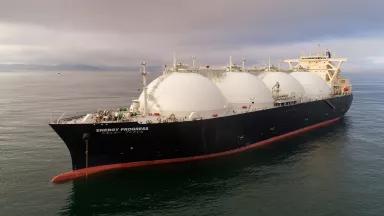
The largest of the terminals would be Saguaro Energía LNG, proposed for construction in Puerto Libertad, Sonora. If completed, it would have the capacity to produce 30 million tons of LNG each year. AMIGO LNG would be farther south in Guaymas, Sonora, and even farther down the coast, Vista Pacifico LNG is sited for Topolobampo, Sinaloa. The AMIGO and Vista Pacifico terminals could produce 4.2 million tons and approximately 3.5 million tons per year, respectively. For reference, one million tons of LNG is the carbon emissions equivalent to around 600,000 gas-powered cars driven for a year.
Exporting LNG also presents dangers on the ground and at sea. A 2023 FrakTracker Alliance report revealed that of the more than 8,100 pipeline incidents in the United States between 2010 and 2023, natural gas pipelines accounted for a very large majority of the explosions, fires, evacuations, injuries, and deaths. Meanwhile, the Gulf of California’s marine life would be especially vulnerable to enormous tankers shipping the LNG from port to port. LNG shipping tankers are on average around 980 feet long, roughly the length of two and a half football fields. This makes them a sizable threat to the area’s exceptional whale and dolphin populations through potential ship strikes, noise pollution, and LNG or oil spills.
“This isn’t just a question of what the climate impacts would be of continuing fossil fuel development,” says Joel Reynolds, a senior attorney with NRDC’s Nature program. “It’s that when you industrialize a World Heritage site, you destroy it.”

A California sea lion near Espiritu Santo Island, Baja California, Mexico, Sea of Cortez
The Gulf of California is no place for exporting LNG
UNESCO designated the Islands and Protected Areas of the Gulf of California as a World Heritage site in 2005. In the gulf’s northernmost stretches, a UNESCO Biosphere Reserve helps protect unique volcanic formations and an outstanding diversity of plant life. Six years ago, the gulf joined the List of World Heritage in Danger sites, due in part to the near extinction of the vaquita, an endemic porpoise that is dying in fishing nets at unsustainable rates.
“UNESCO designations are a way of identifying the best that the world has, and the host countries are the ones who nominate the sites,” says Reynolds. So while Mexico cares about the fate of the Gulf, he points out, the country’s National Commission of Natural Protected Areas, which manages the heritage site, has been facing consistent budget cuts for the past eight years. The dearth in funding has made it difficult to oversee the 4.7 million acres of the site’s land and waters.
One of the biggest challenges is addressing the rampant overfishing taking place in the Gulf. The fishing industry plays a large role in supporting local economies, especially in the Upper Gulf of California, where the annual catch value is around $3.5 million. But overfishing and illegal fishing, combined with the effects of climate change, have led to a decline in the region’s populations of smaller pelagic fish, such as sardines, which serve an important role at the base of this marine ecosystem.
The loss of such fish harms countless species and habitats. For instance, the gulf is an important breeding ground for endangered seabird species, but without an adequate food supply, these birds are struggling both to find mates and to reproduce. Industrial fishing practices, such as bottom trawling and the use of gillnets, can also damage the seafloor, along with coral reefs, and contribute to biodiversity loss through accidental bycatch of endangered species, such as the vaquita.


Clockwise from top left: Participants from Conexciones Climaticas, NRDC, BCSiscletos, and Say No to LNG before the "Ballenas o gas?" public hearing in downtown La Paz, January 22, 2025; brown pelicans fishing in the waters of the bay of La Paz; Claudia Campero of Conexciones Climaticas presenting during the "Ballenas o gas?" hearing.
Meghan Dhaliwal for NRDC
; 2)Meghan Dhaliwal for NRDC
; 3) Meghan Dhaliwal for NRDCHow NRDC and other environmental groups are fighting back
“The fate of the Gulf of California watershed may be one of the most consequential land use decisions anywhere in the world today,” wrote Reynolds and Bergen in recent open letters to the project’s developer, Mexico Pacific, and its private equity owner, Quantum Capital. The letters urge the companies to cancel the Saguaro project, which would open the door to the other two LNG terminals and further industrialization of the Gulf.
Financing remains an obstacle. Mexico Pacific needs to land $15 billion in investments just to start construction on the Saguaro terminal. And because the LNG market is volatile, the risk for potential investors is high. “Mexico Pacific is a new entity, so it doesn’t have a track record of its ability to complete projects,” says Bergen, offering a potential explanation as to why the project is having difficulty securing funding.
Investors may also be reluctant over the fact that the project is currently battling three separate lawsuits. The first concerns FERC’s approval last year of the 1,000-foot portion of the pipeline that would cross the U.S.-Mexican border in Hudspeth County, Texas. The lawsuit—filed by the advocacy groups Sierra Club and Public Citizen—argues that the agency needs to review the entire U.S. section of the pipeline, not just the small border section.
The other two lawsuits are playing out south of the border. One involves the Mexican nonprofit Defensa Ambiental del Noroeste, which is challenging Mexico’s environmental review of the project. The other concerns a private landowner whose lawsuit won an injunction against pipeline construction on the property for the time being.
NRDC has also filed a resolution with the International Union for Conservation of Nature for consideration at its World Conservation Congress this year, in the hopes of bringing global attention to the Gulf of California’s plight. After all, for wary investors, being complicit in the destruction of a World Heritage site is a decidedly bad look.
This NRDC.org story is available for online republication by news media outlets or nonprofits under these conditions: The writer(s) must be credited with a byline; you must note prominently that the story was originally published by NRDC.org and link to the original; the story cannot be edited (beyond simple things such as grammar); you can’t resell the story in any form or grant republishing rights to other outlets; you can’t republish our material wholesale or automatically—you need to select stories individually; you can’t republish the photos or graphics on our site without specific permission; you should drop us a note to let us know when you’ve used one of our stories.
Our seas aren’t gas stations!
Mexico Pacific has been trying to turn a marine sanctuary into a gas station and shipping channel for dirty liquefied natural gas. Tell it to reverse its plans!

Our seas aren’t gas stations
U.S. energy company Mexico Pacific has been trying to turn a marine sanctuary—home to nearly 40 percent of all marine mammal species—into a gas station and shipping channel for liquefied natural gas. Tell Mexico Pacific to reverse its plans to export dirty energy out of the Gulf of California.
A Snorkeler’s-Eye View of the Gulf of California
From Whales to Walruses, Sea Mammals Are Under Attack—and So Is the Law That Protects Them
Single-Use Plastics 101