
The Federal Clock Is Ticking: Actions Chicago Must Take to Get the Lead Out
Getting all the lead service lines out is complicated, but it is worth it and necessary for the viability of its future.

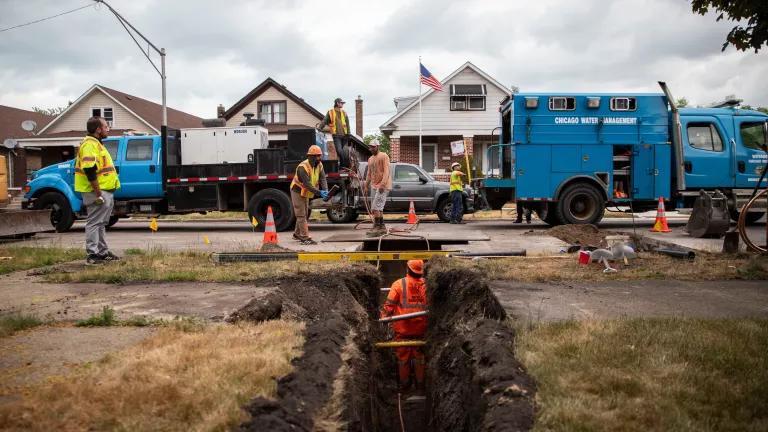
Workers unrolling new copper line while replacing a lead service line outside a home in the West Roseland neighborhood of Chicago
Chicago has the most lead service lines (LSL) in the country. The city is currently replacing its lead pipes on a 50-plus-year replacement timeline under Illinois state law. With the federal Lead and Copper Rule Improvements (LCRI) timeline quickly approaching, the city must adjust its plan to meet a new replacement schedule of around 20,000 lines per year to comply with the approximate 20-year requirement under federal law. The city has only replaced around 8,000 of its 412,000 known lead lines since the program started in 2021. This is a huge shift from its current pace, and to do this work effectively, city officials must address the administrative hurdles that are hindering progress and make significant investments in public outreach to improve planning, transparency, and execution.
A city council hearing surfaced some of these challenges, prompting alderpeople and journalists to ask questions about the Department of Water Management’s (DWM) LSL progress. When the city missed an important federal Lead and Copper Rule requirement (LCRR) to notify residents with lead service lines and provide public health resources, officials cited postage and administrative costs as primary barriers. They also mentioned that the city could only handle sending 3,000 notifications per week, while other cities made more progress. By addressing some of its hurdles, not only will Chicago increase the pace of its replacement program but also deepen public trust.
What we need to do
DWM announced a public hearing to discuss the intent to apply for $28 million in funding from the Illinois EPA’s Public Water Supply Loan Program to support lead service line replacement (LSLR) projects across census tracts. DWM is required to update and publish its LSLR plan annually under state law. Chicago’s current replacement plan is still structured around the state’s 50-year replacement timeline, with a goal of replacing 8,300 LSLs a year starting next year.
In light of the federal EPA doubling down on its defense of the LCRI to accelerate LSL replacements across the country, here are a few considerations DWM should take to ensure it is prepared to scale its replacements from approximately 8,300 to 20,000 in 2027.
- Publish a strategic spending plan: Last year, it was revealed that the city has struggled to get LSL funds out the door. It is important that we maximize the funds currently at our disposal and get them out the door as soon as possible. In addition to sharing how many lead pipes the city plans to replace this year, officials should also publish a monthly or quarterly spending plan with neighborhood-level targets that outlines how and where funds will be spent. This improves transparency and public trust because instead of waiting for an annual summary of their replacement progress, the information is made public on the front end to track milestones and promote accountability.
- Explore alternative financing options: While the city works to get current LSL funds out the door, it must also use additional financing options to get the lead out in a sustainable way, given limited state and federal funding. The city should use the water utility budget to pay for replacing the entire line and avoid the dangerous practice of partial replacement, which can release more lead into the water. That means not just the pipe from the water main to the curb stop (public side) but also the pipe that connects directly to people’s homes (customer side). The city believes it is unable to use water revenues to pay for customer-side replacements, which places residents in an peculiar position: If you can’t afford thousands of dollars out of pocket, or don’t qualify for a city-run LSLR program, you are overlooked and can’t get your lead pipes replaced. LSLR should not be treated any differently from other critical water infrastructure projects. The city could finance those costs through tax-exempt bonds and spread the costs over time. Not only is it a more sustainable financing solution, but it is also the most equitable approach to avoid further burdening those already impacted by lead in their drinking water.
- Invest in robust public outreach: The public health harms of lead in drinking water are well documented, but it is important that this information reaches residents so they understand the importance of replacing their lead pipes. Trusted partners, such as block club presidents, faith leaders, and organizations with deep community ties, are needed to help disseminate information and meet residents where they are. Cities that have replaced their lead pipes more quickly than Chicago are investing in on-the-ground partnerships instead of relying solely on government workers and contractors to deliver the message. The Principles for Lead Service Line Replacements is a good resource to model its program and ensure the communities most vulnerable to lead in drinking water are adequately prioritized in the process.
-
Restructure contracts to maximize work: When contracts are too short, infrequent, or lack specificity around project location and scope, contractors struggle to bid on projects, and the city can’t scale its LSL program because it can’t deploy enough crews to tackle multiple areas concurrently.
This year, Chicago announced $1.6 million in contracts to expand participation in its lead service line replacement programs, incorporating feedback gathered from contractors during listening sessions on how to improve the program. This is a step in the right direction to help restructure contracts, get more crews on the ground, and prioritize most impacted communities, leading to more competition, greater predictability, and better coordination. This approach could also bring down costs because it would open the door for more block-by-block replacements to improve efficiency and improve cost savings, as we have seen in Newark, New Jersey, that which replaced 23,000 lead pipes in under three years while developing a local hiring program to work alongside unions and contractors. `
- Improve the restoration process: During a 2023 hearing, DWM shared that it launched a division on restoration to help reduce the amount of time residents must wait to have their property restored after a replacement. Depending on the LSL removal method used (the “pull-through” method is the most cost effective and less disruptive), the amount of time and resources needed to restore the street, sidewalk, or property as close to its original appearance as possible, varies. According to DWM, restoration is one of the largest contributors driving its high-cost estimates. In the spirit of transparency, DWM could provide quarterly status updates on the division's effectiveness, including details about completion time, resident feedback, and any key changes to plans that have led to increased efficiency. Shorter project durations and increased cost savings from more efficient project implementation will play a role in lowering per-line replacement costs.
Where we want to be
Chicago still has a lot of work to do to improve its LSLR program, but it's a challenge worth tackling to deliver residents, especially our children, safer drinking water for generations to come. Cities like Newark have shown us what’s possible when the work is treated like the urgent public health crisis it is. NRDC worked with the Newark Education Workers Caucus to call attention to and demand accountability for drinking water violations impacting Newark residents, leading to an aggressive LSLR program at no direct cost to residents.
Newark’s program included key provisions, such as allowing tenants to give contractors permission to replace their lead pipes, realizing that tracking down absentee landlords only hinders progress and denies residents the autonomy to protect themselves from lead in drinking water. This is one of several examples of how Newark was able to get their lead pipes out in a short amount of time, but it took deliberate actions and political will to address its administrative, public outreach, and workforce issues to speed up the process and prioritize its most impacted communities.
Chicago has an opportunity to do the same, and while more state and federal funding for this work are needed, we already have a ton of resources at our disposal to set ourselves up for success ahead of the expedited federal timeline.
Related Blogs
What the EPA’s New Federal Water Rule Means for Chicagoans

Q&A: Chicago’s Drinking Water Problem Needs a Real Solution
