EPA Undermines the HFC Phasedown
A proposal to delay the shift away from climate super-pollutants will hurt consumers, industry, and the climate.


In the sea of conflict over climate change policies, there’s been one island of relative calm, where industry and environmentalists—and officials of both political parties—have worked together to phase down the potent climate-warming chemicals called hydrofluorocarbons (HFCs).
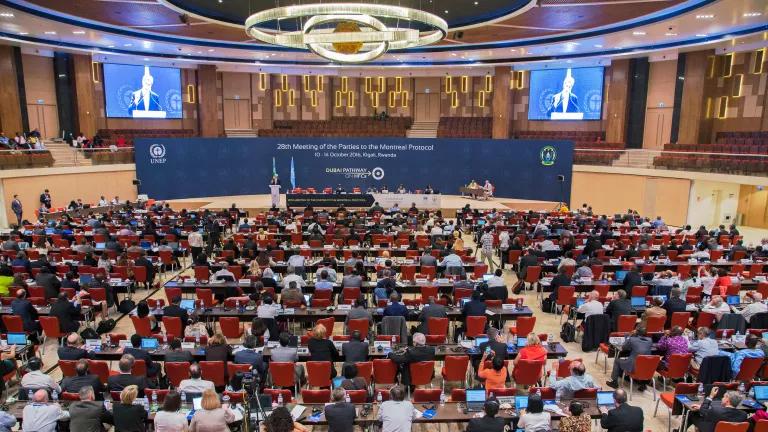
Used primarily in heating and cooling equipment, HFCs are among the fastest-growing climate pollutants in the United States and the world. The very refrigerants that keep our food fresh and help keep billions of people cool in the face of extreme heat are also accelerating warming. Reducing these gases is critically important, and timely implementation of the Kigali Amendment—the U.S.-ratified treaty to phase down HFCs worldwide—could prevent an additional 0.5 degrees Celsius of warming by 2100.
Learn More

The American Innovation and Manufacturing (AIM) Act, enacted by Congress and signed by President Trump in 2020, was the first major piece of climate legislation to cross the finish line in two decades. The U.S. Environmental Protection Agency (EPA) got off to a fast start by implementing rules that earned praise and support from both industry and NRDC while also aligning with the obligations under Kigali.
Now, however, Trump’s second-term EPA administrator, Lee Zeldin, is threatening to upend the first Trump administration’s singular environmental and economic achievement. Listening to a small group of foot-dragging companies, Zeldin has proposed delaying key deadlines for transitioning to safer alternatives in supermarkets, food warehouses, and other key applications.
Even though Zeldin dismisses climate change as “religion,” we thought he’d listen to the bulk of the industry that supports the HFC phasedown. These companies have accepted the science and invested in making new refrigerants and new cooling and heating equipment. They have already installed them in thousands of stores and other facilities. Instead, Zeldin is undercutting them by catering to a few corporate laggards.
The 2023 HFC Technology Transitions rule had the potential to avoid emissions equal to hundreds of millions of tons of carbon dioxide between now and 2050. Now, the new EPA proposal is taking two big steps backward while the agency still has not acted on a third measure, despite support from both industry and environmentalists.
Supermarket slowdown
More than 2,800 U.S. supermarkets and food stores have already installed refrigeration equipment that uses carbon dioxide or other alternatives to high-potency HFCs in new or rebuilt stores. Companies have hundreds more conversions planned for next year. The EPA regulations required all stores built or rebuilt after January 1, 2027, to use those alternatives.
Even though there are thousands of stores using the new technologies already, a small splinter group of companies has fought the requirement. When they sued over the 2023 regulations, NRDC opposed them. Most observers expected them to lose, but the court did not decide the case before the change of administrations. Under President Trump, the EPA asked the court to hold off while it considered changes sought by a splinter group. Now the EPA has proposed extending the supermarket compliance deadline an additional five years, to 2032.
This change is not supported by the industry at large, however. Indeed, the industry’s two main trade associations—the Air-Conditioning, Heating, and Refrigeration Institute (AHRI) and the Alliance for Responsible Atmospheric Policy—representing hundreds of manufacturers, opposed the proposed changes, noting that shifting the compliance dates and global warming potential (GWP) limits in this sector would unnecessarily raise HFC demand and increase costs across the industry. NRDC also opposed the proposed changes for supermarket systems, and if the EPA finalizes the delay, the agency should expect more legal challenges.
Cold storage warehouses get the cold shoulder
Ammonia—a refrigerant with no climate-warming potential—has been used in cold storage warehouses for decades with appropriate safeguards and has a proven track record of safety, cost-effectiveness, and energy efficiency. As the EPA noted in the final 2023 rule, most cold storage warehouses in the United States are already using ammonia. The final rule also included a thorough evaluation of safety concerns and an assessment of available alternatives, all of which led the EPA to determine that it was feasible for cold storage warehouses to use ammonia or other relatively low-potency alternatives (under 150 or 300 GWP) by January 1, 2026.
Another splinter group, however, successfully lobbied Vice President J.D. Vance and Zeldin to weaken the rules. The EPA proposed to push back the cold storage warehouse compliance deadline from 2026 to 2032 and to more than double the GWP limit to 700. Despite the prevalence of ammonia and directly contradicting its conclusions in the 2023 rules, the EPA alleged new concerns over available alternatives and safety without any supporting data.
Again, the larger industry does not support weakening the standards. In its comments, Heating, Air-Conditioning & Refrigeration Distributors International—representing more than 500 U.S.-based wholesale distribution companies—said the technologies exist to meet the current rules and raising the GWP limit just reflects some companies’ unwillingness to comply. NRDC also opposes the proposed changes for cold storage warehouses.
Chop-and-drop loophole remains open
The new proposal also leaves open a gaping loophole in the 2023 rule’s provisions for residential air-conditioning systems. That rule allowed unlimited import of condensing units filled with high-potency HFCs. These can be used to repair broken systems in a piecemeal fashion, busting limits on the amount of those high-potency HFCs that can be made here at home. Having no deadline for such components to use lower-potency HFCs creates a loophole that allows old air conditioners to be patched up well beyond their expected useful lives. While that may sound attractive at first, these units are both leaky and energy inefficient, costing American homeowners more over the long run. Importing these components also undercuts U.S. refrigerant and equipment manufacturers that are already producing and selling the better alternatives.
The chemical producer Chemours and AHRI filed petitions seeking to close this loophole, but the EPA has chosen not to respond. NRDC supports the companies’ request as well.
Conclusion
Zeldin’s stated goal is to save Americans money, but the proposed rule will not do so. It will hurt companies that have played by the rules and adopted new, cost-effective technologies and help those that are dragging their feet. It will worsen the risk that HFC demand will stay artificially high, even as HFC supply is phased down as required by the AIM Act, which will only leave consumers facing higher bills. The delay would also reduce American competitiveness in the new global markets for climate-friendlier refrigerants and equipment emerging under the Kigali Amendment.
Related Blogs

We Can't Afford to Slow Down on Climate Action
10 Years After Kigali: What Comes Next for the Global HFC Phasedown?