
Building Community Resilience Through Smarter Oil and Gas Revenue Policy
There are real fiscal risks of failing to plan for the volatility of the fossil fuel industry when the industry inevitably winds down.

Traffic on a highway in Las Cruces, New Mexico
Yifu Wu


Two things about the oil and gas industry have always been true. First, sooner or later, one way or another, the oil and gas industry’s days in a given place are limited. Second, oil and gas have always been boom and bust. Reserves run dry; a company moves to a more attractive area; another energy source (or sources) will make it uncompetitive; geopolitical and market forces beyond our control catalyze wild swings in demand, supply, and price. The only question is how the communities that have hosted and supported the industry will fare after its departure or demise.
NRDC supported new research from Resources for the Future (RFF) Save It or Spend It? How New Mexico, Pennsylvania, and Texas Manage Oil and Gas Revenues for the Future. The study provides one of the clearest pictures to date on the major differences between how major fossil fuel–producing states collect and distribute oil and gas revenues. The study sheds new light on the fiscal impacts of extraction—and on the outsize financial risks faced by the communities living closest to it.
For decades, oil- and gas-producing communities have lived with a dual reality: They bear the environmental, health, and infrastructure burdens of extraction while their local budgets rise and fall with volatile commodity markets. The RFF analysis shows how stark that volatility is and how few protections exist for the counties, municipalities, and school districts that depend on these revenues to provide basic public services.
This is not an argument about the long-term decline of fossil fuels. This is about the demonstrated volatility of the industry today, the well-documented impacts on frontline communities, and the real fiscal risks of failing to plan for that volatility and the inevitable future when the industry winds down.
Volatility is a structural feature of the oil and gas industry—not a future risk
RFF’s findings show that New Mexico, Texas, and Pennsylvania take very different approaches to taxing oil and gas production, but they share one core weakness: None of them provides consistent and predictable revenue protection for local governments.
- In New Mexico, the state has built strong long-term savings funds and pioneered some innovative uses of funds, but counties and municipalities still face highly unstable annual revenue streams.
- In Texas, property tax rules create a one-way ratchet—rates fall during booms but are extremely difficult to raise during downturns—forcing communities to absorb deep losses when prices fall.
- In Pennsylvania, communities rely heavily on drilling-dependent fees that swing sharply with market cycles, with no permanent savings or smoothing mechanisms.
These shortcomings matter because oil and gas markets remain inherently volatile. Boom-bust cycles are not a hypothetical future; they are the defining characteristic of the industry’s past and present. Yet frontline communities—those providing labor and emergency response, maintaining the roads damaged by heavy truck traffic, and funding schools—have the fewest tools to manage it.
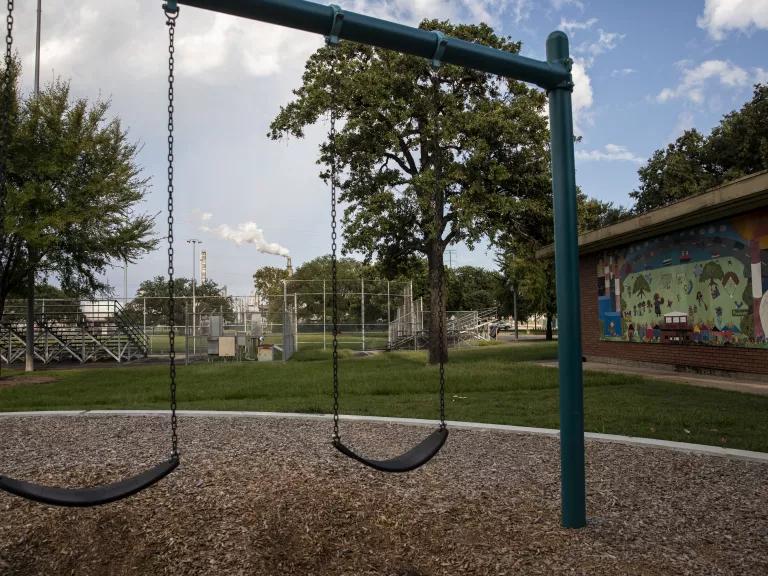
A playground at Hartman Park in the Harrisburg/Manchester neighborhood beside the Valero Houston Refinery located on the Houston Ship Channel in Texas
The communities bearing the burden are the least protected
Extraction often occurs in rural counties with limited fiscal reserves and high infrastructure needs. These communities experience a cascade of effects:
- Increased air and water pollution
- Higher demand on emergency services
- Road deterioration from heavy truck traffic
- Housing-market spikes during booms
- Associated needs (e.g., schools) to accommodate a population that can rapidly swell and then shrink
- Sharp revenue losses during busts
And yet, as the RFF report illustrates, none of these top-producing states has designed its revenue system to prioritize stability or resilience for the communities facing these impacts.
Simply put: The people living closest to extraction carry all the environmental, health, and fiscal risks.
Other governments show what it looks like to save more and protect communities
International and U.S. examples show that it is possible—and prudent—to collect more revenue from extraction and channel it into long-term community benefits.
Norway offers perhaps the most well-known model. The government has long ensured that “a large share of the value creation accrues to the state,” and upstream petroleum activities face a marginal tax rate of 78 percent (combining its corporate tax and special petroleum tax).
Revenues are invested in the country’s sovereign wealth fund, the Government Pension Fund Global, which was created “to shield the economy from ups and downs in oil revenue” and to ensure that both current and future generations “benefit from our oil wealth.”
North Dakota demonstrates how a U.S. state can apply similar principles. Its constitutionally created Legacy Fund receives 30 percent of oil and gas production and extraction taxes—automatically saving a meaningful share of revenue “for the benefit of future generations.” The fund not only preserves wealth but also channels part of its capital into in-state investments such as infrastructure loans, community bank deposits, and equity investments in emerging local businesses.
While the scale of resources differs, the core lesson is the same: Higher revenue capture paired with long-term savings leads to greater stability and greater community benefit.
States can act now to reduce fiscal risk and strengthen community resilience
States and local governments must modernize oil and gas revenue systems so that local communities are not left exposed to unpredictable swings in global energy markets. Three priorities stand out:
1. Stabilize local revenue streams
States can create smoothing mechanisms, baseline minimum payments, and local stabilization funds that ensure communities receive reliable annual funding, regardless of short-term booms or busts.
2. Ensure communities receive a fair share
Producing counties should consistently receive commensurate revenue, given the long-term impacts of extraction on their land and communities, from abandoned wells to road maintenance to health impacts to emergency response and beyond.
3. Establish or expand long-term savings funds
Permanent funds—whether statewide or designed to benefit producing regions—can transform volatile revenue into durable, intergenerational support for education, infrastructure, and economic development.
Volatility is inevitable. Fiscal harm is not.
The RFF research provides a clear, objective grounding for what frontline communities have long understood: Oil and gas revenues are unstable, and without intentional policy design, that instability lands hardest on those living closest to extraction.
States have the tools to do better. They can plan for volatility, save more, protect more, and ensure that the communities that have powered our energy economy for decades are equipped not only to weather the next price cycle but to thrive beyond it.

Say no to the Trump administration’s plan to open up our waters to oil and gas drilling!
The Interior Department is proposing to expand oil and gas drilling across more than ONE BILLION acres of U.S. waters. This will threaten endangered whales, generate toxic air pollution, and put coastal communities and economies at risk of oil spills and other drilling impacts. Submit your public comment now opposing this proposal.
Related Blogs

COP29: Key Outcomes Signal Need to Deliver Greater Climate Action
A Summer of No Sanctuary
