California Crab Fishery Leads the Way in Pop-Up Fishing
California is the first state in the nation to oversee a large-scale, commercial pop-up fishing season aimed at protecting marine life.

Many whale species—like the entangled humpback whale shown here—are at risk from accidental entanglement in fishing gear, particularly the vertical lines associated with pot and trap fisheries.

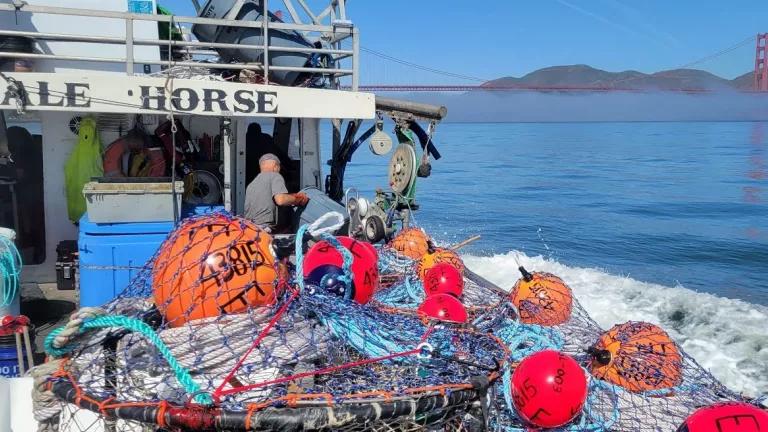
The California Dungeness crab fishery has completed its first commercial season using pop-up fishing gear, a new technology that helps prevent entanglements of whales and sea turtles.
Preliminary results indicate that around 29 commercial crab vessels fished with pop-up gear in the spring and summer, when the fishery was otherwise closed to protect migrating whales from entanglement. Nearly 151,000 pounds of crab were landed, worth about $1.2 million.
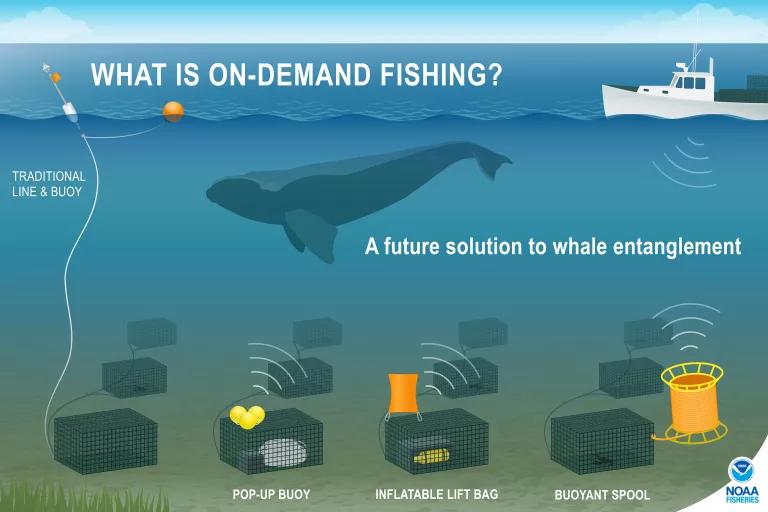
Whales and sea turtles are vulnerable to accidental entanglement in the vertical buoy lines used to mark the location of crab and lobster traps that are on the seabed. Pop-up fishing gear (also known as “on-demand” or “ropeless” gear) works by storing the lines at depth, or replacing them entirely with a lift bag, until the captain is ready to retrieve the pot or trap. In doing so, whales and fishers can safely coexist. Pop-up fishing gear also dramatically reduces the risk of gear loss, helping to prevent ghost fishing and decreasing marine pollution.
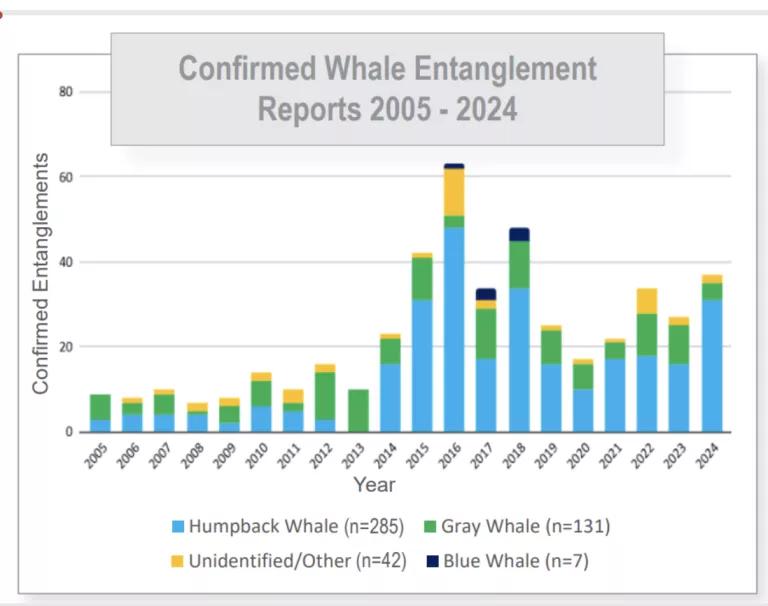
There has been a significant increase in entanglements off the western coast over the past decade. A growing incidence of marine heat waves and other shifts in the climate now frequently compress cool-water habitats shoreward. This compression concentrates whales and their prey closer to the coast and increases their risk of interaction with fisheries operating in the same area.
Learn More

Entanglements in Pacific Coast fisheries pose a survival risk to several species, including an endangered population of humpback whales that migrates between breeding grounds in Central America and feeding areas off the western coast; the fewer than 50 surviving North Pacific right whales; iconic gray whales; and leatherback sea turtles. Even the blue whale, the largest animal to have ever lived, is not immune to becoming entangled in rope.
The California Department of Fish and Wildlife led the West Coast in approving pop-up fishing gear developed by Sub Sea Sonics and Guardian Ropeless Systems as an “alternative gear” to commercially catch Dungeness crab between April 1 and July 15. The approval followed several years of collaborative testing of pop-up fishing gear in the fishery, including two seasons of extensive field trials.
The gear manufacturers played a key role in making pop-up fishing a reality in California. Sub Sea Sonics and Guardian Ropeless Systems oversaw three increasingly successful years of experimental fishing and the implementation of the first commercial fishing season, including by providing 24/7 technical support. They also helped lead the implementation of the virtual gear marking system that allowed fishers, managers, and enforcement staff to see where pop-up gear was located on the seabed. Additionally, their extensive outreach to fishers, training and capacity building efforts, and work to continuously improve the gear, all helped expand participation in the pop-up fishery. Through our partnership with the Marine Innovations Gear Alliance, NRDC supported these efforts by helping train dozens of fishers, managers, and enforcement staff on how to use the gear and longline their traps.
Outfitting a vessel with pop-up fishing gear requires capital investment. To help offset these costs and lower the barrier of entry to participation in the pop-up fishery, the Euphotic Foundation and a private philanthropic organization provided fishers with financial support. California FarmLink, a nonprofit lender, has also established a low-interest loan program to finance pop-up fishing gear.
The first pop-up fishing season in the Dungeness crab fishery offered many useful learnings for future seasons. For example, delays in opening the fishery to pop-up fishers at the start of the spring season lessened the overall economic benefit to fishers. For pop-up fishing to be economically viable in the Dungeness crab fishery, the start date for pop-up fishing should be no later than April 1 in all fishing zones.

Pop-up fishing gear technology, developed by Sub Sea Sonics and Guardian Ropeless Systems, was successfully used by California Dungeness crab fishers in spring/summer 2026.
Guardian Ropeless Systems–Sub Sea Sonics
The success of pop-up fishing in the California Dungeness crab fishery is a foundation for widespread commercial pop-up fishing in California. Fishers can now voluntarily use pop-up fishing gear in the California commercial coonstripe shrimp fishery, and an experimental California box crab fishery—of which NRDC is a project partner—is successfully operating year-round using entirely pop-up fishing gear.
Fishing communities can protect marine life from entanglement and stop losing gear by adopting new technologies in ropeless fishing. Learn more about the fishing of the future.
And the impact is extending beyond California. Just a few days ago, the state of Oregon adopted new rules that will allow pop-up fishing gear to be tested in the Oregon commercial Dungeness crab fishery next year. And the state of Washington was just awarded a grant from the Marine Mammal Commission to start testing pop-up gear in its crab fishery.
These developments are all crucial strides toward developing a robust and trusted supply chain of West Coast seafood that is safer for whales and sea turtles.
This NRDC.org blog is available for online republication by news media outlets or nonprofits under these conditions: The writer(s) must be credited with a byline; you must note prominently that the blog was originally published by NRDC.org and link to the original; the blog cannot be edited (beyond simple things such as grammar); you can’t resell the blog in any form or grant republishing rights to other outlets; you can’t republish our material wholesale or automatically—you need to select blogs individually; you can’t republish the photos or graphics on our site without specific permission; you should drop us a note to let us know when you’ve used one of our blogs.
Related Blogs
Offshore Wind Plan Propels California’s Clean Energy Future

California’s Entanglement Regulations: The Stronger the Better