Uncovering the Secret Documents Behind the Trump Administration's Clean Manufacturing Cancellations
NRDC FOIA’ed the DOE to learn why it canceled billions in clean manufacturing awards. Here’s what we found.

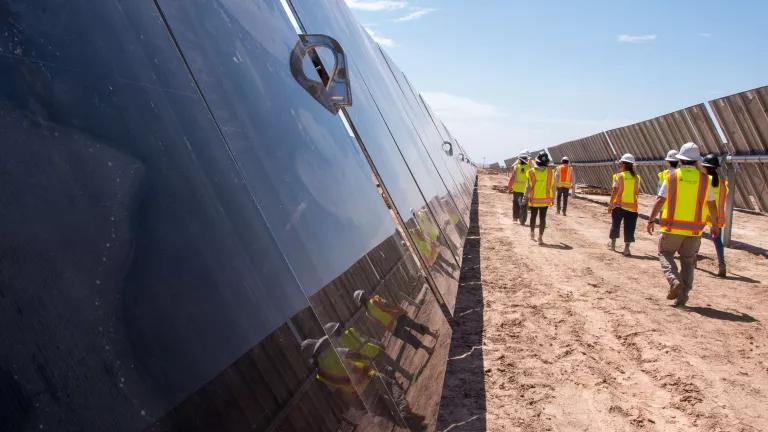
A solar panel manufacturing plant in White, Georgia

Last year, the U.S. Department of Energy (DOE) went on a funding cancellation spree. In May 2025, Energy Secretary Chris Wright announced the abrupt and unexplained termination of 24 major clean energy and manufacturing awards managed by the DOE’s Office of Clean Energy Demonstrations (OCED). A few months later, in October, the department cut hundreds more awards, amounting to nearly $8 billion in federal funding, which the DOE has since admitted to doing in an effort to punish states that didn’t vote for President Trump.
These cuts hit critical sectors—like industrial manufacturing—hard: The DOE cut billions of dollars to modernize and reduce pollution from American manufacturing alone. Not only did this devastate local communities that were slated to receive investment, but the agency’s action was unprecedented: The Department of Energy historically terminates very few awards per year and generally does so only as a last resort to address severe performance issues or financial insolvency.
Given the dramatic scale of these cuts and the suspicious circumstances around their announcement, NRDC wanted to find out more, so we sent a Freedom of Information Act (FOIA) request to the DOE. When it didn’t get back to us, we sued. After that, the agency started sending documents our way. While what we have is heavily redacted, we’ve been able to piece together some general takeaways. About a year and a half since these terminations started, here’s what we found:
1. The DOE committee charged with reviewing awards was made up of only political appointees
To help decide the fate of billions of dollars of public money, the department created a Portfolio Review Process committee (PRP committee). Documents we received in response to our FOIA indicate that this committee was composed entirely of political appointees and Department of Government Efficiency (DOGE) representatives. Below is a table of all staff members included in an email addressed to PRP committee members as well as their positions in the DOE and current role in government.
2. DOGE staff were driving the PRP committee
Internal emails show that staff from DOGE actively directed initial steps on how the PRP committee would be run. DOGE staffer Adam Blake emailed political appointees, instructing them on how to run the process and named Geoffrey Jervis as the chairman of the PRP committee. DOGE staffer Alex Glaubach directly provided lists of targeted OCED awards to political appointees for cancellation.
3. DOE staff planned for award cancellations even before the PRP committee conducted any official review
The department claimed it was conducting individualized, technical evaluations of awards. However, internal records show that on May 8, 2025, political appointees in OCED were already circulating lists of “OCED DOGE Cost Efficiency—Low Hanging Fruit” (first tranche, document 7, page 23), which presumably contained awards slated to be cut. Additionally, acting General Counsel David Taggart was circulating form termination letters as early as May 22, 2025 (first tranche, doc 12, page 41). This occurred days before the agency even formally chartered its official Portfolio Review Process (PRP) committee on May 27 (first tranche, doc 16).
4. Decisions to cancel awards were made (too) quickly
On May 29, 2025, a member of the PRP committee sent Secretary Wright a memo with the subject “Action: Approval of awards to be terminated”—just two days after the PRP Committee met for the first time to review awards and 24 hours before the public announcement of cancellations (fourth tranche, page 85). This rapid turnaround seems to suggest that the $3.7 billion in cuts—which have had profound economic consequences for the American companies involved—was executed via a rushed, top-down administrative decree rather than a rigorous, case-by-case review of awardee performance.
Much mystery still surrounds how the DOE decided to cancel billions of dollars of public investment in industrial modernization, but the materials we have been able to receive through the FOIA process so far seems to sketch out a troubling possibility: Public money was being directed for political ends, not purely for the public good.
The DOE still has thousands more documents it needs to produce. NRDC will continue to pursue transparency in court and hold the department accountable to the communities, workers, and innovators building America's clean energy future.
Read the documents for yourself
Tell us what you see
This NRDC.org blog is available for online republication by news media outlets or nonprofits under these conditions: The writer(s) must be credited with a byline; you must note prominently that the blog was originally published by NRDC.org and link to the original; the blog cannot be edited (beyond simple things such as grammar); you can’t resell the blog in any form or grant republishing rights to other outlets; you can’t republish our material wholesale or automatically—you need to select blogs individually; you can’t republish the photos or graphics on our site without specific permission; you should drop us a note to let us know when you’ve used one of our blogs.
Related Blogs

We Can't Afford to Slow Down on Climate Action
Renewable Energy on Federal Lands Brings New State and County Revenues