
What Will It Take for Ambition to Become Action? Delivering on Canada’s Nature Strategy
Canada’s new nature strategy will only succeed if political will, Indigenous leadership, and long‑term financing translate its bold vision into coordinated, enforceable action.

Little Caribou Lake near Armstrong, Ontario, Canada, September 11, 2025
Canada’s newly released A Force of Nature: Canada’s Strategy to Protect Nature arrives at a moment when the urgency of action eclipses the comfort of incrementalism. For years, scientists, Indigenous Peoples, conservation groups, and communities have warned that the natural world is changing faster than the country’s institutions can keep up.
Canada—like much of the world—is facing a rapid decline in biodiversity, driven by land use change, pollution, overexploitation, invasive species, and climate change. One in five species is at risk in Canada. Biodiversity loss is accelerating. Climate impacts are intensifying. And federally supported conservation programs designed to slow the pace of ecological decline have been winding down long before their potential has been achieved. All of this is unfolding against the backdrop of a fast‑approaching global deadline of the Kunming-Montreal Global Biodiversity Framework, which requires Canada to protect and conserve 30 percent of its lands and waters by 2030.
Prime Minister Mark Carney has taken an important first step in launching this strategy. His government has an unprecedented opportunity to halt and reverse biodiversity loss and signal to the world that Canada is a trusted partner that will deliver on its commitments.
- Protecting nature by expanding protected areas to encompass 30 percent of lands and waters by 2030 (30x30) through new national parks, marine protected areas, and Indigenous Protected and Conserved Areas (IPCAs), as well as by safeguarding biodiversity, which includes actions to reduce threats to marine ecosystems.
- Building Canada well by integrating nature‑based solutions into infrastructure, resource development, climate adaptation, and community planning. This means both ensuring communities benefit from natural defenses (e.g., flood mitigation and erosion control) and supporting Indigenous‑led planning and stewardship as a foundation for community well‑being and land use governance.
- Mobilizing capital for nature by leveraging public and private investments to support conservation and sustainable economic development. This includes expanding nature‑positive finance tools, embedding natural capital accounting and biodiversity‑aligned infrastructure spending into economic decision‑making, and encouraging businesses and investors to integrate nature risk into their bottom lines.
Why is the nature strategy so important?
As the world’s second‑largest country, Canada is home to roughly 20 percent of the planet’s freshwater, 25 percent of its wetlands, and 24 percent of the world’s boreal forests. It is also one of the largest marine territories and has the longest coastline on earth. Protection at this scale is globally significant.
This nature strategy comes at a time when Canadians increasingly recognize the importance of protecting ecosystems. With less than 15 percent of its terrestrial areas currently protected, meeting the 30x30 target will require doubling protected lands in just four years. If this ambitious undertaking is achieved, it will represent the largest conservation expansion in Canadian history, safeguarding at least 1.6 million square kilometers (almost 400 million acres) of land and up to 700,000 square kilometers (more than 270,000 square miles) of ocean.
Strengths of Canada’s nature strategy
At the strategy’s core is a recognition that meaningful conservation in Canada cannot happen without Indigenous support and leadership, sustained public investment, and a shift in how the country thinks about economic development.
The importance of Indigenous leadership
Indigenous First Nations are already leading some of the most ambitious conservation proposals in the country. IPCAs are positioned as a primary pathway to achieving protection at scale. From the Seal River Watershed to the Wiinipaakw, dozens of First Nations have put forward visions for Indigenous-led conservation, rooted in cultural responsibility and multigenerational stewardship. The federal government, for its part, has signaled a willingness to act as a partner in turning these visions into legally recognized protections.
“For so long, outsiders dictated where we live, where we went to school, how we wore our clothes, our hair, what language we spoke. Now, our communities are standing up and defining how we’re going to care for these lands and waters.”
The importance of sustained finance
The strategy also proposes to close the biodiversity finance gap. Protecting ecosystems at scale demands stable, long‑term investment. To that end, the strategy introduces a significant federal commitment of $3.8 billion, paired with new tools designed to mobilize private capital. The goal is to build a financial foundation strong enough to support conservation over decades, not just budget cycles, and to ensure that protecting nature becomes an economically viable choice for governments, businesses, and communities alike.
The importance of transformational economic models
The strategy acknowledges that healthy ecosystems are fundamental to economic prosperity, climate resilience, and overall well‑being. Healthy ecosystems underpin major sectors—agriculture, fisheries, forestry, tourism—and provide trillions of dollars in ecosystem services globally. Across the country, many of those systems are under increasing pressure. Economic development grounded in environmental protection in Canada can be achieved by integrating clean growth, strong environmental regulation, and nature conservation into the country’s core economic planning rather than treating the environment and the economy as competing priorities.
What will achieving the goals require?
While the strategy emphasizes protection and restoration, it says little about how Canada will address the actual drivers of biodiversity loss. It remains unclear how more lands and waters can be protected if an expanding industrial footprint—including logging and mining as well as urban development and the combined cumulative effects of these land uses—is not avoided or curtailed. Degraded ecosystems weaken these economic foundations and increase long‑term costs from disasters, pollution, and declining resource productivity.
The nature strategy seeks to draw in significant private and philanthropic investments, but many of the financial tools it relies on, such as natural capital accounting and emerging market‑based approaches, are still in the early stages of development. Further, clear governance arrangements with Indigenous First Nations and steady public funding are required, both of which depend on long‑term political commitment to confirming the leadership role of Indigenous First Nations and sustained finance.
Additionally, it is the provinces and territories in Canada (i.e., subnational governments), not the federal government, that control much of the land where 30x30 commitments will be delivered (e.g., 94 percent of British Columbia and 87 percent of Ontario are under provincial jurisdiction). The ambition of Canada’s federal government can only go so far. Progress will continue to be impeded by the lack of binding coordination mechanisms with provinces. In fact, provincial legislation and policies have already created barriers to new protections, including Indigenous-led conservation, as seen in Ontario. This same province just axed its Endangered Species Act. Alberta has rejected the federal nature strategy altogether.
There are also risks with prioritizing the quantity of new protected and conserved areas over the quality of biodiversity value that these sites provide. Area-based targets must be matched by ecological representativeness, management effectiveness, and restoration outcomes. To ensure this, standardized Other Effective Area-Based Conservation Measures (OECM) and protected‑area quality metrics need to be fully defined and maintained.
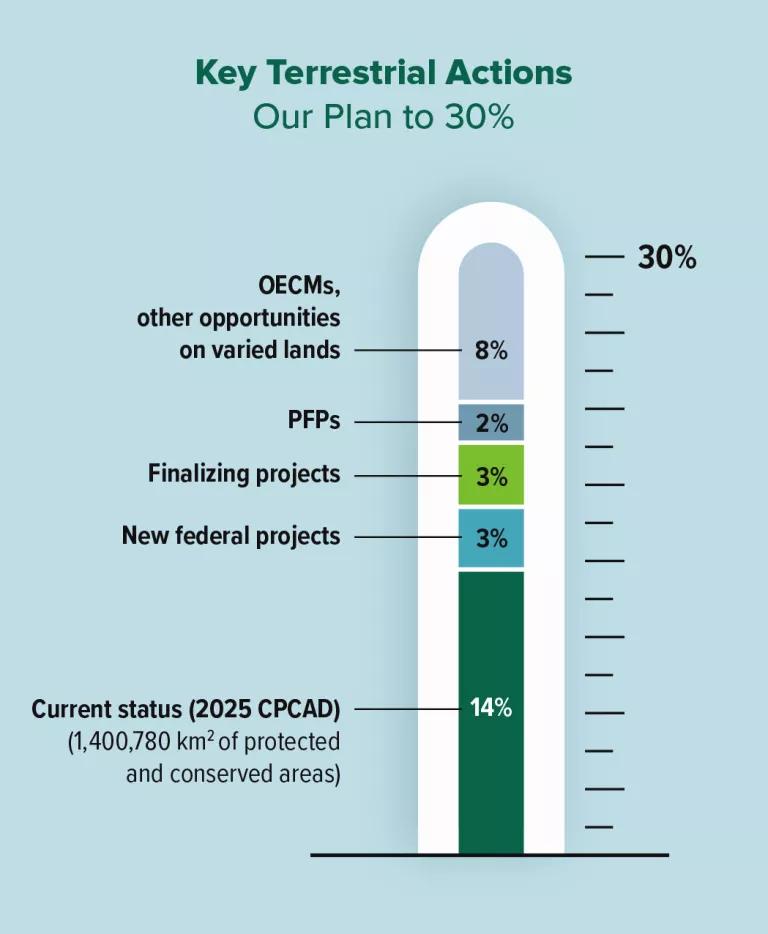
Canada’s proposed pathway to 30×30 would add 16 percent more protected land and water by creating up to 3 percent in new federally protected areas, completing at least 3 percent in previously funded projects, securing at least 2 percent through Indigenous‑led Project for Finance Permanence (PFP) initiatives, and expanding partnerships and OECM‑based conservation to deliver at least 8 percent across varied landscapes. Source: Government of Canada (En4-792-2026-eng.pdf).
System-level change is needed
NRDC welcomes the strategy’s ambition and alignment with global goals but stresses that system‑level change is needed. Biodiversity governance in Canada has been notoriously fragmented, with overlapping federal, provincial, territorial, municipal, and Indigenous authorities. Delivering on ambitious targets by 2030 will require unprecedented coordination. That means stronger policy coherence across jurisdictions and faster mobilization of public and private finance and clear interim milestones, as well as standardized monitoring, reporting, and accountability mechanisms.
Achieving bold ambition requires structural reforms that address the drivers of biodiversity loss and provide transparency and accountability. Without that, Canada’s new nature strategy risks the insufficient pace, efficacy, and inclusivity that hindered the implementation of past plans.
Related Blogs

Eagles, Ancestors, and Allies Join Frontline and Indigenous Community Protection Efforts for the Farabout Peninsula

Quebec Degrading Caribou Habitat: Federal Government to Intervene
