Getting Off the Gas Price Rollercoaster
When gas prices spike, families pay. Electric vehicles offer a cheaper alternative.

High gas prices being advertised in San Francisco, California, on March 12, 2026.
Sipa USA via AP

Thanks to the war in Iran, the price of a gallon of gasoline is $4 and rising. We have seen this movie before; a global conflict or other unforeseen supply disruption drives oil and gas prices upward, putting additional strain on Americans’ already tight budgets. Over time prices start to decrease, but only until the next global disruption. This is not a blip but a trend that has played out repeatedly for decades. In marked contrast, driving on electricity provides predictable fuel cost savings that households and businesses can bank on.
When we look at the cost of driving an electric vehicle (EV) on average residential electricity prices, expressed in dollar-per-gallon gasoline equivalent terms and adjusted for inflation since 2005, we see the price of electricity has stayed close to the dollar-a-gallon equivalent mark for more than 20 years, as depicted in the chart below. Meanwhile, gasoline prices spike and drop over that same period.
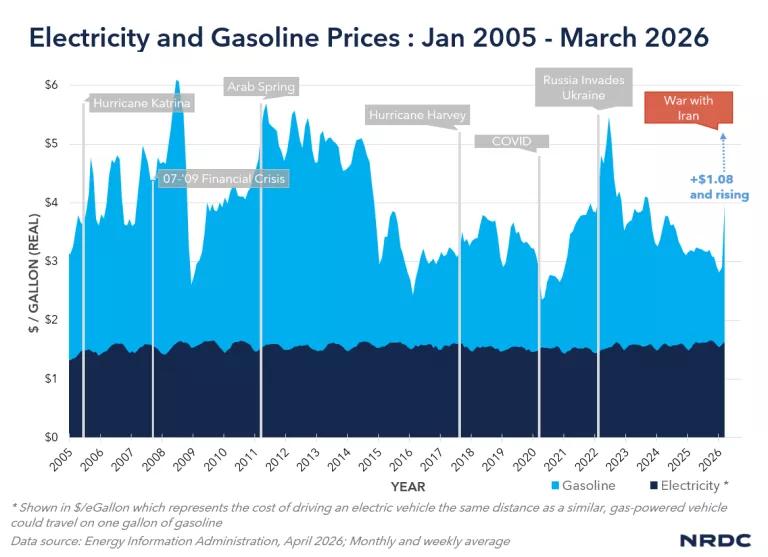
The spike we’re seeing today is caused by the ongoing war in Iran and is perhaps the most glaring recent example of how our dependence on fossil fuels is deepening affordability and national security crises. According to Brown University, the war has cost $20 billion so far and rising. That equates to an additional $153 per American household. Crude oil prices have increased from $70 per barrel to $120, and families have to spend 35 percent more to refuel their vehicles. Even if the war were to end today, the supply chain issues caused by the conflict will likely result in months, and potentially years, of higher prices at the pump.
These oil spikes don’t just impact drivers; they impact all aspects of our life. Companies such as Amazon are already responding to the rising costs and uncertainty by adding surcharges to customers’ orders. According to BloombegNEF, $5-per-gallon diesel could increase prices to consumers by 35 percent. The average price of diesel in early April was more than $7 per gallon in Los Angeles.
This is part of a broader pattern from this administration of policies that benefit fossil fuel executives at the expense of regular people—raising costs and threatening our health, national security, and safety.
Instead of helping to drive toward clean, affordable solutions, we’ve seen people in power putting their thumb on the scale of gas-powered cars to try to keep consumers stuck on dirty, expensive gasoline. This includes the recent elimination of carbon pollution standards for vehicles (which will cost Americans more than $180 billion dollars), the proposed weakening of fuel efficiency standards (which will also cost drivers more), and repeals of tax incentives that would save consumers thousands.
Instead of continuing to fuel this affordability crisis, our leaders should be embracing solutions that can help us get off oil in a way that will enhance national security, reduce costs, prevent price shocks for Americans, and put people over billionaire and corporate profits.
That includes giving people more access to clean, affordable cars and trucks. For decades, drivers had limited options for their vehicles and were stuck driving gasoline-fueled vehicles, and Americans’ budgets were forced to be at the whim of the global oil market. But now we have options, and more Americans (and U.S. companies) are choosing to ditch the pump and go electric.
Going electric is a cleaner, cheaper, and more stable alternative to the highly volatile oil market and wildly fluctuating gas and diesel prices – even as electricity prices climb.
EVs are cheaper to fuel and maintain
Going electric means that drivers no longer need to take trips to the gas station. Instead, most drivers can refuel at home. On top of that, increased driving ranges for EVs are maximizing how far people can go before they need to recharge, and a growing, robust network of chargers is making public charging easier.
Electricity prices are more stable than gasoline prices because the power industry is regulated, and utilities must get approval to increase prices. When prices do increase, they are over a period of time, and customers are given advance notice. On the other hand, the world oil market is not regulated, and gas prices fluctuate due to global events that drivers have little control over and change day to day.
Additionally, unlike gasoline that is made just from oil, electricity is produced by a diverse mix of sources, most of which are produced domestically. This provides additional national security and further stabilizes the price of energy and therefore electricity.
Driving on electricity provides savings to households across the country given the more affordable, predictable costs. According to AAA it is 130 percent more expensive to drive a gasoline vehicle than an electric vehicle and that total is higher when accounting for gasoline price spikes. Plus, EVs have lower maintenance costs than gasoline vehicles, further reducing monthly household expenses.
There are a large range of EV options at various price points with new options being released every year. Battery prices—the most expensive part of the vehicle—are continuing to fall, dropping 8 percent in 2025 to $108 per kilowatt-hour. And automakers such as Slate, Ford, and Rivian have all announced plans in the coming months and years for cheaper electric vehicles.
Additionally, more than half of used EVs in early 2026 cost less than $30,000. Because most Americans buy used vehicles, lower-priced used EVs offer affordable upfront costs along with lower fueling and maintenance expenses.
Several new tools make it easy for drivers to see how much money they can save by switching from gasoline to electric, including:
- Coltura’s savings index, which shows average fuel and maintenance savings by driving an EV
- Veloz’s calculator, which estimates your personal annual savings by going electric
- The New York Times’ EV cost comparison, which breaks down the savings of buying versus leasing an EV
- Yale Climate Connections’ analysis which shows how low EV charging costs are nationwide in gasoline gallon equivalent terms
But if the cost savings and price stability weren’t enough, electric vehicles are also the cleanest vehicles on the road—emitting about a quarter as much climate pollution as the average gas-powered vehicle. Driving electric reduces health-harming and air-quality pollution as well. Unlike gasoline, electricity to fuel these vehicles will get even cleaner over time as more renewable energy comes online.
Rising diesel prices ripple through freight—and consumer prices
Gasoline isn't the only fuel effected by rising oil prices. At a time when consumers are frustrated over growing costs, increased oil prices make things worse. That’s because diesel prices also are contingent on the price of a barrel of oil—and this has broad consequences for supply chains and freight movement around the world.
Diesel price spikes not only affect fleet operators—they also quietly raise the cost of nearly everything Americans buy. Most goods move by truck at some point in their journey, meaning higher diesel prices flow through supply chains and show up as higher prices on store shelves. While gas price shocks are immediately visible to drivers, rising freight costs function as a hidden tax on households, pushing up prices over time across the entire economy.
Over the past month, we have seen a $3.387 billion "hidden freight tax" due to the increased price of diesel that inflates the cost of nearly every consumer product. To put this in perspective, if these funds had instead been invested in clean, zero-emission trucks, the United States could have added 11,679 Tesla Semi trucks—providing clean air and reducing health harming pollution across the country.
A clean transportation future
Helping consumers make the switch to electric vehicles is one of many ways to help households manage rising transportation costs while gas prices increase. The upcoming federal transportation funding bill presents an opportunity. Decision‑makers could advance a clean transportation future by supporting policies that help more communities access clean, safe, and affordable transportation options for their daily needs – including expanded transit and more bikeable and walkable communities.
American households have been held to the whims of the global oil market for too long, and drivers are increasingly seeing the benefits of driving electric. Instead of keeping us dependent on oil and tearing down clean energy—our leaders should be ramping up cheap, home-grown, clean energy and increasing consumer access to affordable electric vehicles and clean transportation options, so families’ budgets are less vulnerable to foreign military conflict.
It’s time for us to get off the oil price rollercoaster once and for all.
Related Blogs

Trump’s EPA Declares It’s “Futile” to Fight Climate Change

Demolition Derby Deregulation That’s Too Much, Even for Industry
