
Tailoring the Grid: The Complex Reality of Western Seams Management
We need action, not just talk: Address compatibility issues now to avoid costly operational hiccups later.


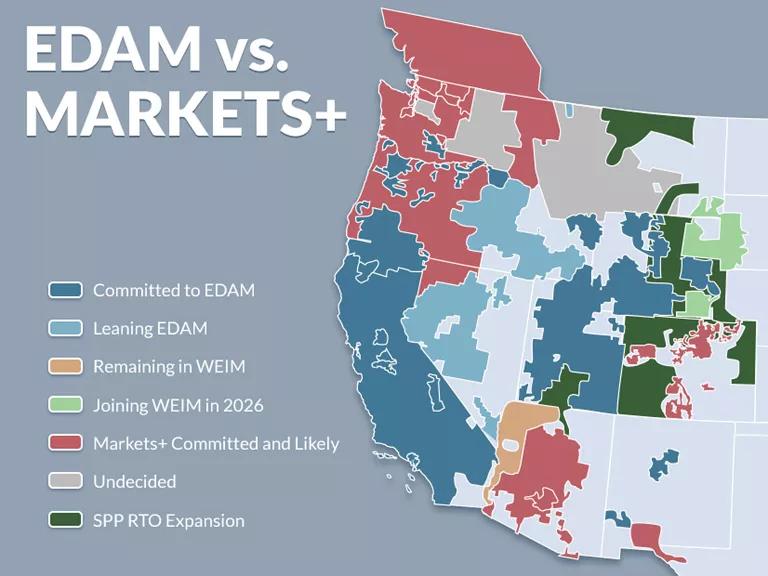
In the fall of 2025, the Southwest Power Pool (SPP) announced it would be hosting a Western Seams Symposium to take place in early 2026. This sparked hope for western advocates that SPP was taking the call to collaborate seriously on seams issues—boundaries between two markets that cause economic and operational hiccups— by gathering stakeholders and decision-makers to get to work. However, when the symposium came around in February 2026, it left folks wanting for more.
This event was advertised to highlight, but subsequently missed, a critical inflection point for the Western Interconnection. As two competing day-ahead electricity market options, the California Independent System Operator’s (CAISO) Extended Day-Ahead Market (EDAM) and SPP’s Markets+, move toward implementation, the discussion is shifting from if the West will have multiple markets to how they will function together. CAISO’s attendance at the symposium was not utilized to dive deep on inter-market coordination but rather was limited to a single 45-minute panel about a separate issue entirely. While the collaborative tone from SPP is a welcome starting point, the West needs more than guiding principles; we need the tangible action behind those words, and we need it from both SPP and CAISO.
What does “seams issues” actually mean?
The overuse of the term seams issues has risked it becoming a meaningless catchall term for any disagreement in an electricity market. So let’s level set on what market seams actually are: operational and economic friction points that arise at the boundaries between different markets. The more boundaries you have between different markets, the more problems you see. In practical terms, they are hurdles created by differing electricity dispatch processes, conflicting market rules, and mismatched transmission policies.
The most prominent example of such a hurdle is “loop flow,” where energy transfers within one market impose unscheduled flows on neighboring systems. Left unmanaged, these flows cause transmission congestion and force the neighboring balancing authorities to pay for re-dispatching generators just to maintain reliability. To mitigate loop flow and other issues, proper seams management requires a variety of concrete, technical solutions outlined in recent reports from Western Resource Advocates (WRA) and GridStrategies as well as the Federal Energy Regulatory Commission (FERC), including: standardized data sharing, formal market-to-market operating agreements, and moving to flow-based modeling that more accurately reflects the physical reality of the grid and allows market operators to see exactly how much transmission is available between EDAM and Markets+.
Lessons learned from the East
At the symposium, SPP leadership suggested that seams are “manageable” and that the tools exist to solve them with ease. However, the history of the SPP, Midcontinent Independent System Operator (MISO), and the PJM seams in the eastern interconnection suggests a much more complicated and expensive reality. The three regional transmission organizations (RTOs) have failed to develop an agreed-upon methodology to update the “firm flow entitlements,” despite 22 years of trying. The lack of seams agreements can rear its head in an emergency situation: A January 2018 winter weather event sent MISO South into emergency operating procedures; it was later noted in a review by MISO, Southeastern Reliability Coordinators, SPP, and Tennessee Valley Authority, as well as being cited in WRA’s seams report, that a “lack of common emergency procedures and a lack of understanding of each other’s systems increased the challenges faced during that event.” Further, even solutions such as market-to-market coordination is shown to be an imperfect tool, demonstrated by administrative errors that resulted in $119 million in excess congestion costs at the MISO-SPP seam in 2022 alone.
Claims that seams agreements are easy to create don’t stand when faced with the decades of multimillion-dollar inefficiencies in the East. Consequently, the eastern issues serve as a warning for the West that it is necessary to formalize binding coordination agreements before both markets go live. Failing to implement seams solutions across the market footprints risks creating a complex mess of systems that will drive up costs and compromise reliability for western consumers.
The myth of beneficial redundancy
During the Western Seams Symposium, SPP leadership suggested that multiple day-ahead markets create a redundancy that builds resilience and strengthens the grid. However, this narrative overlooks the economic reality. Fragmentation of the western grid into two markets introduces new barriers to energy transfers, increasing transaction costs and price uncertainty.
Multiple analyses have confirmed that a single West-wide day-ahead market would be the best economic and reliability solution for the region. A single, unified footprint would maximize the benefits of harnessing geographic and resource diversity to provide the highest annual savings for consumers. Splitting the West into two markets creates inefficiencies at the market seams that could prevent the lowest-cost resources, which are increasingly renewable resources, from being dispatched during times of need, putting a cap on the region’s affordability and decarbonization potential.
Governance: A solved problem
SPP continues to state that utilities must choose between the best economic market and independent governance, an issue on which SPP assumes its market offering will come out ahead. This is a false dilemma. The West-Wide Governance Pathways Initiative has already cleared the primary roadblock to broad EDAM participation by approving a structure for fully independent governance, including a board that is selected by stakeholders rather than appointed by politicians, is not beholden to any single state’s requirements, and is representative of the geography of the market.
Through a two-step approach, the Pathways Initiative is creating the Regional Organization for Western Energy with an independent board, selected by a group of western stakeholders, that will have sole authority over the CAISO western markets, EDAM, and the real-time market, the Western Energy Imbalance Market (WEIM). This new governance framework ensures that no single state has undue influence over regional market operations. Meanwhile, Markets+ is still in the preliminary stage of creating its own independent governance framework, with the final Markets+ Independent Panel not scheduled to be sat until after Markets+ goes live in 2027.
A call to action
With EDAM set to go live this May and Markets+ still working toward a fall 2027 launch, it is time for both SPP and CAISO to move past the “spirit of cooperation” talk and move into the “doing something about it” phase. To avoid harm to consumers, both operators need to work together and commit to:
-
Developing formal protocols for congestion management and emergency procedures that are binding and transparent.
-
Aligning network models and real-time data exchange to ensure one market solution does not compromise the other’s reliability.
-
Establishing fair rules for hurdle rates and delivery priorities to ensure the grid’s backbone is utilized for the benefit of all western ratepayers.
While we continue to urge the prioritization of a path toward a single, integrated western market, we understand that a few western utilities still state that they aim to join Markets+, and we therefore urge tangible action on seams now. Managing day-ahead market seams is not a simple task of goodwill between market operators; it will require fundamental changes to how the grid is modeled and coordinated.
Related Blogs
Market Boundaries Matter: Western Electricity Markets Can Better Share Affordable Power

Connecting the West to a More Stable Clean Energy Future
