Does Congress Really Want More Lead Leaching into Drinking Water?
New map illustrates that repealing the EPA’s drinking water rule would leave tens of millions without certain commonsense protections from this dangerous toxic chemical.

Lucy Lambriex/Getty Images

Congress is considering repealing protections for millions of fetuses, infants, children, and adults from being poisoned by lead in tap water. A pending resolution would erase the U.S. Environmental Protection Agency's (EPA) Lead and Copper Rule Improvements, which require water systems to remove nine million lead service lines—the pipes that deliver water from the water main in the street to the homes of tens of millions of Americans.
The EPA has estimated that under the old rules that would snap back into place if the resolution passes, 95 percent of the nation’s lead service lines could remain in use. My colleague, Erik Olson, explained why that’s a horrible idea and why revoking the new rules would be completely unjustified.
But that’s not all. If the new rule disappears, millions of people would also lose other protections from lead in drinking water, including measures to reduce corrosion from the inside of existing lead pipes, enhanced public education about lead risks, and, in some places, distribution of home water filters that can remove lead. Those protections are triggered by the new rule’s more stringent lead action level of 10 parts per billion (ppb).
The new map below, which we’ve generated using EPA data, shows how rolling back the new action level could remove those protections from communities in every corner of the nation.
The map shows that 1,057 water systems—which collectively serve 22,987,690 people—exceeded the new action level at least once in the last five years but did not exceed the old action level (15 ppb) that was in effect at the time.
You can see the whole list here.
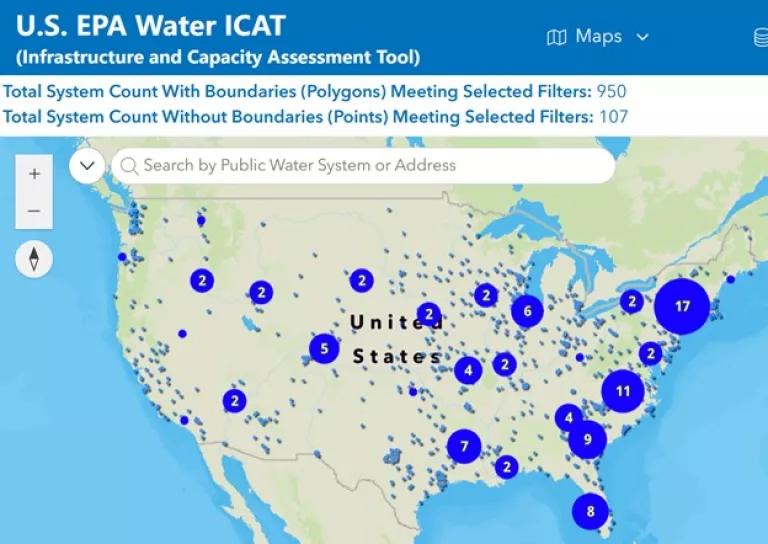
Source: EPA’s Water Infrastructure and Capacity Assessment Tool (ICAT), which uses water systems’ own lead sampling data. (Map and data tables downloaded 11/21/2024)
NRDC
These systems are all over the country, including at least one in 49 of the 50 states (none were recorded in Hawai'i). Also included are water systems in some Tribal lands and U.S. territories.
More than 10 percent of these systems (serving over 11 million people), exceeded the 10 ppb action level multiple times. In New York City, for example, there were five separate reporting periods when lead levels in drinking water exceeded the new action level.
And, although lead in drinking water is sometimes viewed as exclusively a big-city problem, almost half of these systems serve areas that are 100 percent rural, serving a combined population of about 459,000. (Many others, too, are predominantly rural.)
The full list even includes four military bases—Vance AFB in Oklahoma; Kings Bay Submarine Base in Georgia; Hanscomb AFB in Massachusetts; and Newport Naval Station in Rhode Island—where service members and their families are exposed to lead in drinking water.
Even national parks aren’t spared. The list includes water systems that serve some of the lodging at Yellowstone and Death Valley.
How does the lead action level work?
All utilities must perform periodic testing for lead in tap water in a certain number of homes. If results at 10 percent or more of the homes exceed the lead action level—which the new rule tightened to 10 ppb—then the utility must install or improve corrosion-control treatment before water leaves its water treatment plant. This centralized treatment can help reduce lead exposure at the tap systemwide. It reduces (but does not eliminate) the risk that lead will leach into water from the insides of pipes and other plumbing, including pipes buried outside a home and lead-bearing plumbing located inside of buildings (such as lead solder and common lead-containing brass faucets).
Utilities exceeding the lead action level must also ramp up efforts to notify residents of lead risks (although the rule’s public education provisions are still far short of what they should be). If there are multiple action level exceedances, under the updated EPA rule they must also distribute water filters for home use.
Scientists agree there’s no safe level of lead. But with new rule’s lower lead action level, more water systems will at least take these commonsense steps to help protect their communities, which benefit people who have lead service lines (while they await replacement of their lines as required by the new rule) and those who don’t.*
What happens next?
The new action level applies only to future tap sampling results. But the past five years’ sampling results, shown in the map, illustrate how widespread exceedances of 10 ppb have been. And with the improved the methods for tap water sampling under the new rule, even more instances of elevated lead levels should be detected in the future. That means the new rule is expected to result in a lot more communities getting the benefit of enhanced corrosion control, as well as more public education about lead risks and, in some cases, home water filters.
But tens of millions of people could lose out on those protections—and be left with lead pipes delivering their water—if Congress repeals the rule.
Instead, let’s move ahead toward the vital work of implementing these new health protections. Our kids and grandkids will thank us for it.
NOTE: *Corrosion control is definitely not a substitute for replacing lead service lines, which are the largest source of lead in drinking water. But when used properly, it does help reduce everyone’s risk of lead exposure.
For more posts from this author, please see these blogs and LinkedIn articles.
Related Blogs

Political Control of Research Funding Threatens Sound Science

Governors, Legislators, and Utility Affordability: Broadening the Frame to Water