Michigan Primed for First Statewide Water Affordability Program in United States
Collaboration among community advocates, water utilities, and environmental groups is key to progress on landmark legislation, creating a model for other states.


UPDATE: On November 4, 2025, Michigan’s landmark statewide water affordability bill package cleared the state Senate Committee on Housing and Human Services with bipartisan support. The package moves next to the Senate floor.
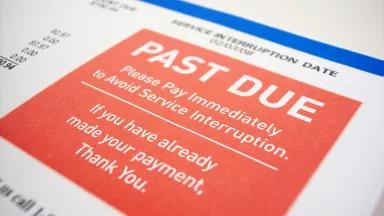
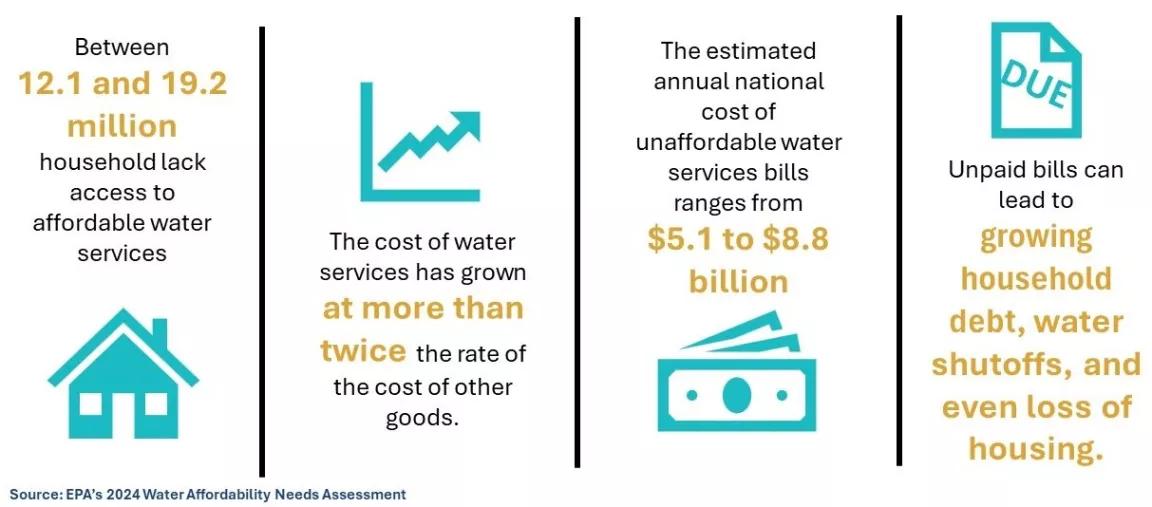
Every day, tens of millions of people in the United States worry about how they’ll make their monthly budget—housing, food, medicine, utilities, and more. For many, even paying the water bill is out of reach without sacrificing some other, equally essential need. The U.S. Environmental Protection Agency has estimated that 12 to 19 million low-income households (9.2 to 14.6 percent of all U.S. households) face unaffordable water bills. The consequences of not paying those bills can include losing access to water, housing, and even custody of children.
Water advocates and water utilities agree that Congress should help by creating a permanent, federal low-income water assistance program. Last year saw several bills introduced in Congress to do just that.
But right now, the most promising opportunity for real solutions is at the state level—especially in Michigan, where a powerful collaborative effort is leading the way. (A robust coalition in California is also advancing legislation to create a statewide program.)
Leaders in the fight share their insights with webinar audience
In May, NRDC and the Water Center at the University of Pennsylvania hosted a webinar entitled “From Crisis to Collaboration: Michigan’s Journey Toward Water Justice,” which highlighted the collaborative process to develop a landmark package of bipartisan water affordability legislation that will help ensure all Michiganders can afford their water bills. In fact, the legislation would create the nation’s first comprehensive statewide water affordability program.
Watch the full webinar "From Crisis to Collaboration Michigan’s Journey Toward Water Justice"
The package of bills, which nearly passed last year and was reintroduced in March 2025, would do the following:
- Create a permanent, statewide low-income water affordability program, which would effectively cap water bills for low-income customers at a certain percentage of income.
- Establish a dedicated funding source to support the statewide program.
- Adopt the nation’s strongest statewide water shutoff protections for low-income residents and customers who rely on water to treat medical conditions.
- Protect tenants from water shutoffs when their landlord fails to pay the water bill.
Learn More


The program would be funded by a minimal fee assessed on each service connection. Communities would have the option of administering their own programs that meet the state criteria or working with other communities in their region to fund a shared program.
The webinar’s diverse group of presenters included Sylvia Orduño, director of the People's Water Board Coalition, which is comprised of three dozen groups, from labor unions to faith communities; Sara Rubino of the Oakland County Water Resources Commissioner's office; State Senator Stephanie Chang, who led the collaborative process to develop the current legislation; and NRDC's Cyndi Roper, who has been working closely with Senator Chang’s stakeholder group in this effort.
A history of struggle leads to hard-won progress and teaches lessons that apply beyond Michigan
This didn’t all just happen overnight, and it didn’t start out as a collaboration. In fact, these efforts were borne out of years of conflict between water utilities and community groups united under the People’s Water Board Coalition.
Michigan has long been known nationally, and even internationally, as ground zero for water affordability in the United States, ever since Detroit came under fire for mass shutoffs and home foreclosures seeking to collect water debt more than a decade ago. Yet the problem wasn’t—and isn’t—limited to Detroit. A University of Michigan study found that the inflation-adjusted average cost of water across Michigan has increased 188 percent since 1980 and up to 320 percent in individual cities, with roughly 7 to 11 percent of households across the state struggling with water bills.
The problem also isn’t limited to Michigan. It’s national in scope—and it’s growing, as water utilities play catch-up on long-overdue infrastructure upgrades following decades of federal disinvestment.
Michigan has been at the forefront of the struggle and the work to develop solutions. In 2020, for the first time, the state legislature acknowledged that residents were struggling to pay their water bills when lawmakers provided $25 million for a short-term water assistance program to help erase past-due balances on customers’ water bills. Using data from that program, NRDC found that 317,631 households, representing approximately 800,000 Michiganders, were behind on their water bills—counting just the 144 water systems, out of the state’s roughly 1,400 water systems, that applied for and received funding. These households were spread across the state, in urban, suburban, and rural areas, and in legislative districts represented by both Republicans and Democrats.
In the years since, Michigan has continued, on an ad hoc basis, to allocate state funding to water bill assistance for people at risk of a shutoff. Now, after years of conflict over water shutoffs and unaffordable bills, community groups, water utilities, social service agencies, environmental groups, and others have built a wide consensus around legislation to help ensure that water bills are affordable on an ongoing basis. Notably, one development that helped break the logjam was the emergence of strong leadership from a subgroup of the Michigan Section of the American Water Works Association, which catalyzed the water utility engagement in this effort.
Altogether, about 60 stakeholders worked for more than two years developing the bipartisan legislation. The resulting package of bills protects public health by simultaneously helping water customers and the utilities that serve them. First, it does so by making bills affordable and restricting shutoffs, protecting people from losing access to water because they can’t afford the bill. Second, but no less importantly, the statewide affordability program would help cities, townships, and villages throughout Michigan access revenue they sorely need to operate and improve their water systems.
- American Association of Retired Persons (AARP)
- American Water Works Association – Michigan Section
- Area Agencies on Aging of Michigan
- Clean Water Action
- Detroit Water and Sewerage Department
- Great Lakes Water Authority
- Michigan Association of United Ways
- Michigan Catholic Conference
- Michigan League for Public Policy
- Michigan League of Conservation Voters
- Michigan Nurses Association
- Michigan Poverty Law Program
- Michigan Unitarian Universalist Social Justice Network
- Michigan Welfare Rights Organization
- National Association of Social Workers – Michigan
- NRDC (Natural Resources Defense Council)
- Oakland County Water Resources Commissioner
- People’s Water Board Coalition*
- Sierra Club of Michigan
- The Nature Conservancy
- The Salvation Army
- United Way for Southeastern Michigan
- Wayne Metro Community Action Agency
* PEOPLE'S WATER BOARD COALITION MEMBERS: AFSCME Local 207; Baxter’s Beat Back the Bullies Brigade; Black Autonomy Network Community Organization (BANCO); Benton Harbor Community Water Council (BHCWC); Boggs Center – Detroit; Congregation for Humanistic Judaism of Metro Detroit; Detroit Bible Tabernacle; Detroit Black Community Food Security Network; Detroit Catholic Pastoral Alliance; Detroit Greens; Detroit Hamtramck Coalition for Advancing Healthy Environments; Detroit Jews for Justice (DJJ); Detroit People’s Platform; East Michigan Environmental Action Council; Ecumenical Theological Seminary; Flint Rising; For Love Of Water (FLOW); Food & Water Watch; General Baker Institute; Highland Park Human Rights Coalition (HPHRC); Immaculate Heart of Mary (IHM); Islamic Organization of North America; Methodist Federation for Social Action – Michigan; Michigan Emergency Coalition Against War and Injustice (MECAWI); Michigan Citizens for Water Conservation (MCWC); Michigan Coalition for Human Rights (MCHR); Michigan Interfaith Power and Light; Michigan Unitarian Universalist Social Justice Network (MUUSJN); Michigan Welfare Rights Organization (MWRO); Moratorium NOW!; Rosa and Raymond Parks Institute for Self Development; Sierra Club; Sisters of Mercy; St. Peter’s Episcopal Church; United Church of Christ – Detroit Area Social Justice Team; and Water You Fighting For
This effort in Michigan offers a model for collaboration and state policy innovation around water affordability. When community and environmental advocates, utility leaders, and elected officials came together, they discovered their fundamental shared goals: No one should lose access to water because they can’t afford the bill, and utilities should have the funds they need to provide safe water to everyone. When Michigan enacts the bipartisan legislation they developed together, it will be a whole lot closer to achieving those goals.
Related Blogs
800,000-Plus Risk Water Shutoffs in the Great Lakes State
Bold Protections Against Toxic Forever Chemicals in Michigan’s Tap Water