The Key to Lowering a Building's Carbon Footprint? Embodied Carbon.
Reducing the greenhouse gas emissions of construction materials is critical to achieving full building decarbonization—and states can lead the way.


When you think of the carbon footprint of a building, what comes to mind? The air conditioner? The electricity used in light bulbs? What about the concrete used to construct the building’s foundation? Or the steel beams that stand it up?
As the building sector designs more energy-efficient buildings, the greenhouse gas (GHG) emissions of a building’s construction materials—such as concrete, steel, and wood—are quickly becoming a larger share of a building’s carbon footprint. These emissions are more commonly known as “embodied carbon.”
What is embodied carbon?
Embodied carbon describes the GHG emissions from the manufacturing, transportation, installation, maintenance, and disposal of building and infrastructure materials. Over the next 25 years, more than half of the emissions from new buildings will come from the materials that make up a building, rather than its operations. Once these emissions are released into the atmosphere, there is no reducing them later on. With 40 million new homes and 60 billion square feet of commercial floor space expected to be constructed in the United States by 2050, tackling embodied carbon now is paramount.
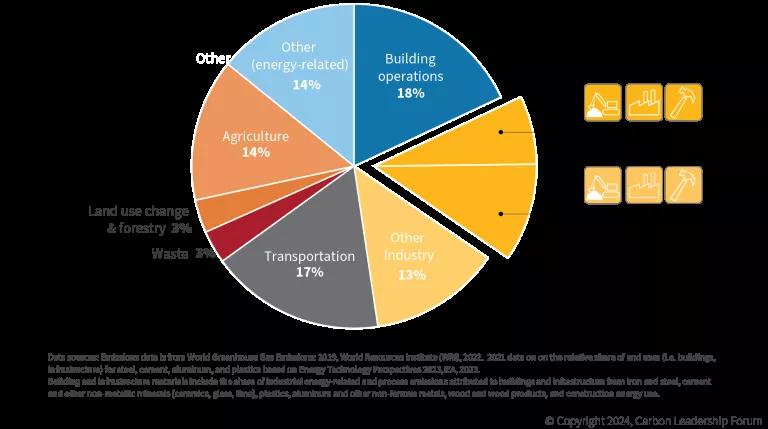
Global end-use greenhouse gas emissions breakdown by sector in 2019. Embodied carbon from manufacturing construction materials is a part of the largest sector of emissions: industry.
How is embodied carbon measured? Introducing the alphabet soup.
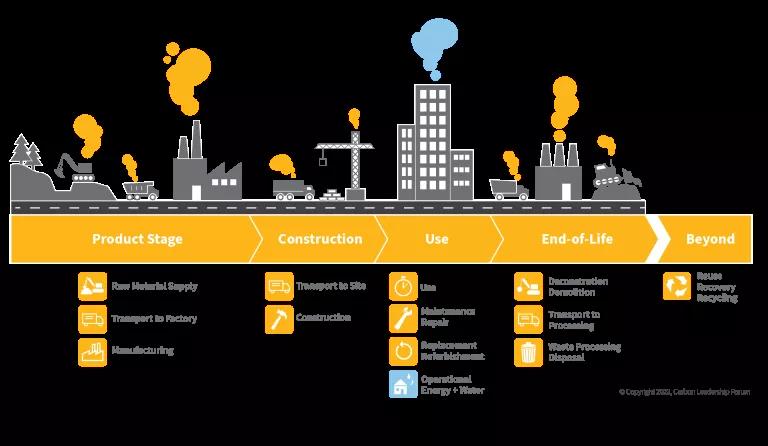
Embodied carbon is measured using a methodology called “life cycle assessment” (LCA). An LCA assesses the emissions of a product by evaluating all stages of its life. These life stages are referred to in categories from A1–C4, where A represents the production and construction stages, B represents the use and maintenance phase, and C represents end-of-life phase. An LCA can provide a comprehensive view of the environmental impacts of a building, product, or process.
Carbon emissions of a material or product are shown as global warming potential (GWP) in kilograms of CO2 equivalent (kg CO2e), encompassing all of the emissions associated with its production and use. For construction-related products, GWP and other related metrics are displayed on third-party-verified environmental product declarations (EPDs). EPDs can be thought of as “nutrition labels” for construction materials, showing the emissions associated with the product up to the point where it’s available for purchase.
Embodied carbon (yellow) and operational carbon (blue) across the life cycle of a building
Source: Carbon Leadership Forum
How can embodied carbon be reduced?
There are plenty of opportunities to think creatively about the project design and construction phases to reduce embodied carbon. The main approaches are to:
- Reuse existing buildings
- Reusing all or part of an existing building
- Design buildings with less new material
- Designing more efficient structural systems that use less material
- Substitute with low-carbon materials
- Using low-carbon concrete in place of standard concrete
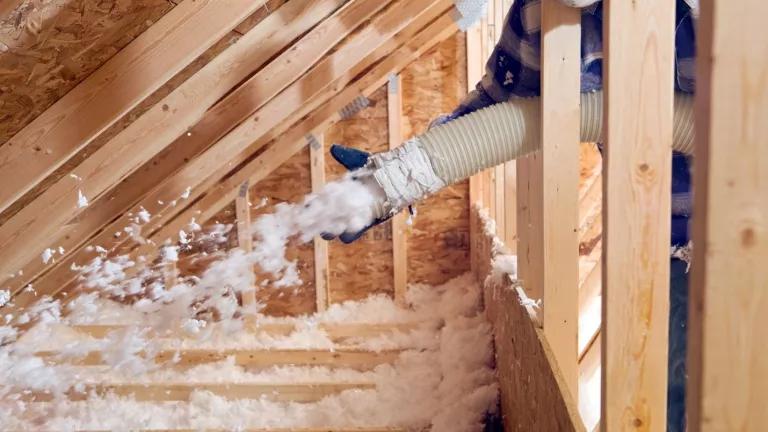
- Replacing spray foam insulation with cellulose insulation
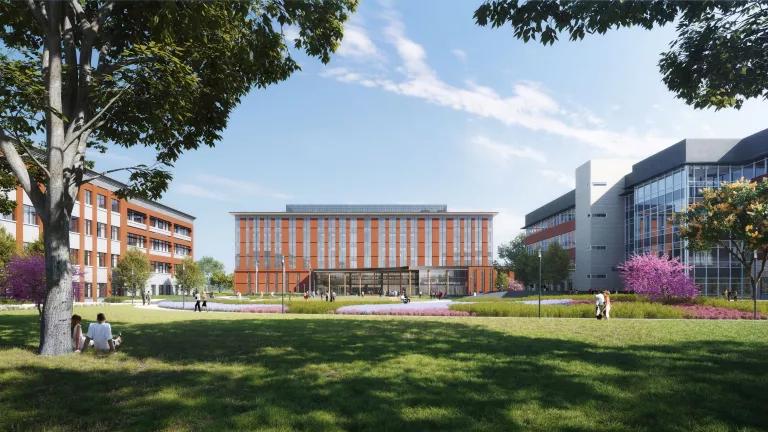
A rendering of the Clackamas County courthouse in Oregon, which reduced project costs by decreasing embodied carbon emissions
Courtesy ProjectCo
Reducing embodied carbon can save money on construction projects
Reducing embodied carbon can often reduce project costs. The opportunity to save carbon occurs when a major renovation or new build occurs. Often, the building site already contains materials that can be used. For renovations or remodels, reusing the existing building shell and foundation is often more cost-effective than demolishing and building new. For new builds, by choosing a building design that uses less material overall, the project developer and owner can save money by procuring less of the product. For example, DCI Engineers, a nationwide engineering firm, optimized the structural layout of the Clackamas County Courthouse in Oregon to use less concrete, resulting in a savings of $235,000 and 1,360 metric tons of CO2e.
In situations where it’s not possible to save money on a project by choosing low embodied carbon options, it’s still often possible to reduce emissions at a very low cost relative to the project’s overall budget. RMI case studies demonstrate that embodied carbon in commercial buildings can be reduced by 20 to 45 percent with either no cost increase or less than 1 percent cost premium for the project.
Driving demand for low-carbon materials
Customer demand is a powerful tool for incentivizing the production and use of low-carbon materials. Demand-side strategies can either leverage existing purchasing efforts or facilitate new demand from new or existing customers.
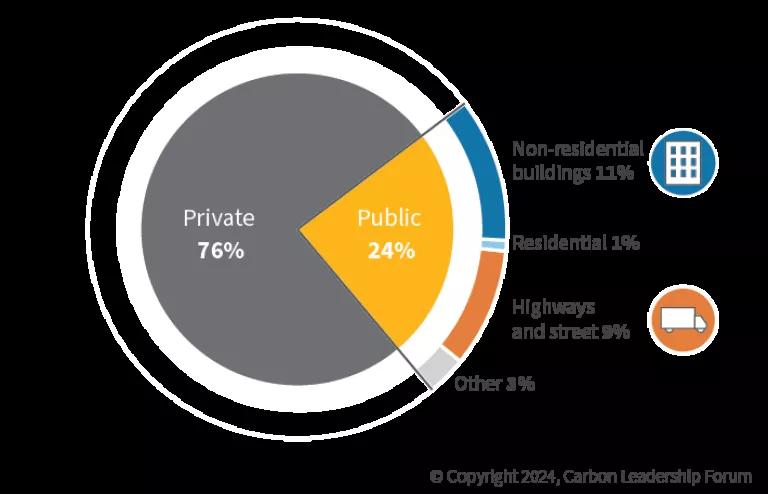
Interventions that aggregate demand also send strong market signals. Communicating interest in clean energy products from buyers is essential for innovation to occur that leads to the development of low-carbon materials. Buy Clean is an approach that harnesses the purchasing power of the government by incorporating requirements for the use of low-carbon materials on projects paid for with public funds. For cement and concrete, nearly half of all of the material in the United States is purchased for government projects. An impressive 12-13% of the U.S. gross domestic product is covered by these procurements. To date, nine states have adopted Buy Clean procurement policies, with more on the way.
Requiring EPDs can help building owners, contractors, designers, and suppliers better understand how products compare to each other on climate performance. Adopting maximum GWP limits for a material or project can send even stronger demand signals. In California, Marin County adopted a Local Carbon Concrete Code, which includes GWP limits for concrete. Similarly, the Port Authority of New York and New Jersey has adopted EPD requirements and emissions limits for the concrete used on its projects.
Environmental requirements for products either sold or purchased in a jurisdiction are another demand strategy. These have been especially helpful in states like California, which has developed standards for clean cars and trucks ahead of national requirements.
For situations where a specific product is needed but not yet available on the market, advance market commitments (AMCs) can be employed. They guarantee a purchaser for a set amount of the product, providing a collateral funding stream to secure the loan for its production. Once a product is widely available on the market, public codes—for buildings, appliances, or another category—can provide additional impetus for adoption.
Private sector demand is just as crucial. While most policies to date have focused on aggregating public demand, it’s also important to reduce emissions on privately funded projects. Large, private-sector purchasers like Amazon or Google can use their sizable purchasing power to require low-carbon materials to be used on their projects, via requirements in solicitations or through prime contracts for construction on multiple projects. Design and construction firms can adopt environmental, social, and governance goals or emissions targets and LCA requirements for their projects, as SOM and Turner construction have done, as well as signing on to pledges to reduce emissions. However, for owners with smaller projects or those involving only a handful of sites, more strategies, including project financing, are likely needed.
Relative contributions of U.S. private and public sector construction GWP
How to finance embodied carbon reductions
Financing tools have been used in the energy efficiency and renewable energy space for more than a decade to enable owners to include projects elements that save or produce energy. Rebates for Energy Star appliances and tax credits for purchasing solar panels are among the financing tools that help drive demand for efficient and renewable energy products. As embodied carbon is still a developing policy area, more financing is needed. While many products, like low-carbon concrete, can be available at no additional cost, there are some products that do have a cost premium. To address these costs, and to finance an LCA analysis to determine areas of possible reduction on a project, several strategies are emerging at the state level:
- Sales tax exemptions can be used to drive uptake of low-carbon construction materials among businesses and individuals. For example, in Colorado, beginning in July 2024, all eligible decarbonizing building materials are exempt from state sales and use taxes.
- Tax credits are a common policy tool used to drive the uptake of clean manufacturing and products. They were a key policy lever in the Inflation Reduction Act and will continue to play a major role in the decarbonization efforts at large. For embodied carbon, states are trialing different types of tax credits. In New Jersey, a bill passed in 2023 created a performance-based tax credit for low-carbon concrete that’s procured for state-funded projects. A bill in Colorado this year expands an existing industrial tax credit to include low-carbon construction materials.
- Commercial property assessed clean energy (C-PACE) programs provide low-cost, long-term financing for property owners to fund green energy improvements on their property, repaid through property tax bills. It works by leveraging the low interest rates available to cities and counties that can issue bonds to support repayment of a loan if needed. The city or county acts as a reinsurer to the lender, shoring up the loan in case of default. When C-PACE financing originated in 2009, available measures were limited to energy efficiency retrofits to reduce energy bills. Now, many regions include renewable energy, water efficiency, and resiliency measures.
- Leveraging existing grant programs is a way to incentivize embodied carbon reductions with existing funds. For example, the New York State Energy Research and Development Authority’s Buildings of Excellence Competition program uses embodied carbon as part of its awards criteria. Grants funded from energy ratepayer funds are awarded to best-in-class projects. To be best in class, the projects must demonstrate high performance across multiple categories, including embodied carbon.
In New York, in this year’s legislative session, S7648 provides financing for embodied carbon materials used in the state. The bill includes a sales tax exemption for specified low-carbon building materials and a grant program for concrete manufacturers for the development of EPDs.
Looking ahead
Embodied carbon is an essential part of building decarbonization that can no longer be ignored. Once emitted into the atmosphere, emissions from construction materials are extremely difficult and expensive to remove. We urge public agencies and policymakers to implement these policies to realize immediate, meaningful reductions in the short term while paving the way for long-term reductions in building sector emissions in the future.
Related Blogs

Building Codes, Buy Clean, and Beyond: An Embodied Carbon State Policy Playbook

We Can't Afford to Slow Down on Climate Action