
The DOJ Is in Crisis—the Courts Can Help Save Our Democracy
Litigating against the government is a way to shine a light on the encroaching darkness

President Trump holding a press conference with Attorney General Pam Bondi (right) and Deputy Attorney General Todd Blanche (far right)

The president is a prolific liar, having uttered more than 30,000 documented untruths during his first term in office. The lying of the president and his subordinates is so frequent and pervasive that it can dull our senses and create a sense of futility or despair. For those of us who believe in democracy, despair is not an option. Neither is passivity nor silence.
We need to fight back.
One critical way to resist the lies: Litigate against the government
A comforting virtue of litigation is its focus on facts. Especially at the trial level (district courts in the federal system), cases tend to be decided on the basis of evidence. Courts attempt to determine, from competing interpretations of text and events, the truth of the matter. No matter the political party of the president who nominated them, federal judges can discern the difference between true and false.
This distinguishes litigation from politics. Truth is not an essential tool in the politician’s playbook—sometimes lying may be the more effective language. While lying may work in politics, it doesn’t work in court. Trial courts are one place where truth prevails.
Trump’s lies about the 2020 election provide a high-profile example. The MAGA narrative is that the election was rigged and stolen. Politicians currying favor with President Trump have toed his fantastical line in public. But in litigation, the absence of supporting evidence revealed the claim to be a lie.
The pattern of political lying has persisted into Trump’s second term, but there is one critical difference. The fact-free 2020 election charges were prosecuted by the president’s private lawyers. Regrettably, during Trump’s second term, the U.S. Department of Justice (DOJ) has joined—and often leads—the malevolent choir of liars, dishonoring the difference between politics and law.
Preserving the difference between politics and law is critical to NRDC’s mission. Limits on pollution flow from the law, not from the voluntary restraint of polluters. Our work is built on the faith that when Congress enacts a law and the courts interpret it, the president will carry out his constitutional duty to “take Care that the Laws be faithfully executed.” The DOJ is abetting the president’s defiance of that duty, and in the process, upending its own credibility.
In case after case, courts have called this out. While federal officials have historically enjoyed a “presumption of regularity” in court—a presumption that they have “properly discharged their official duties”—many judges have observed that the Trump administration has lost that presumption. As Judge Zia M. Faruqui wrote, “Blind deference to the government? That is no longer a thing. Trust that has been earned over generations has been lost in weeks.” Another judge, Paula Xinis, similarly told the DOJ that it had “taken the presumption of regularity and…destroyed it.”
Patterns of disingenuous or false arguments
This pattern in the courts started early during Trump’s second term. Consider, for example, the case against former New York City Mayor Eric Adams. The Trump DOJ moved to dismiss the indictment against him without prejudice. The obvious and singular intention was to keep the charges hanging over the mayor’s head to coax or coerce his cooperation with the administration’s immigration enforcement agenda. Principled prosecutors in the Southern District of New York refused to participate in this abuse of prosecutorial power and were forced to resign. The case went to Judge Dale Ho, who pulled no punches in calling out the government’s false representations. After finding that there was “zero” evidence for the Trump DOJ’s stated reasons to dismiss the indictment, Judge Ho concluded: “Everything here smacks of a bargain.”
Deployment of the National Guard offers another illustration. As Judge Sara L. Ellis detailed in a 233-page opinion, the Trump administration “would have people believe…that the Chicagoland area is in a vise hold of violence, ransacked by rioters, and attacked by agitators—which justifies the unprecedented swath of indiscriminate uses of force unleashed on journalists, peaceful protestors, and religious practitioners.” But, Judge Ellis found, “[t]hat narrative simply is untrue.”
In another case challenging the deployment of the National Guard in Chicago, Judge April M. Perry made similar findings. She concluded that the government’s declarations were not reliable, demonstrated a “potential lack of candor,” and “call[ed] into question [the government’s] ability to accurately assess the facts.”
Similarly, in Portland, Oregon, while Trump told the public that the city was “war ravaged,” in the court case challenging his deployment of the National Guard, Judge Karin Immergut repeatedly found the federal government’s account lacked credibility and ultimately concluded that there was no “colorable” basis for the deployment based on the “facts on the ground.” The Trump DOJ subsequently submitted an extraordinary letter to the Ninth Circuit correcting several factual inaccuracies it had previously relied on.
In other instances, the Trump DOJ has misled courts in an attempt to contrive a legal justification for the administration’s illegal actions. When the president issued an executive order banning transgender people from serving in the military, Secretary of Defense Pete Hegseth touted the ban on social media. In court, the DOJ argued that the order was really focused on people with the medical condition “gender dysphoria.” Judge Ana C. Reyes refused to let the administration get away with it, saying, “I am not going to abide by government officials saying one thing to the public—saying what they really mean to the public—and coming in here to the court and telling me something different, like I’m an idiot. I am not an idiot.”
The decay at the DOJ
The language of politics has infected DOJ court filings. In one case, Judge David J. Novak found that a government brief, signed by the attorney general and her deputy, “contain[ed] a level of vitriol more appropriate for a cable news talk show and falls far beneath the level of advocacy expected from litigants in this court, particularly the Department of Justice.”
Attorney General Pam Bondi and her subordinates have also gone after (the highly respected) Judge James Boasberg, who had the audacity to rule against the government in an immigration case and seek to hold officials accountable for violating a court order. The DOJ filed a preposterous code of conduct complaint against Judge Boasberg, which Judge Jeffrey Sutton dismissed in an opinion critical of the DOJ’s behavior. It’s one thing (and not a good thing) when Trump, J.D. Vance, Stephen Miller, or Karoline Leavitt lashes out at judges or calls for their impeachment after an unfavorable ruling. When the Justice Department tries to intimidate a judge by filing a bogus ethics charge, it aims to corrupt the justice system the department is sworn to uphold.
And Judge Boasberg appears to have set his sights on a pervasive problem. The Trump administration, represented by the DOJ, has repeatedly defied or ignored court orders. A judge in Minnesota recently blasted the U.S. Immigration and Customs Enforcement (ICE) for violating nearly 100 court orders related to its activities in the state, writing, “ICE has likely violated more court orders in January 2026 than some federal agencies have violated in their entire existence.”
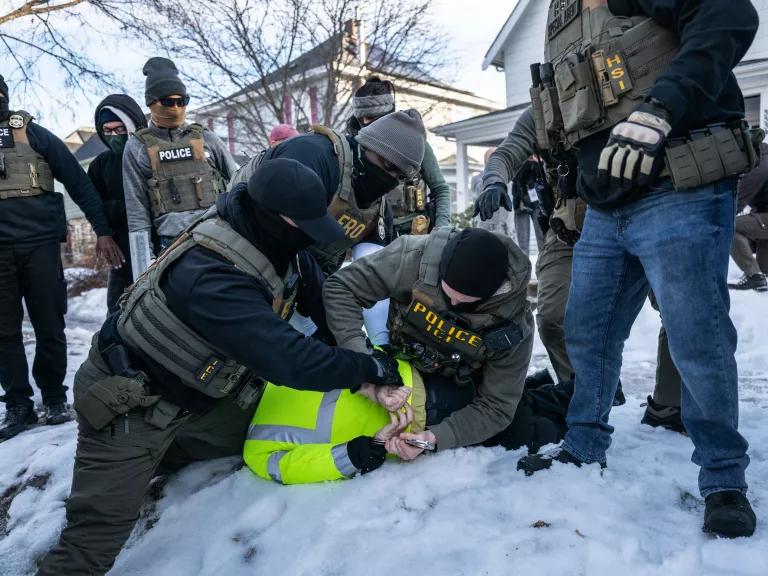
Federal law enforcement agents detaining a demonstrator during a raid in south Minneapolis, January 13, 2026
As a direct result of the DOJ’s preference for politics over law, principled rank-and-file government lawyers have chosen to leave the department rather than discard their ethical compass. There were approximately 10,000 DOJ attorneys in 2024. Around 5,500 people (not all of them attorneys) have now been fired or have chosen to leave. While many left for financial reasons in response to early buyout options, many others left because they refused to be complicit in the DOJ’s support for the administration’s unethical actions. Several federal prosecutors in Minnesota resigned following the DOJ’s pressure to investigate the widow of Renee Good after she was killed by an ICE agent. And prosecutors in the Eastern District of Virginia have resigned or been fired for refusing to pursue politically vindictive criminal prosecutions of James Comey and Letitia James.
Other Justice Department lawyers have been fired for upholding their duty of candor. The Fourth Circuit wrote in one case: “…in response to the candid responses by the Government attorney to the district court’s inquiry, that attorney has been put on administrative leave, ostensibly for lack of ‘zealous advocacy.’” But, as the court added, “the duty of zealous representation is tempered by the duty of candor to the court, among other ethical obligations, and the duty to uphold the rule of law, particularly on the part of a Government attorney.”
The DOJ has made a concerted effort to replace the longtime DOJ attorneys who have resigned or been fired with people loyal to the president.
Facts still prevail in the courts
Without a DOJ that is faithful to its responsibility to guard the rule of law, the country is missing one of its critical checks on authoritarianism. Other historically important checks are also missing now. Presidents can self-moderate, but not this one. The president’s advisors can be a moderating influence, as they apparently were during the first Trump administration; we don’t have that now. A political party could step in, as it did during the end of President Richard Nixon’s tenure, but the Republican party has failed to do so here. Congress can assert itself, but instead, on balance, it is a supine group of observers or enablers. The media can provide a vigorous check, but the splintered nature of information gathering, analysis, and dissemination discourages a shared understanding of objective facts.
What we do have is the courts, and they can shine a light into the encroaching darkness. They can put a “judicial finger in the constitutional dike.” Particularly at the district court level, facts prevail—lying or obfuscating does not work. Litigation is what makes it possible for courts to play this critical role, despite all else. And district judges throughout the country are playing their assigned role, holding the government accountable to the rule of law.
Just last month, in an attempt to rewrite history, the Trump administration removed exhibits commemorating the people enslaved by George Washington at the first presidential residence in Philadelphia. In an incisive opinion barring the administration's action, Judge Cynthia M. Rufe wrote, “As if the Ministry of Truth in George Orwell’s 1984 now existed, with its motto ‘Ignorance is Strength,’ this Court is now asked to determine whether the federal government has the power it claims—to dissemble and disassemble historical truths when it has some domain over historical facts. It does not.” This applies to current facts as well.
At a recent No Kings rally, there was a sign that read “Prevent Truth Decay.” The courts can provide that kind of hygiene, which is essential to counter political lies, vindicate the rule of law, and save our democracy. So, when the administration violates environmental laws, NRDC will seek to hold it accountable in court. The government’s intimidation and dishonesty will inspire, not discourage, our resistance.
That’s the truth.
RELATED CONTENT

Here’s How NRDC Is Fighting Back Against the Trump Administration in Court

White House Watch: Tracking Attacks on Our Environment & Health
