From the Streets to the StoryMap: Putting Kansas City Youth at the Center of Environmental Justice
Using personal stories, history, and community science, seven young leaders are reimagining what environmental justice can look like in Kansas City.

Members of RiSE4EJ and Street Science Institute, a youth-centered program designed to equip future leaders with the knowledge and tools needed to advocate for environmental justice in their communities
Courtesy of RiSE4EJ

In Kansas City, Kansas, where highways, railroads, and industrial and chemical manufacturing factories converge in the Armourdale and Argentine neighborhoods, seven young people stepped into leadership. They did not do so through traditional institutions or textbooks. Instead, they walked their streets, collected data, analyzed air quality, and listened closely to community concerns. With support from RiSE4EJ, the Street Science Institute launched this year as an environmental justice storytelling and leadership program that reimagines who holds knowledge and power to address environmental harm.
Over the course of four months, RiSE4EJ brought together a team of young adults who co-created a digital StoryMap that explores local environmental justice issues through place-based knowledge and research. The program asks students what they care about and what issues impact their neighborhoods, and it helps them explore solutions to those issues in meaningful ways. Participants learned about air quality monitoring, data science, environmental health policy, and community science. “We wanted to make sure we incorporated as many tools as possible that most people don’t encounter until they’re in an academic setting,” explained Jennifer Ahumada, an instructor for the institute who helped develop its curriculum. More important, the program created space for the students to connect their lived experiences to broader patterns of environmental racism and to articulate what environmental justice means in the places they call home.
Designing leadership from lived experience
The Street Science Institute grew from a need for environmental health literacy and leaders who tackle real-world problems in ways that create tangible change. “The biggest inspiration is having youth involved in the environmental justice movement,” says Ahumada. “It’s the world they will inherit, and too often, youth are left out of decision-making spaces.” Lived experience is essential for understanding the distribution and impacts of environmental burdens.
The selection process for the pilot program was intentional. RiSE4EJ worked with students from frontline communities, which are directly impacted by environmental injustice. Grounding the program in place-based knowledge and research showed that expertise can exist in the voices of young people who see and feel the impacts of environmental injustice every day. Students learned about the regulatory process and how to use data to create positive change. When regulatory data were unavailable, students gathered and analyzed their own local data.
To make the program possible, RiSE4EJ partnered with public health experts, air monitoring specialists, organizers, and other education programs such as 2892 Miles to Go. The curriculum blended in-person workshops with field-based learning. Students codesigned every step of the program by shaping their own research questions and investigative tools. This collaborative approach gave students ownership of their work, which ensured that relationships within the program reflected the respect and accountability needed for lasting community change. “It’s not just about the content,” says Beto Lugo-Martinez, executive director of RiSE4EJ. “It’s about building trust and relationships.”
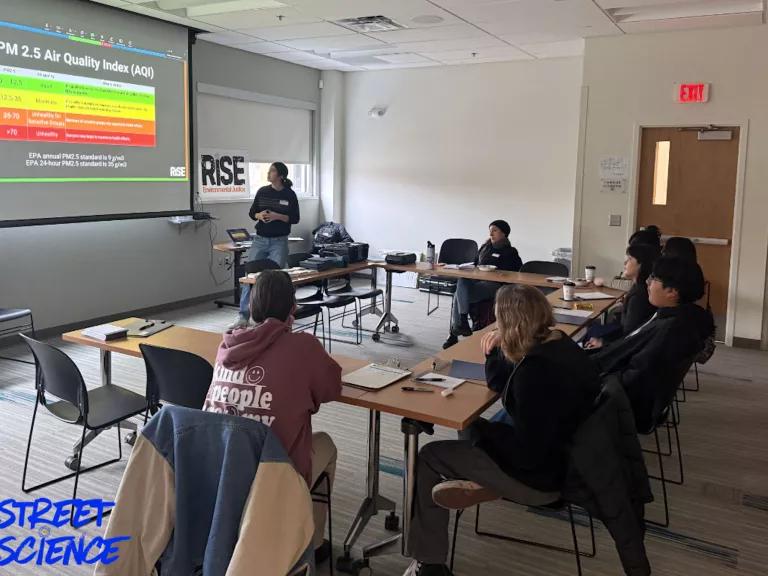
Kansas City youth and community members taking part in the Street Science Institute led by RiSE4EJ
Courtesy of RiSE4EJ
Turning community concerns into science
Each student began with a question: What environmental issues matter most in our community, and how can we tell that story with data, history, and our own voices? Their projects revealed how environmental injustice intersects with historical neglect, economic disinvestment, and the long-term toll on mental and physical health in the historically vibrant communities of Armourdale and Argentine, located in Wyandotte County. These communities were shaped by immigrant labor in the meatpacking, steel, and railroad industries, but years of disinvestment, redlining, and neglect left these neighborhoods with some of the worst health outcomes in Kansas, including life expectancy that is 22 years shorter than surrounding areas. The students learned about the major pollution sources in and around their neighborhoods, and they explored how these environmental burdens shape their daily lives. Alongside documenting these challenges, they envisioned a future with community-owned solutions, more green infrastructure, stronger environmental enforcement, and greater youth involvement in policy decisions.
The students translated their research and personal stories into vision drawings that reimagined what their communities could become. The resulting StoryMap is a powerful record of their understandings and reimaginings. Alejandra F., who lives near a highway and railroad, says, “I took everything in my community and just improved it, based on what we’ve been learning.” She envisioned more vegetation, better park upkeep, and air quality monitors near the highway. Carlos M. used an iceberg metaphor to show how society notices the “beautiful things,” but often ignores the pollution lurking beneath. He envisioned separating homes, parks, and farms from industrial zones so that pollution and people are no longer forced to coexist. Other students imagined more green space, cleaner air, and the use of research to validate community concerns.
Lessons and impact
The Street Science Institute creates space for the knowledge, observations, and hopes that young people already hold about their own communities. One major takeaway was students’ increased confidence in speaking up about community issues and advocating for change, grounded in both their own experiences and increased understanding of air quality data and public health metrics. Ahumada says that a key goal in building the curriculum was to inspire students to “stay engaged in environmental justice even after the program and keep advocating for their communities.” For instance, some students attended a community meeting about a facility expansion that would increase air pollution. “They were asking questions and were among the most knowledgeable in the room because they had already gone through this experience. Accessibility to information is liberating,” says Lugo-Martinez. “We’re fighting the bad, but you also have to find the things that are a catalyst for positive change, growth, and strength!”
Students also came to understand that in many frontline communities, air pollution does not exist in isolation but rather accumulates over time and across sectors that all interact to create layered public health risks. “The impetus for this project was the air pollution impacts faced by communities,” says Lugo-Martinez, “with the intent of creating a different kind of program that responds to community concerns.” The program demonstrates the need for cumulative impacts analysis in environmental decision-making. This need is especially urgent in the face of current federal rollbacks to air emission standards and threats to the Clean Air Act’s protective provisions. Even where monitoring data exist, they may not capture neighborhood-level realities. The institute empowered students to collect local data, advocate for stronger protections, and understand the broader regulatory landscape of air pollution.
By the end, these students became community scientists, advocates, and educators—not through textbooks but through lived experiences and a commitment to solving the environmental problems affecting their neighborhoods.
The next chapter
“We named our organization RiSE4EJ because when things fall apart, we resist, we build, and we rise,” says Lugo-Martinez. “This program is an extension of that principle.” The Street Science Institute is only the beginning of RiSE4EJ’s vision of cultivating youth leadership and deepening community partnerships.
The work of these young people is a reminder that some of our most urgent environmental innovations won’t come from labs or government offices. They will come from the streets, where lived experience, collective inquiry, and the courage to demand better can drive lasting change.
Related Blogs

Environmental Injustice: Cumulative Impacts in Kansas City
The People Behind Climate-Friendly Cooling
