
Lessons from India’s Transition to Electric Vehicles
What India’s state-level EV strategies can teach policymakers worldwide.
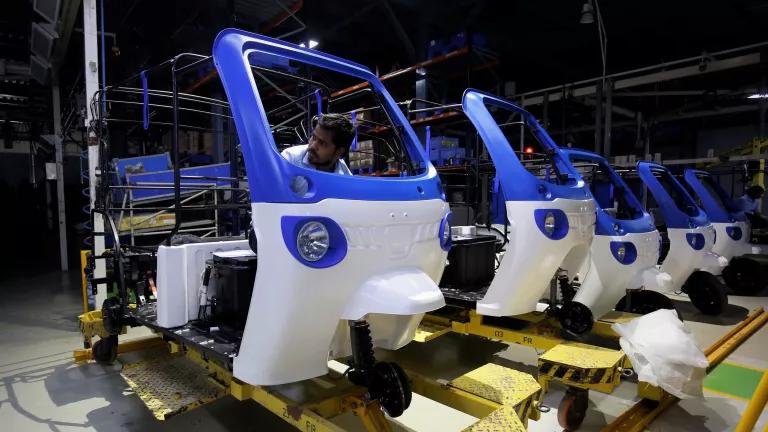
An e-auto factory in Bengaluru, India

Authored by Swapnil Fulari, clean transportation specialist, NRDC India; Amitosh Gautam, state-based representative (Gujarat & Maharashtra), NRDC India; and Harshit Gupta, state-based representative (Uttar Pradesh)
India’s electric vehicle (EV) market has gained significant momentum. According to the Indian government’s vehicle registration data, cumulative EV sales have now reached 10.21 million among more than 449 million vehicles on Indian roads, and the share of EVs in new vehicle sales rose to 8.25 percent in fiscal year ending March 2026, up from 7.48 percent the year before. This growth reflects deliberate policy support: Schemes such as the PM Electric Drive Revolution in Innovative Vehicle Enhancement (PM E-DRIVE), the Production-Linked Incentive (PLI) for automobile manufacturing, and the PLI for Advanced Chemistry Cell (PLI-ACC) battery storage (a federal scheme to develop domestic ACC manufacturing capacity) have lowered costs and de-risked investment for both manufacturers and buyers. Other countries pursuing their own EV transitions can draw on the same policy tools.
While the national policy sets the baseline, outcomes are shaped at the state level. The pace of adoption, which vehicle categories lead, and how the benefits are distributed all vary because states have pursued different strategies. Some prioritize industrial capacity, others stimulate demand before manufacturing matures, while others focus on regulation. None of these approaches is fixed or exclusive. States can combine and sequence manufacturing, demand, and policy levers in different orders, and the lessons apply well beyond India to any national government trying to accelerate EV adoption.
The manufacturing bet: Building supply before demand
Industrial policy offers an obvious route into the EV transition: Build a manufacturing base to attract investment, strengthen supply chains, and create jobs. But factories solve only half the challenge. Generating demand is harder since it depends on purchase costs coming down, charging infrastructure being available, and consumers trusting that EVs meet their needs. None of that comes from a factory. Production capacity alone doesn’t guarantee that consumers will buy the vehicles.
Gujarat is one of several Indian states pursuing a supply-side strategy: an economic approach that focuses on increasing manufacturing capacity to drive growth rather than managing consumer demand, betting that demand will follow. It isn’t alone in this: Tamil Nadu and Maharashtra have built comparable manufacturing hubs. But Gujarat’s experience shows the limits of that approach clearly. The state hosts 12 recognized original equipment manufacturers (OEMs)—including Tata Motors, MG Motor, and Maruti Suzuki—that are supported by 10 facilities approved under the PLI-Auto scheme, a federal program that gives auto manufacturers financial incentives tied to production output. Gujarat has also attracted major battery manufacturing investment, including a large allocation under PLI-ACC to Reliance New Energy, a battery venture of Reliance Industries. This manufacturing strength has not yet translated into comparable levels of local EV adoption. Gujarat’s share of new vehicles that were electric was just 3.63 percent in fiscal year ending March 2026 and 1.33 percent cumulatively, both well below the national averages of 8.05 percent and 2.17 percent, respectively. A temporary road-tax reduction lifted sales by 75 percent in early 2026, showing that demand can respond quickly to the right incentive. But the incentive expired in March without a confirmed extension, and sales cooled again.
Tamil Nadu shows what the same manufacturing bet can look like when it’s paired with demand-side effort. The state has 38 facilities approved under the PLI-Auto scheme, more than any other state besides Maharashtra, and it hosts the country’s single-largest PLI-ACC award: Ola Cell Technologies’ 20 gigawatt-hour (GWh) allocation; half of the 40 GWh awarded nationally. Unlike Gujarat, Tamil Nadu paired that manufacturing push with matching demand-side incentives: Its EV Policy 2023 layers a 100 percent State Goods and Services Tax (SGST) reimbursement for EV manufacturers on top of federal incentives while buyers get a 100 percent exemption on road tax, registration fees, and permit fees through the end of 2025. The result is that Tamil Nadu’s share of new vehicles that were electric reached 8.24 percent in fiscal year ending March 2026, closely tracking the national rate rather than trailing far behind it the way Gujarat’s did. The lesson isn’t that industrial policy failed in Gujarat and succeeded in Tamil Nadu. Both states pursued similar manufacturing incentives. What’s different is that Tamil Nadu matched its manufacturing push with demand-side measures and Gujarat hasn’t yet.
Gujarat’s story is not a cautionary tale but an unfinished one. Manufacturing has built industrial capacity, attracted investment, and strengthened the state’s position in India’s EV ecosystem. But supply alone doesn’t create a market. Sustained demand must be cultivated deliberately, a gap that Gujarat now appears to be addressing through its upcoming Green Mobility Policy 2026, a more ambitious successor policy that targets 30 percent of new vehicle registrations as electric or powered by other green fuels by 2031.
Demand first: How buyer demand can pull in supply
Conventional industrial thinking assumes governments must build manufacturing capacity before consumers will buy. Several Indian states show that EV manufacturing doesn’t have to come before demand: Strong domestic demand can attract investment on its own, simply by proving to investors that the market is real.
The state of Uttar Pradesh is the clearest example of that story, built almost entirely on the electrification of commercial mobility—vehicles used to move people or goods for a fee, like taxis, three-wheelers, and delivery vans—rather than personal cars. The state has emerged as India’s largest EV market, with 1.72 million registered EVs, accounting for nearly 18 percent of India’s cumulative EV fleet. That growth has been driven largely by the rapid electrification of commercial three-wheelers used for last-mile passenger and goods transport: Uttar Pradesh accounted for above 40 percent of India’s electric three-wheeler sales, supported by more than 2,300 public charging stations. The demand came first, and the manufacturing followed: Ashok Leyland opened a 70-acre, EV-focused greenfield plant in Lucknow in January 2026, because the market was already there.
Karnataka is a state that tells a different story. Demand there has been driven less by shared or informal transport and more by rising fuel costs and higher incomes in the city of Bengaluru's tech economy, which has made private EV ownership increasingly attractive. Karnataka has emerged as India’s third-largest EV market, with electric two-wheelers accounting for nearly 78 percent of all EV registrations. The state has also built the strongest charging network in the country: more than 6,000 public stations, close to a quarter of India’s total, concentrated heavily in Bengaluru.
Between Uttar Pradesh and Karnataka, the lesson is the same, even though the sources of demand differ: A market doesn’t need factories in place before it can grow. It needs buyers and charging infrastructure that keep pace with the rising demand. Manufacturing tends to follow once both are a reality.
How policy can shape markets
Not every state needs a factory to lead. Sometimes, all it takes is policy certainty: clear targets, phased mandates, and predictable timelines. Done well, these can accelerate the transition faster than subsidies or market demand alone by giving buyers and manufacturers confidence about where the market is headed.
India’s capital of Delhi makes the case better than anywhere else in the country. Its EV Policy 2026, running through 2030, doesn’t lean as much on subsidies but simply mandates the shift. Starting in January 2026, fleet aggregators and delivery operators can no longer add new petrol or diesel two-wheelers or light goods vehicles to their fleets. The internal combustion engine (ICE) two-wheelers they already have need to be phased out by the end of 2026. ICE three-wheeler registrations stop altogether from 2027; two-wheelers from 2028. The goal: 95 percent of new vehicle registrations electric by 2027 and 30 percent of the whole fleet by 2030, with charging infrastructure investment running alongside to keep up.
Delhi makes its case through regulation rather than manufacturing capacity. The India Electric Mobility Index is a joint ranking by NITI Aayog (the Indian government’s public policy think tank), together with industry partners, that tracks state-level EV progress. On it, Delhi is one of only a handful of states rated as a front-runner. It has also built the largest fleet of electric public buses in the country, nearly 4,850 of them as of July 2026, with more on the way. Delhi’s experience suggests that well-designed regulation that creates demand can be a more powerful policy tool than manufacturing incentives or buyer subsidies alone: Even without an industrial base, clear mandates and firm timelines can build a market as fast as manufacturing investment would—or faster.
There is no single blueprint for a successful EV transition
None of these pathways is an end point. Manufacturing, demand, and regulation are starting strengths, not finish lines. The states pulling furthest ahead aren’t the ones that mastered one lever; they are the ones that kept building past it. The state of Maharashtra makes that case well: It has 85 EV manufacturing facilities, more than any other state. It also recorded roughly 280,000 EV sales in fiscal year ending March 2026, which made up nearly 11 percent of India’s EV sales that year, while leading adoption in two-wheelers, passenger vehicles, and electric buses.
Andhra Pradesh and Telangana are states that show two different ways that smaller states can build demand on their own. Andhra Pradesh layered its own incentives directly on top of central government schemes: a full reimbursement of the SGST, the state’s share of India’s Goods and Services Tax (GST), plus a 50 percent rebate on electricity duties for EV charging. That support has helped Andhra Pradesh quietly become one of India’s leading states for battery manufacturing, measured by its contribution to national economic output in that sector. Telangana took a narrower route: a full road tax and registration exemption running through the end of 2026, plus a March 2026 deal negotiating purchase discounts of up to 20 percent for state government employees buying EVs.
There’s still plenty left on the table for every state: retiring older combustion-engine vehicles faster, getting chargers into homes and workplaces rather than just highways, and taking freight seriously. Trucks alone account for an outsize share of transport emissions. None of that happens without the national government doing its part too: keeping schemes like PM E-DRIVE, the national EV incentive program, funded and predictable long enough for states to actually plan around them. Electrification also needs to be treated as a systemic problem rather than a series of separate incentives; one where demand, supply, and grid readiness all have to advance together.
Three lessons for policymakers everywhere
Demand and supply do not have to develop in the same order, but ultimately, both matter. Gujarat shows the limits of building supply without sufficient demand. Tamil Nadu demonstrates the value of developing both together. Uttar Pradesh shows that strong demand can itself attract manufacturing investment.
Regulation that creates demand can outperform subsidies alone. Delhi built almost no EV manufacturing base of its own yet its mandates and firm timelines made it one of the country’s front-runners. Policy certainty turned out to be its own kind of industrial strategy.
There’s no single correct sequence; only sustained follow-through. Andhra Pradesh, Maharashtra, and Telangana each started from a different strength—manufacturing scale, tax incentives, or targeted subsidies—and they kept building on it rather than stopping once one lever was in place.
The specific policies will vary by country, but the same discipline applies everywhere: Start from an existing strength and build outward from there.
India’s experience shows there’s no single pathway to an EV transition. States can lead through manufacturing, demand, or regulation, but the most successful transitions combine these levers and sequence them deliberately, building both markets and productive capacity over time. The key at the national level is a clear vision that gives states the flexibility to build on their own comparative advantages—whether existing industry, market demand, or policy capacity—rather than a single model that every state is expected to copy.
This NRDC.org blog is available for online republication by news media outlets or nonprofits under these conditions: The writer(s) must be credited with a byline; you must note prominently that the blog was originally published by NRDC.org and link to the original; the blog cannot be edited (beyond simple things such as grammar); you can’t resell the blog in any form or grant republishing rights to other outlets; you can’t republish our material wholesale or automatically—you need to select blogs individually; you can’t republish the photos or graphics on our site without specific permission; you should drop us a note to let us know when you’ve used one of our blogs.
Related Blogs
Finance Beyond the COP: How India Is Rebuilding the Case for Global Climate Finance
Countries Announce Continued Action on 2035 Climate Plans
